
La Bibliothèque d'Applications présente des modèles construits avec COMSOL Multiphysics pour la simulation d'une grande variété d'applications, dans les domaines de l'électromagnétisme, de la mécanique des solides, de la mécanique des fluides et de la chimie. Vous pouvez télécharger ces modèles résolus avec leur documentation détaillée, comprenant les instructions de construction pas-à-pas, et vous en servir comme point de départ de votre travail de simulation. Utilisez l'outil de recherche rapide pour trouver les modèles et applications correspondant à votre domaine d'intérêt. Notez que de nombreux exemples présentés ici sont également accessibles via la Bibliothèques d'Applications intégrée au logiciel COMSOL Multiphysics® et disponible à partir du menu Fichier.

This is a template MPH-file containing the physics interfaces and the parameterized geometry for the model Electrical Heating in a Busbar. En savoir plus
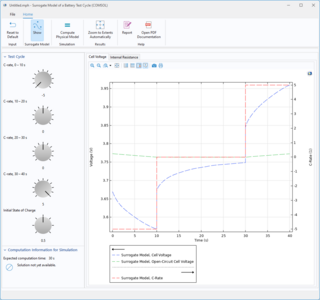
This app demonstrates the usage of a surrogate model function for predicting the cell voltage, cell open circuit voltage and internal resistance of an NMC111/graphite battery cell undergoing a battery test cycle. The surrogate function, a Deep Neural Network, has been fitted to a ... En savoir plus

This app demonstrates the following: Parametric geometry containing a geometry sequence with if-statements to produce different types of designs Options to set the mesh size A graphical user interface that includes different windows that can be shown or hidden Light Theme Water ... En savoir plus
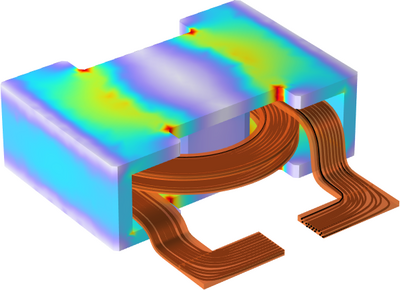
Inductors are used in many applications for low pass filtering or for impedance matching of predominantly capacitive loads. They are used in a wide frequency range from near static up to several MHz. An inductor usually has a magnetic core to increase the inductance, while keeping its ... En savoir plus
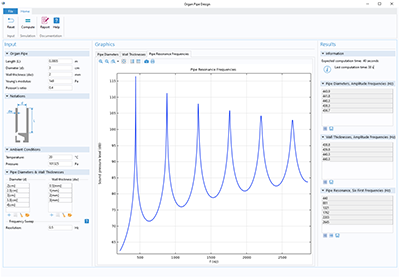
This app demonstrates the following: Using a Java® utility class for combining several waveforms and for playing sound Using tables for presenting results The app allows you to study the design of an organ pipe and then play the sound and pitch of the changed design. The pipe sound ... En savoir plus
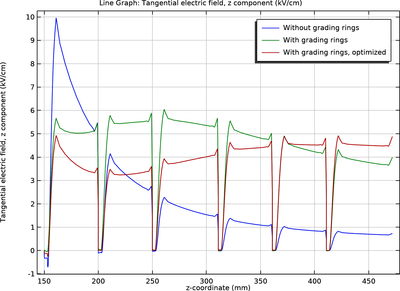
Extending the High Voltage Insulator model, this example shows how to set up an Optimization Study to determine the optimum position of the grading rings to obtain the highest flashover voltage. En savoir plus
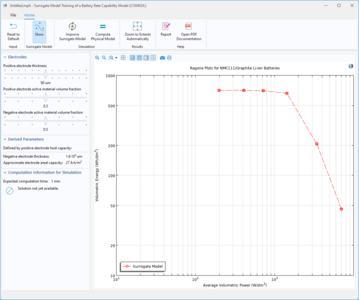
This app demonstrates the usage of a surrogate model function for predicting the rate capability of an NMC111/graphite battery cell. The rate capability is shown in a Ragone plot. The surrogate function, a Deep Neural Network, has been fitted to a subset of the possible input data ... En savoir plus
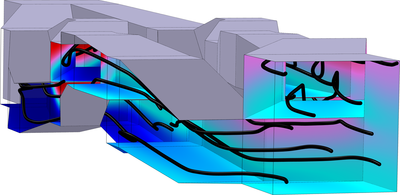
This example studies a laminar static micromixer with two parallel sets of split-reshape-recombine mixing elements. The mixer works through lamination of the streams without any moving parts and the mixing is obtained through diffusion. The purpose of this model is to demonstrate how to ... En savoir plus
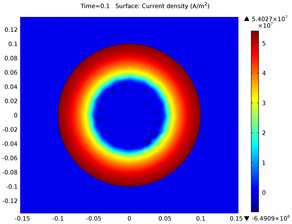
Superconducting materials have zero resistivity up to a certain critical current density, above which the resistivity increases rapidly. To model such a material, this example uses the Magnetic Field Formulation physics interface. The model was based on a suggestion by Dr. Roberto ... En savoir plus
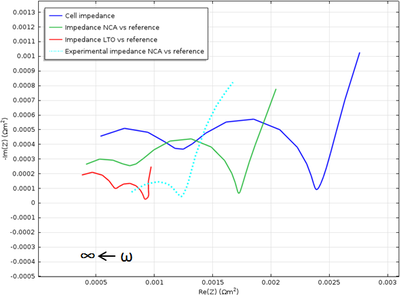
The goal with this app is to explain experimental electrochemical impedance spectroscopy (EIS) measurements and to show how you can use a simulation app, along with measurements, to estimate the properties of lithium-ion batteries. The app takes measurements from an EIS experiment and ... En savoir plus


