
La Bibliothèque d'Applications présente des modèles construits avec COMSOL Multiphysics pour la simulation d'une grande variété d'applications, dans les domaines de l'électromagnétisme, de la mécanique des solides, de la mécanique des fluides et de la chimie. Vous pouvez télécharger ces modèles résolus avec leur documentation détaillée, comprenant les instructions de construction pas-à-pas, et vous en servir comme point de départ de votre travail de simulation. Utilisez l'outil de recherche rapide pour trouver les modèles et applications correspondant à votre domaine d'intérêt. Notez que de nombreux exemples présentés ici sont également accessibles via la Bibliothèques d'Applications intégrée au logiciel COMSOL Multiphysics® et disponible à partir du menu Fichier.

This model studies the natural frequencies of a pre-tensioned string using the 2D Wire interface. This is an example of “stress stiffening”; in fact the transverse stiffness of wire elements is directly proportional to the tensile force. Strings made of piano wire have an extremely high ... En savoir plus
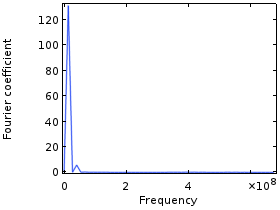
This tutorial model demonstrates how to compute the impedance of a capacitively coupled plasma. The Time Periodic study computes the time periodic solution of the plasma. Subsequently, the solution is transformed to the time domain, after which the fast Fourier transform (FFT) solver is ... En savoir plus
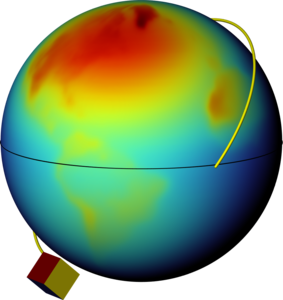
This model demonstrates how to define Earth properties that are spatially varying on the planet. A satellite in orbit experiences solar, albedo, and planetary infrared (IR) loads, where albedo and planetary IR can vary with latitude and longitude. In this example, these inputs are read ... En savoir plus
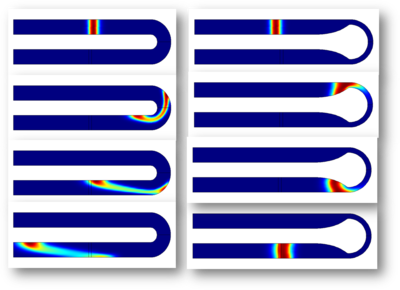
This model studies the dispersion of neutral species band through curved microchannel in an Electroosmotic flow (EOF) . Using Optimization module, geometric optimization is carried out to minimize the curve-induced dispersion.The central idea is to parametrically represent the geometry ... En savoir plus
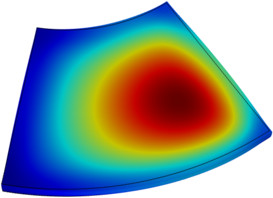
Tilted pad thrust bearings are used in rotating machineries with high thrust loading. The thrust load is transferred from a sliding part to a stationary part through hydrodynamic oil films. The tilted pad thrust bearing consists of a series of flat surfaces sliding over stationary tilted ... En savoir plus
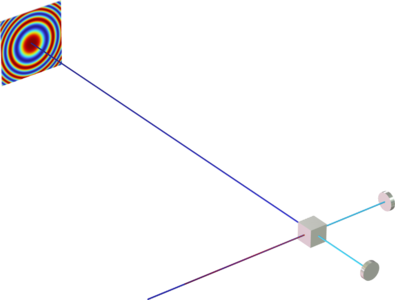
This example demonstrates how to plot the interference pattern from the combination of two rays with slightly different optical path length. A simple Michelson interferometer is used to achieve a change of optical path length by slightly moving one of the mirrors. En savoir plus

Silicon carbide (SiC) epitaxial furnaces are a specialized equipment for the production and preparation of SiC epitaxial wafers. This example model demonstrates the process of preparing an SiC epitaxial wafer based on the physical vapor transport (PVT) method in a furnace. This involves ... En savoir plus
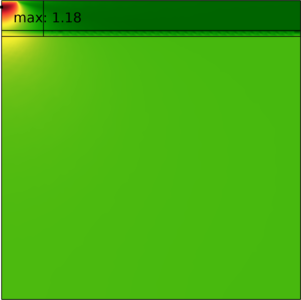
A standing contact fatigue test is a procedure used for testing crack growth on the subsurface level. In such a test, a spherical object is pressed against the tested materials and cycled between a high and low compressive load. No translational movement between the two occurs. After a ... En savoir plus


