
La Bibliothèque d'Applications présente des modèles construits avec COMSOL Multiphysics pour la simulation d'une grande variété d'applications, dans les domaines de l'électromagnétisme, de la mécanique des solides, de la mécanique des fluides et de la chimie. Vous pouvez télécharger ces modèles résolus avec leur documentation détaillée, comprenant les instructions de construction pas-à-pas, et vous en servir comme point de départ de votre travail de simulation. Utilisez l'outil de recherche rapide pour trouver les modèles et applications correspondant à votre domaine d'intérêt. Notez que de nombreux exemples présentés ici sont également accessibles via la Bibliothèques d'Applications intégrée au logiciel COMSOL Multiphysics® et disponible à partir du menu Fichier.
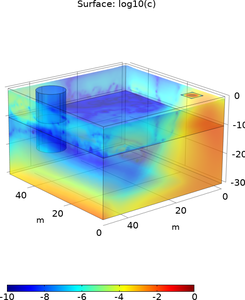
A simple model for groundwater contamination portrays a well that is bored into an aquifer. The aquifer consists of a partially saturated layer and a fully saturated layer. The model investigates how much of the contaminant ends up in the well after a contaminant is introduced in the ... En savoir plus
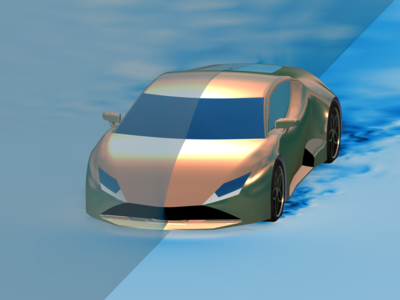
This example simulates turbulent flow around a sports car traveling at a speed of 180 km/h using Large Eddy Simulations (LES). En savoir plus
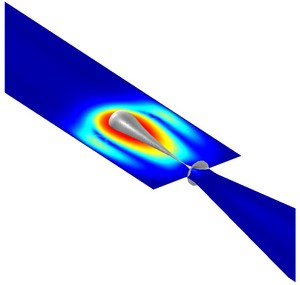
Although initially invented to be used in printers, inkjets have been adopted for other application areas, such as within the life sciences and microelectronics. Simulations can be useful to improve the understanding of the fluid flow and to predict the optimal design of an inkjet for a ... En savoir plus
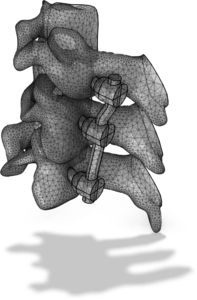
Follow this tutorial series to learn about how to work with imported surface meshes. The instructions detail how to import STL files of three vertebrae and two intervertebral discs as well as how to repair holes, misaligned mesh vertices, and intersecting elements. It further ... En savoir plus
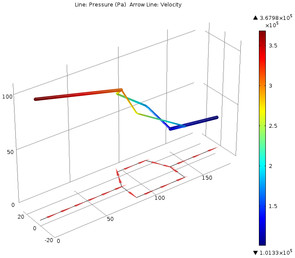
The Pipe Flow interface allows you to simulate non-Newtonian fluids flowing in pipes. This example models a coal slurry being transported in a pipe system where the pipe diameter changes in different sections. The slurry behaves as a non-Newtonian fluid described by the power law model. ... En savoir plus
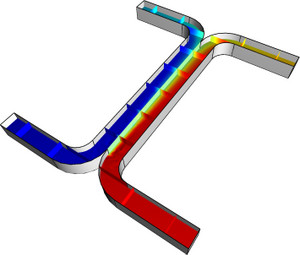
This example was originally formulated by Albert Witarsa under Professor Bruce Finlayson’s supervision at the University of Washington in Seattle. It was part of a graduate course in which the assignment consisted of evaluating the potential of patents in the field of microfluidics ... En savoir plus
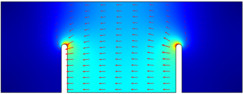
This example treats the modeling of electroosmotic flow in porous media. The system consists of a compartment of sintered porous material and two electrodes that generate an electric field. The cell combines pressure and electroosmotic driven flow. The equations that are solved are the ... En savoir plus
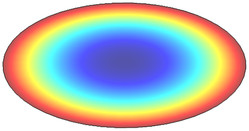
This benchmark model computes the total force acting on a vibrating disc in the frequency and time domains and compares both results with expressions derived analytically. When the vibration amplitude is small enough that the system is linear the frequency and time domain results agree ... En savoir plus
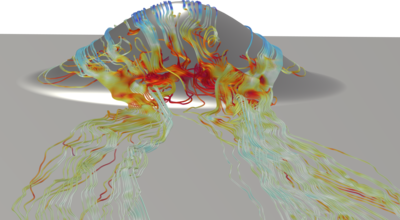
The present example simulates the turbulent flow over a 3D hill geometry using the Large Eddy Simulation (LES) interface with synthetic turbulence at the inlet boundary. En savoir plus
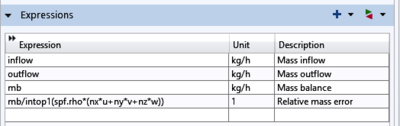
This tutorial model can be used to learn how to calculate mass and energy balances. Get a detailed demonstration in this blog post: How to Calculate Mass Conservation and Energy Balance En savoir plus


