
La Bibliothèque d'Applications présente des modèles construits avec COMSOL Multiphysics pour la simulation d'une grande variété d'applications, dans les domaines de l'électromagnétisme, de la mécanique des solides, de la mécanique des fluides et de la chimie. Vous pouvez télécharger ces modèles résolus avec leur documentation détaillée, comprenant les instructions de construction pas-à-pas, et vous en servir comme point de départ de votre travail de simulation. Utilisez l'outil de recherche rapide pour trouver les modèles et applications correspondant à votre domaine d'intérêt. Notez que de nombreux exemples présentés ici sont également accessibles via la Bibliothèques d'Applications intégrée au logiciel COMSOL Multiphysics® et disponible à partir du menu Fichier.
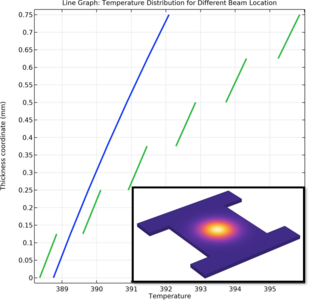
This example uses the thermal expansion of a laminated composite shell model to demonstrate the use of the feature Thermal Contact, Interface, applied on interfaces between layers in a laminated composite shell. The first study is computed neglecting this additional thermal resistance in ... En savoir plus
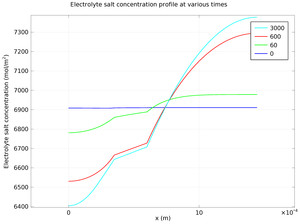
This model simulates the discharge of a Nickel-Metal Hydride (NiMH) battery using the Battery with Binary Electrolyte interface. The geometry is in one dimension and the model is isothermal. The model serves as an introduction to NiMH modeling, and can be further extended to include ... En savoir plus
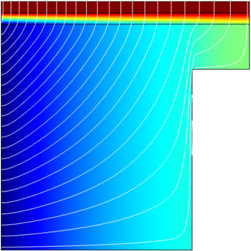
Fluids that move through pore spaces in an aquifer or reservoir can shield the porous medium from stress because they bear part of the load from, for instance, overlying rocks, sediments, fluids, and buildings. Withdrawing fluids from the pore space increases the stress the solids bear, ... En savoir plus
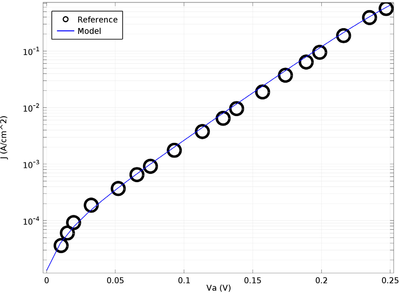
Schottky Contact This benchmark simulates the behavior of an ideal Schottky barrier diode made of a tungsten contact deposited on a silicon wafer. The resulting J-V (current density vs. applied voltage) curve obtained from the model under forward bias is compared with experimental ... En savoir plus
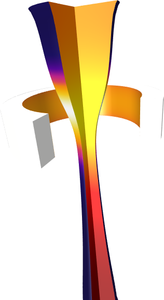
This example is about the modeling of the fiber drawing process. Thermal fiber drawing is a process in which a comparatively thicker structure is heated and drawn into extended lengths of microstructured fiber. This process is done by passing them through the furnace and pulling them ... En savoir plus
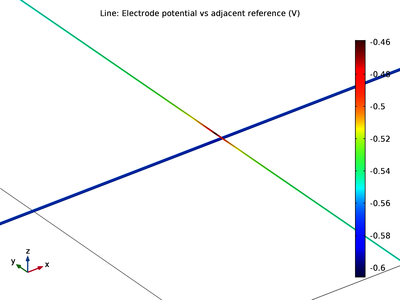
The impressed current cathodic protection (ICCP) system is often employed to mitigate corrosion of buried pipelines in the oil and gas industry. Metallic objects such as buried pipelines, which are present within the current flow of the ICCP system, may suffer from the stray current ... En savoir plus
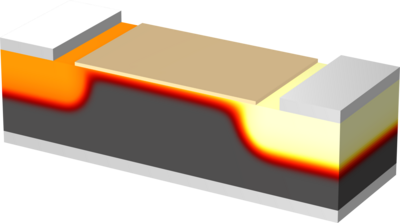
This example is an adaptation of our DC Characteristics of a MOS Transistor (MOSFET) model where the metal and dielectric domains are modeled explicitly and not via a boundary condition. Therefore, the potential profile inside the metal and the insulator can be observed. En savoir plus
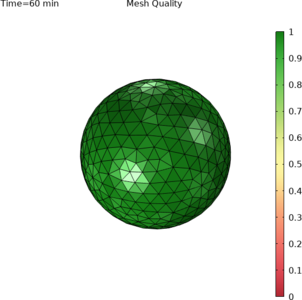
Droplet evaporation is ubiquitous in everyday life and is essential in many industrial processes, such as inkjet printing, cleaning/coating of surfaces, and phase change heat transfer. This model demonstrates how to model phase transition by a moving exterior boundary condition using ... En savoir plus


