
La Bibliothèque d'Applications présente des modèles construits avec COMSOL Multiphysics pour la simulation d'une grande variété d'applications, dans les domaines de l'électromagnétisme, de la mécanique des solides, de la mécanique des fluides et de la chimie. Vous pouvez télécharger ces modèles résolus avec leur documentation détaillée, comprenant les instructions de construction pas-à-pas, et vous en servir comme point de départ de votre travail de simulation. Utilisez l'outil de recherche rapide pour trouver les modèles et applications correspondant à votre domaine d'intérêt. Notez que de nombreux exemples présentés ici sont également accessibles via la Bibliothèques d'Applications intégrée au logiciel COMSOL Multiphysics® et disponible à partir du menu Fichier.
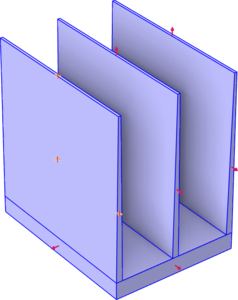
These tutorial models show how to use the tools to assist with defining surface-to-surface radiation models. In the first model, radiation direction symbols are used to find an unexpected configuration where the opacity is not correctly defined. In the other, the topology check ... En savoir plus
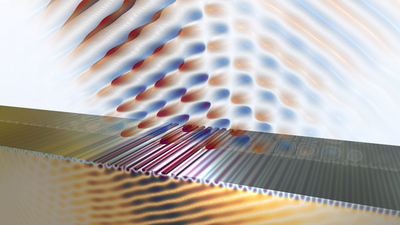
This model simulates the coupling of free-space laser radiation into waveguide modes using an optical grating coupler. The coupling efficiency and the radiation loss are calculated for different angles of incidence of the laser beam. En savoir plus
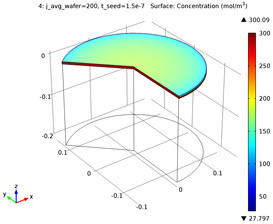
This example extends the analysis made in the model Electrodeposition on a Resistive Patterned Wafer by including the diffusion and convection of copper ions in the electrolyte. The coupled mass transport convection-diffusion effects are of interest in this type of reactor since they ... En savoir plus
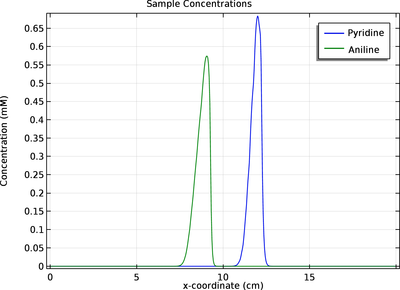
Zone electrophoresis (ZE) is an electrophoretic separation technique typically used for analyzing proteins, nucleic acids, and biopolymers. During the process, different species in a sample are transported in a continuous electrolyte buffer system, subject to a potential gradient. Due to ... En savoir plus
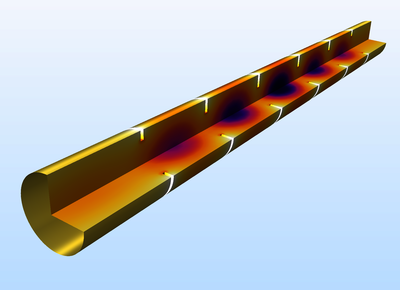
A circular waveguide filter is designed using a 2D axisymmetric model. Six annular rings added to the waveguide form circular cavities connected in series, and each cavity cutoff frequency is close to the center frequency of the filter. The simulated S-parameters show a bandpass ... En savoir plus

This example shows how to implement a stress dependent material model. The Young's modulus changes based on the stress value. En savoir plus

This model illustrates the working principle of an electrodynamic wheel (EDW) magnetic levitation system. EDW magnetic levitation system consists of rotating and/or translationally moving permanent magnet Halbach rotor above a passive conducting guideway/track. Eddy current is ... En savoir plus
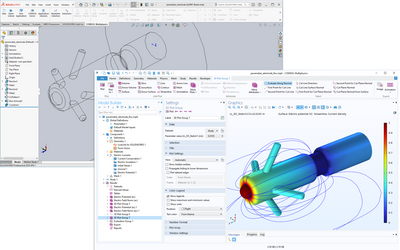
This model, dealing with the current and potential distribution around one pair of electrodes, demonstrates how to synchronize and modify geometry in SOLIDWORKS® by using the LiveLink™ interface with a parametric sweep. En savoir plus


