
La Bibliothèque d'Applications présente des modèles construits avec COMSOL Multiphysics pour la simulation d'une grande variété d'applications, dans les domaines de l'électromagnétisme, de la mécanique des solides, de la mécanique des fluides et de la chimie. Vous pouvez télécharger ces modèles résolus avec leur documentation détaillée, comprenant les instructions de construction pas-à-pas, et vous en servir comme point de départ de votre travail de simulation. Utilisez l'outil de recherche rapide pour trouver les modèles et applications correspondant à votre domaine d'intérêt. Notez que de nombreux exemples présentés ici sont également accessibles via la Bibliothèques d'Applications intégrée au logiciel COMSOL Multiphysics® et disponible à partir du menu Fichier.
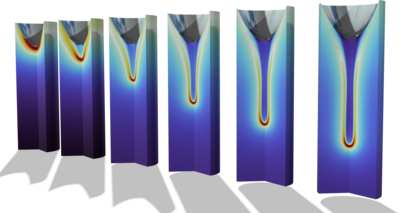
This example simulates the propagation of a positive streamer in transformer oil under a lightning impulse voltage. The space charge density and the electric field are obtained. The simulated streamer radius agrees well with the measured values. En savoir plus
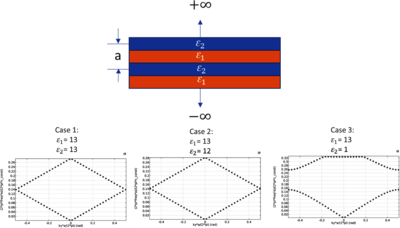
In this model, an eigenfrequency analysis is performed to give a bandgap analysis of a 1D multilayer photonic crystal extending to infinity in +/- y direction. We perform the bandgap analysis for three different cases of material properties, as discussed in Chapter 4 of Ref. 1. Case ... En savoir plus
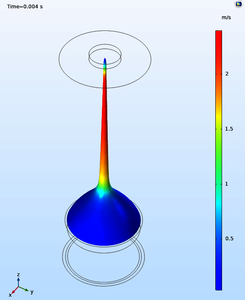
This model deals with electrohydrodynamics (EHD), where a charge separation on the phase boundary between a liquid and air involves the formation of a charged layer. This charged layer allows for a net force to be induced at the interphase when a large electric field is applied. The ... En savoir plus
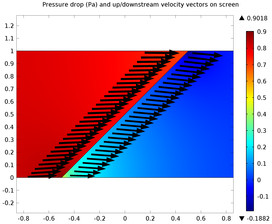
This model simulates the flow through a uniform inclined screen using the Screen feature in Single-Phase Flow physics and compares the results with an analytic solution. En savoir plus
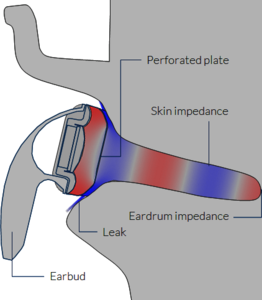
This conceptual model analyzes the influence of leaks on the acoustic response of an earbud speaker placed in an ear-canal-like geometry. Built-in impedance models are used to capture the effects of a perforated plate in front of the speaker, skin impedance, and ear drum impedance. The ... En savoir plus
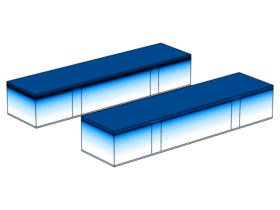
This tutorial model compares the results between a domain approach and the Thin Moisture Barrier feature to simulate the moisture transport in a wall with a vapor barrier. The Thin Moisture Barrier feature neglects diffusion, two studies are proposed, a first one where diffusion is ... En savoir plus
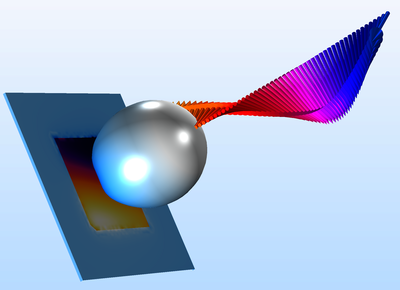
One way to generate circular polarization from a microstrip patch antenna is to truncate the patch radiator. This model is tuned around the GPS frequency range. The axial ratios are calculated to show the degree of circular polarization. En savoir plus
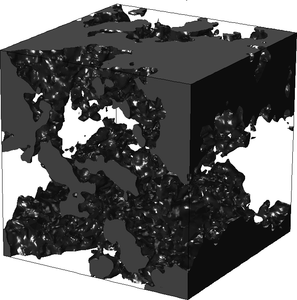
These examples show how to use the tools under the Results node to generate and visualize randomized material data with prescribed statistical properties. The randomness is controlled through a spectral density distribution, which defines the spatial frequency content of the material ... En savoir plus


