
La Bibliothèque d'Applications présente des modèles construits avec COMSOL Multiphysics pour la simulation d'une grande variété d'applications, dans les domaines de l'électromagnétisme, de la mécanique des solides, de la mécanique des fluides et de la chimie. Vous pouvez télécharger ces modèles résolus avec leur documentation détaillée, comprenant les instructions de construction pas-à-pas, et vous en servir comme point de départ de votre travail de simulation. Utilisez l'outil de recherche rapide pour trouver les modèles et applications correspondant à votre domaine d'intérêt. Notez que de nombreux exemples présentés ici sont également accessibles via la Bibliothèques d'Applications intégrée au logiciel COMSOL Multiphysics® et disponible à partir du menu Fichier.
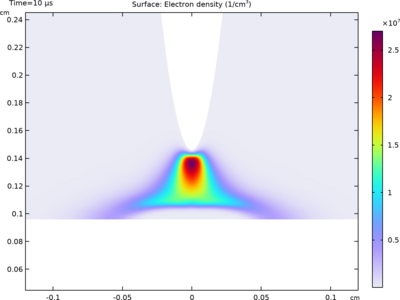
This model simulates a negative dielectric barrier discharge under a point-to-plate electrode configuration. Two solid dielectric layers are inserted into the air gap. A negative voltage of 2.5 kV is applied to the cathode electrode, initiating a corona streamer that propagates and ... En savoir plus
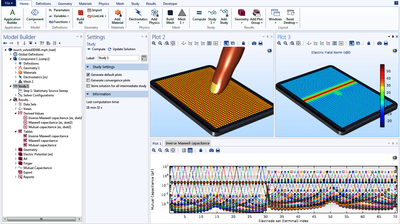
Intended as a tool for early proof of concept in capacitive touchscreen device development, the Touchscreen Simulator app evaluates a simulated capacitance matrix as well as the electric field norm. The app computes the capacitance matrix of a touchscreen in the presence of a human ... En savoir plus
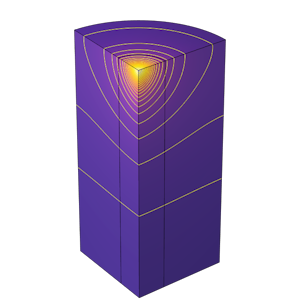
This tutorial shows how to use the Radiative Beam in Absorbing Media interface (Heat Transfer Module) to model the attenuation of a laser light going through a sample of silica glass, and the heat source generated by the absorption. En savoir plus
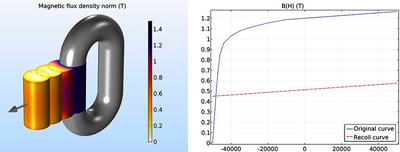
Soft permanent magnets like AlNiCo are easily demagnetized if handled incorrectly. This is a demonstration of how to model the self-demagnetization of a cylindrical AlNiCo magnet when moved out of its associated/protective magnetic circuit. The modeling is performed in three steps: The ... En savoir plus
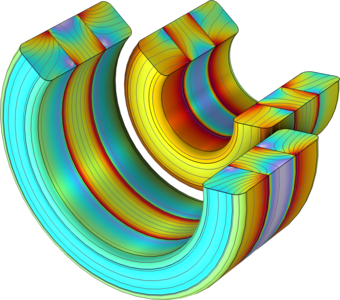
The model compare the electromagnetic force calculated by virtual work and maxwell stress tensor methods on the axial magnetic bearing. The forces is evaluated by studying the effect of a small displacement on the electromagnetic energy of the system. This is done by using the Magnetic ... En savoir plus
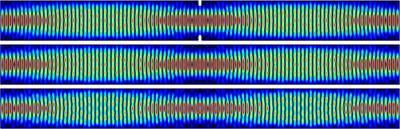
This model demonstrates three different ways to find the eigenfrequencies of a rectangular metallic cavity. The first method uses an eigenfrequency study step together with the Electromagnetic Waves, Beam Envelopes interface. Here, it is important to define a wave vector for the physics ... En savoir plus

The four-point bending test is a conventional test method used to test the mechanical properties of materials subjected to bending. It is a reliability test used for semiconductor packaging and assembly. This model demonstrates the stress analysis of an IGBT module subjected to a four ... En savoir plus
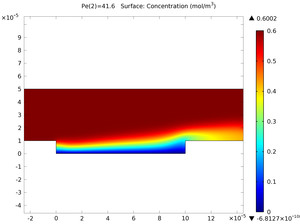
This model demonstrates the impact of convection and diffusion on the transport-limited electrodeposition of a copper microconnector bump (metal post). Microconnector bumps are used in various types of electronic applications for interconnecting components, for instance liquid crystal ... En savoir plus


