
La Bibliothèque d'Applications présente des modèles construits avec COMSOL Multiphysics pour la simulation d'une grande variété d'applications, dans les domaines de l'électromagnétisme, de la mécanique des solides, de la mécanique des fluides et de la chimie. Vous pouvez télécharger ces modèles résolus avec leur documentation détaillée, comprenant les instructions de construction pas-à-pas, et vous en servir comme point de départ de votre travail de simulation. Utilisez l'outil de recherche rapide pour trouver les modèles et applications correspondant à votre domaine d'intérêt. Notez que de nombreux exemples présentés ici sont également accessibles via la Bibliothèques d'Applications intégrée au logiciel COMSOL Multiphysics® et disponible à partir du menu Fichier.
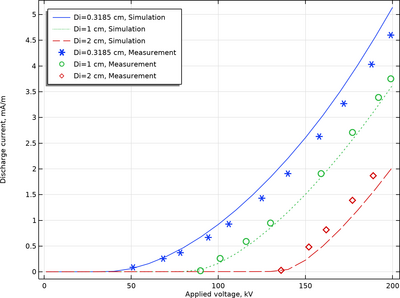
This model examines the behavior of a positive corona formed between concentric cylindrical conductors exposed to high applied voltages. The predicted current–voltage response closely matches the measurements. Rather than reproducing individual positive glow corona bursts, the setup ... En savoir plus
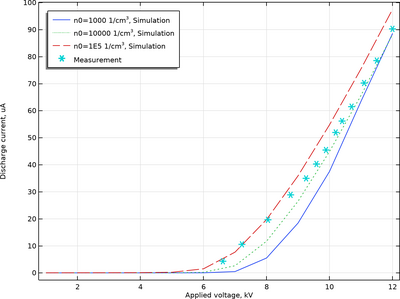
This model analyzes negative corona formation in a point-to-plane configuration driven by high applied voltages. The resulting I–V characteristics align well with experimental observations documented in the literature. The goal here is to capture the steady electrical characteristics ... En savoir plus
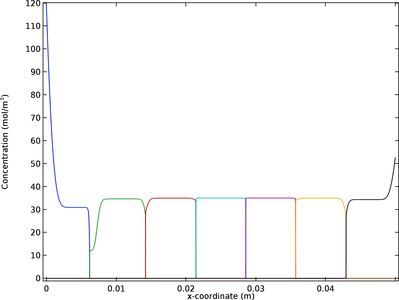
This model demonstrates isoelectric focusing (IEF) of seven ampholytes in a column. The model is in 1D and is solved in a time-dependent simulation. En savoir plus
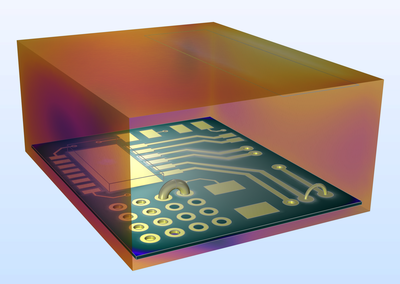
This model example shows how to simulate basic electromagnetic interference (EMI) and electromagnetic compatibility (EMC) behavior in a printed circuit board (PCB). The model contains two analyses to evaluate radiated emissions from PCB traces, crosstalk between adjacent microstrip ... En savoir plus

An acousto-optic modulator (AOM) is a device which can be used for controlling the power, frequency or spatial direction of a laser beam with an electrical drive signal. It is based on the acousto-optic effect, that is, the modification of the refractive index by the oscillating ... En savoir plus
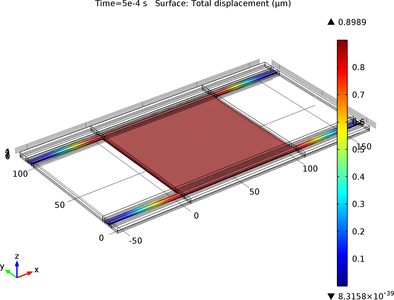
This model analyzes an RF MEMS switch consisting of a thin micromechanical bridge suspended over a dielectric layer. A DC voltage greater than the pull-in voltage is applied across the switch, causing the bridge to collapse onto the dielectric layer with a resulting increase in the ... En savoir plus
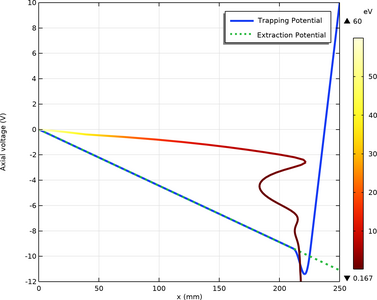
A radio frequency quadrupole ion trap utilizes a radio frequency quadrupole (RFQ) in order to trap an ion beam. A continuous high energy ion beam is first cooled and converted into a spatially confined bunch, which can then be released with minimal heating of the beam. The device is also ... En savoir plus
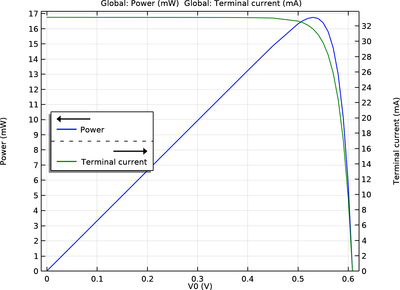
This tutorial uses a simple 1D model of a silicon solar cell to illustrate the basic steps to set up and perform a device physics simulation with the Semiconductor Module. A user-defined expression is used for the photo-generation rate and the result shows typical I–V and P–V curves of ... En savoir plus
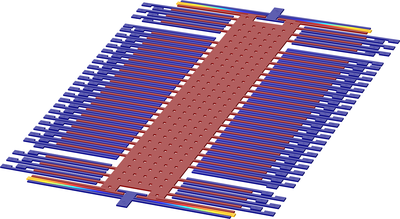
This model shows how to simulate a capacitively actuated surface micromachined accelerometer using the Electromechanics, Solid interface. It is based on a case study from the book Microsystem Design by Stephen D. Senturia (Kluwer Academic Publishers, 5th Edition, 2003, pages 513–525). En savoir plus
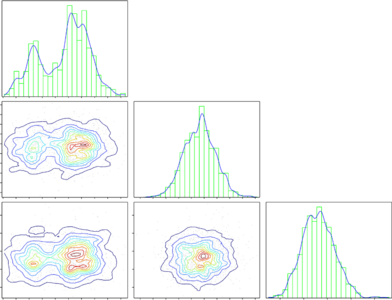
This example demonstrates how to apply inverse uncertainty quantification (IUQ) using the Uncertainty Quantification (UQ) Module in COMSOL Multiphysics to calibrate uncertain material properties of a resistor based on measurement data. When experimental data such as resistance values are ... En savoir plus


