
La Bibliothèque d'Applications présente des modèles construits avec COMSOL Multiphysics pour la simulation d'une grande variété d'applications, dans les domaines de l'électromagnétisme, de la mécanique des solides, de la mécanique des fluides et de la chimie. Vous pouvez télécharger ces modèles résolus avec leur documentation détaillée, comprenant les instructions de construction pas-à-pas, et vous en servir comme point de départ de votre travail de simulation. Utilisez l'outil de recherche rapide pour trouver les modèles et applications correspondant à votre domaine d'intérêt. Notez que de nombreux exemples présentés ici sont également accessibles via la Bibliothèques d'Applications intégrée au logiciel COMSOL Multiphysics® et disponible à partir du menu Fichier.
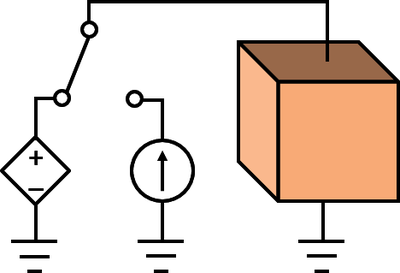
This example exemplifies how to model the switching between current and voltage excitations in Terminal boundary conditions. A more detailed description of the phenomenon and the modeling process can be seen in the blog post "Control Current and Voltage Sources with the AC/DC Module". En savoir plus
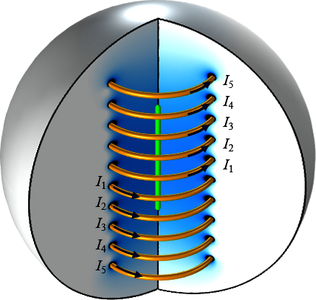
Several different approaches to optimizing a ten-turn axisymmetric coil are presented. First, the current in each turn is adjusted with the objective of having a uniform magnetic flux density along the centerline. Second, the currents are adjusted to minimize power dissipation with a ... En savoir plus
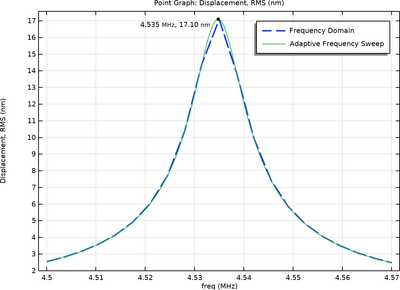
This tutorial shows how to model a miniaturized magnetostrictive antenna developed for use inside living cells. The stress in the antenna, the magnetic flux density, the current density, and the displacement of the tip of the device are investigated at the resonance frequency. En savoir plus
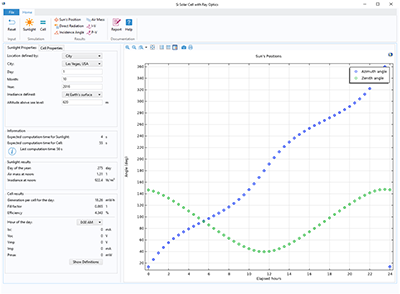
This app demonstrates the following: Multiple components (1D and 3D) in a single app Using the same choice list in the app as in the model using Data Access functionality Output numerical results for a specific time step using a combo box The app combines the Ray Optics Module and ... En savoir plus
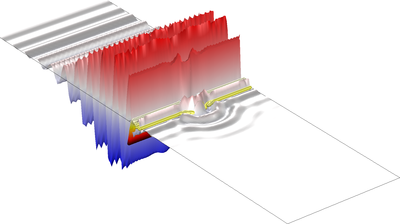
This tutorial shows how to solve the full time-dependent wave equation in dispersive media such as plasmas and semiconductors. The 2D TM in-plane wave model solves for the vector potential from the wave equation and for an auxiliary electric polarization density from an ordinary ... En savoir plus

The Bessel panel is a way to arrange a number of loudspeakers so that the angular sound distribution resembles that of a single speaker. This model combines five Bessel panels in the same pattern to approximate a purely radial sound field. The speakers are driven with different ... En savoir plus
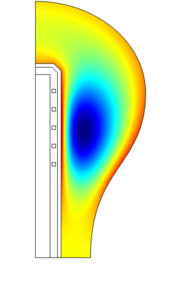
This model simulates an electrodeless lamp with argon/mercury chemistry. The low excitation threshold for mercury atoms means that even though the mercury is present in small concentrations, its behavior dominates. There is strong UV emission from the plasma at 185 nm and 253 nm. The UV ... En savoir plus
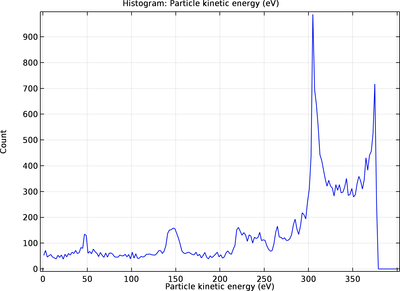
This model computes the ion energy distribution function (IEDF) for a commercial capacitively coupled plasma reactor. The results show good agreement with experimental data. En savoir plus
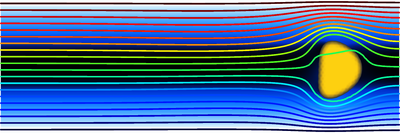
Applying an electric field across a suspension of immiscible liquids may stimulate droplets of the same phase to coalesce. The method known as electrocoalescence has important applications, for instance, in the separation of oil from water. To model electrocoalescence, you need to solve ... En savoir plus
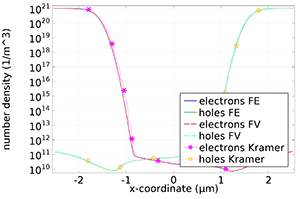
This simple benchmark model computes the potential and carrier concentrations for a one-dimensional p-n junction using both the finite element and finite volume methods. The results are compared with an equivalent device from the book, "Semiconductor Devices: A Simulation Approach," by ... En savoir plus