
La Bibliothèque d'Applications présente des modèles construits avec COMSOL Multiphysics pour la simulation d'une grande variété d'applications, dans les domaines de l'électromagnétisme, de la mécanique des solides, de la mécanique des fluides et de la chimie. Vous pouvez télécharger ces modèles résolus avec leur documentation détaillée, comprenant les instructions de construction pas-à-pas, et vous en servir comme point de départ de votre travail de simulation. Utilisez l'outil de recherche rapide pour trouver les modèles et applications correspondant à votre domaine d'intérêt. Notez que de nombreux exemples présentés ici sont également accessibles via la Bibliothèques d'Applications intégrée au logiciel COMSOL Multiphysics® et disponible à partir du menu Fichier.
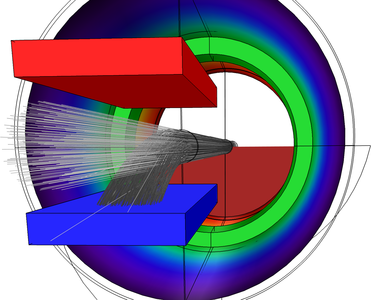
Gas cells have several applications in the design of scientific instruments. A gas cell is used to define a high-pressure region within the instrument's main vacuum system. For example, in this application, note we are designing a high-pressure region 100 mm long, with an operating ... En savoir plus
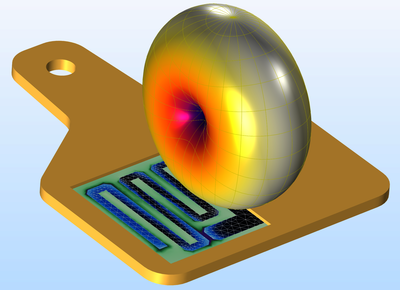
UHF RFID tags are widely used for identifying and tracking animals. This model simulates a passive radio-frequency identification (RFID) tag for the UHF frequency range. With respect to the chip transponder’s complex impedance, a reflection coefficient is computed. This is done using an ... En savoir plus
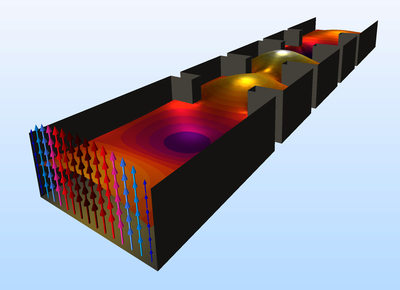
A conductive diaphragm, an iris, placed transverse to a waveguide aperture causes a discontinuity and generates shunt reactance. Bandpass frequency response can be achieved from cascaded cavity resonators combined with these reactive elements which can be created by inserting a series of ... En savoir plus
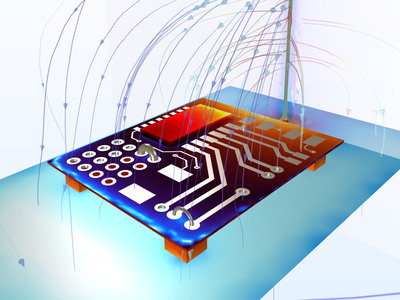
This example demonstrates how an ESD event causes logic error of a microchip on a PCB board. The ESD current is based on the extended HBM (Human Body Model) and it is predefined in the Lumped Port feature. En savoir plus
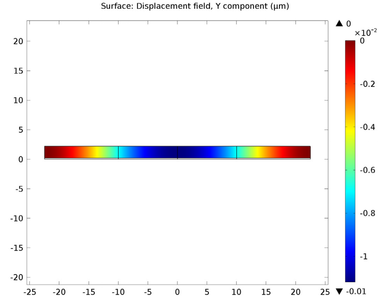
Silicon micromechanical resonators have long been used for designing sensors and are now becoming increasingly important as oscillators in the consumer electronics market. In this series of models, a surface micromachined MEMS resonator, designed as part of a micromechanical filter, is ... En savoir plus
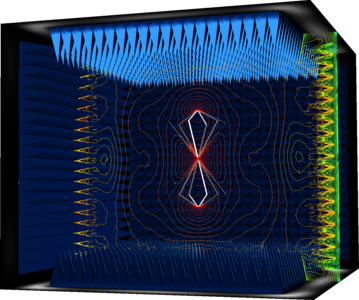
An anechoic chamber is used to measure antenna characterization, electromagnetic interference (EMI), and electromagnetic compatibility (EMC). Within the chamber are absorbers that are configured with an array of pyramidal objects that steer the propagating incident field onto their ... En savoir plus
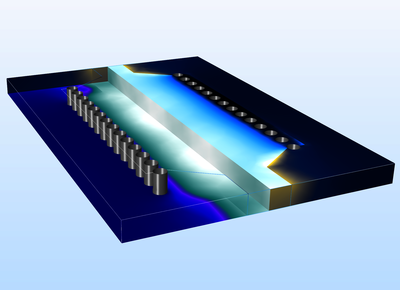
A waveguide-type structure can be fabricated on a substrate by adding vias between the microstrip line and the ground plane. Such a device will behave as a high-pass filter and is attractive because it is easy to fabricate. A model is set up that shows the S-parameters as a function of ... En savoir plus
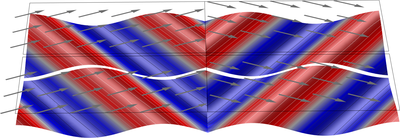
It is possible to engineer the structure of materials such that both the permittivity and permeability are negative. Such materials are realized by engineering a periodic structure with features comparable in scale to the wavelength. It is possible to model both the individual unit cells ... En savoir plus
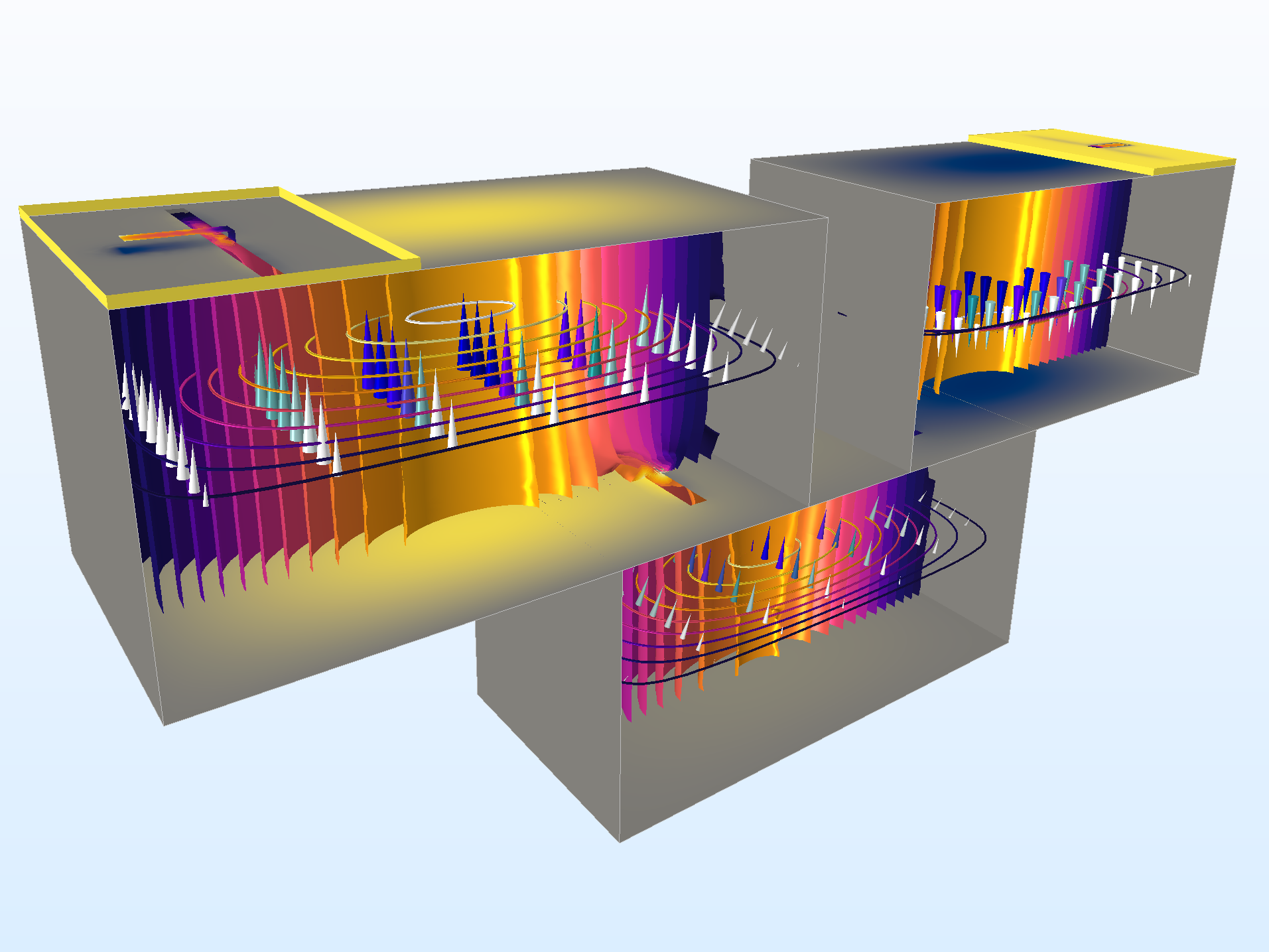
A cascaded cavity filter provides much better bandpass filter performance compared to a single cavity. Out-of-band rejection improves dramatically using a cascaded design. This model uses three rectangular cavity filters coupled via slots. The calculated S-parameters show excellent out ... En savoir plus
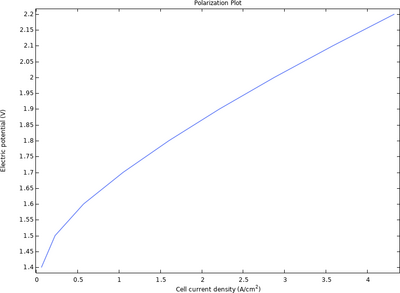
In a polymer electrolyte membrane water electrolyzer cell, hydrogen and oxygen gas is produced by electrolysis. The hydrogen and oxygen compartments are separated by a polymer membrane, that also acts as electrolyte. This introductory tutorial computes the ohmic and activation losses in ... En savoir plus


