
La Bibliothèque d'Applications présente des modèles construits avec COMSOL Multiphysics pour la simulation d'une grande variété d'applications, dans les domaines de l'électromagnétisme, de la mécanique des solides, de la mécanique des fluides et de la chimie. Vous pouvez télécharger ces modèles résolus avec leur documentation détaillée, comprenant les instructions de construction pas-à-pas, et vous en servir comme point de départ de votre travail de simulation. Utilisez l'outil de recherche rapide pour trouver les modèles et applications correspondant à votre domaine d'intérêt. Notez que de nombreux exemples présentés ici sont également accessibles via la Bibliothèques d'Applications intégrée au logiciel COMSOL Multiphysics® et disponible à partir du menu Fichier.
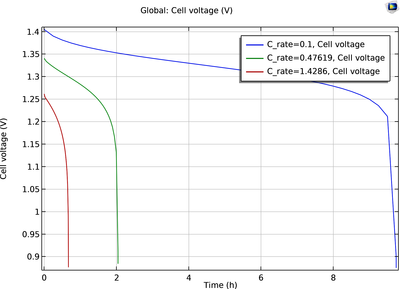
This model reproduces the NiCd battery model and the results presented in De Vidts' and White's paper from 1995. Ref: P. De Vidts, R. E. White, “Mathematical Modeling of a Nickel-Cadmium Cell: Proton Diffusion in the Nickel Electrode”, J. Electrochem. Soc, Vol. 142, No. 5, May 1995. En savoir plus
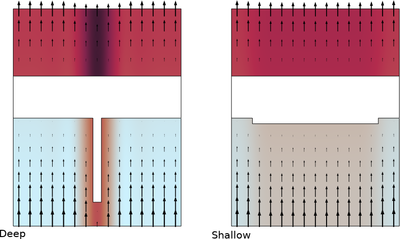
The copper current collector on negative graphite electrodes in lithium-ion batteries have been seen to dissolve at over discharge. This can be a safety concern as the dissolution damages the current collector irreversibly and dissolved copper ions can redeposit and form dendrites. ... En savoir plus
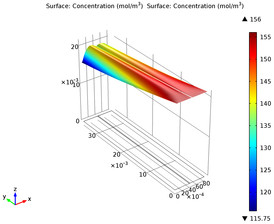
This 2D example of a vanadium flow battery demonstrates how to couple a secondary current distribution model for an ion-exchange membrane to tertiary current distribution models for two different free electrolyte compartments of a flow battery. The Ion-Exchange Membrane boundary node ... En savoir plus
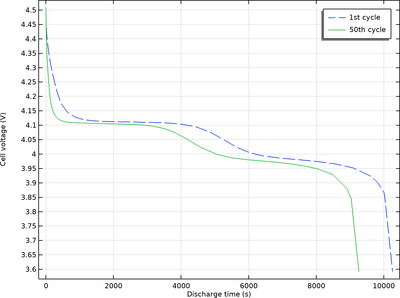
Some positive electrode materials are known to deteriorate in overcharged lithium-ion battery cells. Predominantly, manganese containing electrode materials such as LMO and NMC can loose capacity due to manganese dissolving from the materials at overcharge. This decomposition is a ... En savoir plus
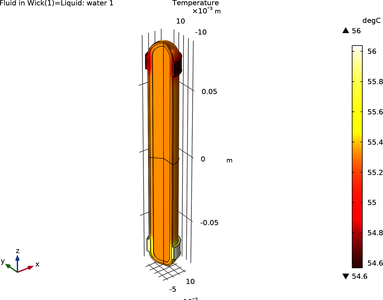
Heat pipes are designed to transfer heat efficiently through vaporization, mass transfer, and condensation of a working fluid. They are found in a wide variety of applications where thermal control is of importance, with cooling of electronics being a prominent example. Inside a heat ... En savoir plus
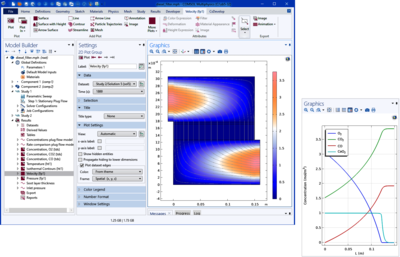
In this tutorial, a filter system for a diesel engine is modeled, including a soot layer development and oxidization. The build-up of the layer is held in check by both catalytic and non-catalytic reactions, where carbon is oxidized to carbon monoxide and carbon dioxide, which in turn ... En savoir plus
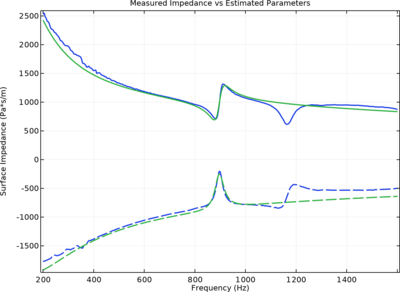
This app is an example of how the poroelastic properties of a porous material can be determined based on measurement done with an impedance tube and parameter estimation. Being able to determine the characteristics of a porous material from a single and simple measurement opens the door ... En savoir plus
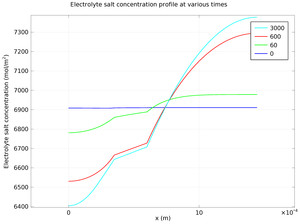
This model simulates the discharge of a Nickel-Metal Hydride (NiMH) battery using the Battery with Binary Electrolyte interface. The geometry is in one dimension and the model is isothermal. The model serves as an introduction to NiMH modeling, and can be further extended to include ... En savoir plus
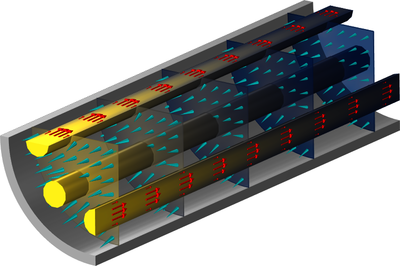
In fuel cell power generators, a steam reformer unit typically produces the hydrogen needed for the cell stack. This example illustrates the modeling of a steam reformer. The reformation chemistry occurs in a porous catalytic bed where energy is supplied through heating tubes to drive ... En savoir plus
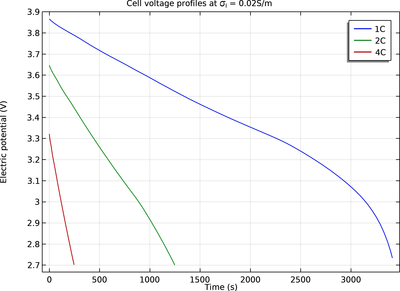
This example demonstrates the Lithium-Ion Battery, Single-Ion Conductor interface for studying the discharge of a lithium-ion battery with solid electrolyte. The geometry is in one dimension and the model is isothermal. The behavior at various discharge currents and solid electrolyte ... En savoir plus


