
La Bibliothèque d'Applications présente des modèles construits avec COMSOL Multiphysics pour la simulation d'une grande variété d'applications, dans les domaines de l'électromagnétisme, de la mécanique des solides, de la mécanique des fluides et de la chimie. Vous pouvez télécharger ces modèles résolus avec leur documentation détaillée, comprenant les instructions de construction pas-à-pas, et vous en servir comme point de départ de votre travail de simulation. Utilisez l'outil de recherche rapide pour trouver les modèles et applications correspondant à votre domaine d'intérêt. Notez que de nombreux exemples présentés ici sont également accessibles via la Bibliothèques d'Applications intégrée au logiciel COMSOL Multiphysics® et disponible à partir du menu Fichier.
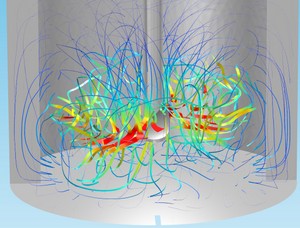
This model exemplifies the use of the Rotating Machinery interface, which allows you to model moving rotating parts in, for example, stirred tanks, mixers, and pumps. The Rotating Machinery interface formulates the Navier-Stokes equations in a rotating coordinate system. Parts that are ... En savoir plus
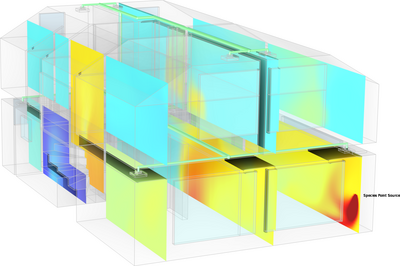
This model of a two-story house can be used to examine a contaminant leak and the subsequent contaminant dispersion that occurs due to convection and diffusion. Airflow and recirculation within the home are dependent on vent placement, and flow velocity may also vary at each vent. ... En savoir plus
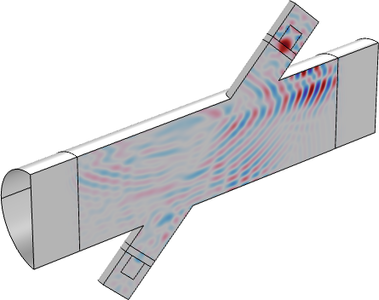
Ultrasonic flowmeters determine the velocity of a fluid flowing through a pipe by sending an ultrasonic signal across the flow at a skew angle. When there is no flow, the transmitting time between the transmitter and the receiver is the same for the signals sent in the upstream and ... En savoir plus
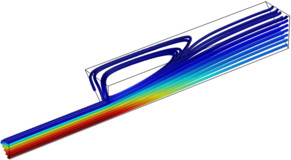
This tutorial model solves the incompressible Navier-Stokes equations in a backstep geometry using the Laminar Flow interface. A characteristic feature of fluid flow in geometries of this kind is the recirculation region that forms where the flow exits the narrow inlet region. The model ... En savoir plus
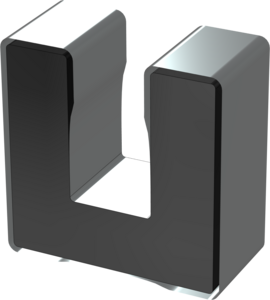
This model analyzed the ALD deposition process of alumina film on the surface of a U-shaped structure. In this process, gaseous precursors are sequentially introduced to the reaction chamber and sequentially undergo a series of adsorption and chemical reactions on the surface. The ... En savoir plus
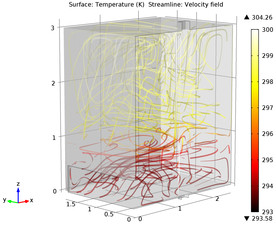
In general, there are two classes of ventilation: mixing ventilation and displacement ventilation. In displacement ventilation, air enters a room at the floor level and displaces warmer air to achieve the desired temperature. Heating sources in the room can include running electronic ... En savoir plus
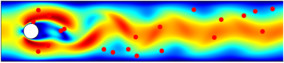
The following model examines unsteady, incompressible flow past a long cylinder placed in a channel at right angle to the oncoming fluid. The cylinder is offset somewhat from the center of the flow to make the steady-state symmetrical flow unstable. The simulation time necessary for a ... En savoir plus
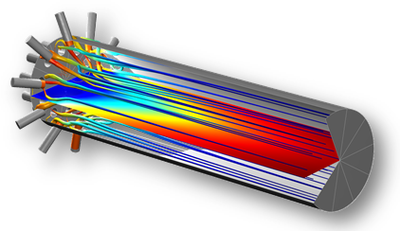
In a polymerization reactor for polyester manufacturing, the mixing in the reactor is achieved by impinging turbulent jets of reactants onto each other. The turbulence affects the reaction kinetics and quality of the polymer linkage. Turbulent flows involving rapid reaction kinetics are ... En savoir plus
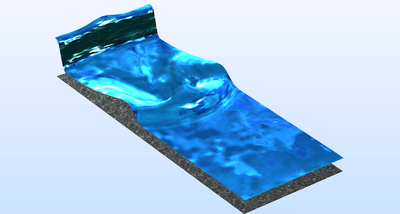
This example uses the Shallow Water equations to model the impact of a water wave on a column. A body of water with a height of 0.3 meters is initially contained behind a gate. At the start of the simulation, the gate is suddenly released and the body of water forms a wave moving toward ... En savoir plus
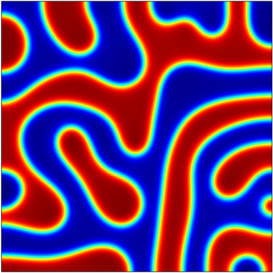
Phase separation occurs when a binary system is quenched from its stable, homogeneous one-phase state into the two-phase region of its phase diagram. The spontaneous separation of two immiscible fluids is sometimes referred to as spinodal decomposition. Each phase tends to separate into ... En savoir plus


