
La Bibliothèque d'Applications présente des modèles construits avec COMSOL Multiphysics pour la simulation d'une grande variété d'applications, dans les domaines de l'électromagnétisme, de la mécanique des solides, de la mécanique des fluides et de la chimie. Vous pouvez télécharger ces modèles résolus avec leur documentation détaillée, comprenant les instructions de construction pas-à-pas, et vous en servir comme point de départ de votre travail de simulation. Utilisez l'outil de recherche rapide pour trouver les modèles et applications correspondant à votre domaine d'intérêt. Notez que de nombreux exemples présentés ici sont également accessibles via la Bibliothèques d'Applications intégrée au logiciel COMSOL Multiphysics® et disponible à partir du menu Fichier.
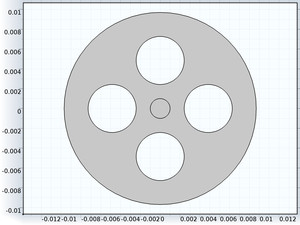
A quadrupole mass filter (QMF) is a key component of a modern mass spectrometer. A QMF uses direct current (DC) and alternating current (AC) electric fields to analyze positive or negative ions by mass to charge ratio. A QMF consists of 4 parallel rods spaced equidistantly, the ratio of ... En savoir plus
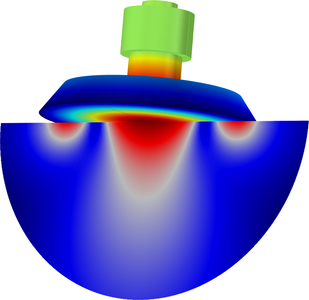
A tonpilz transducer is used for relatively low frequency, high power sound emission. It is one of the popular transducer configurations for SONAR applications. The transducer consists of piezoceramic rings stacked between a head mass and a tail mass which are connected by a central ... En savoir plus
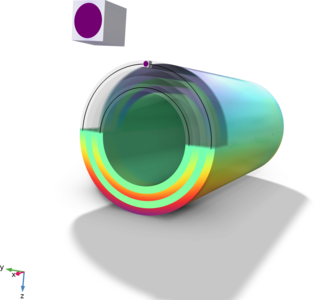
In this example, the structural integrity of a cylinder made by a fiber composite is assessed both at the macroscale and at the microscale level. Along with macroscale analyses, structural composites need microscale stress and failure analyses to identify the critical constituents in ... En savoir plus
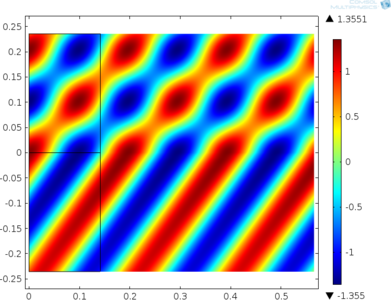
This model determines the reflection coefficient of plane acoustic waves, at different frequencies and at different angles of incidence, off a water-sediment interface. The ability of the Poroelasitc Waves interface to model the coupled acoustic and elastic wave in any porous substance ... En savoir plus
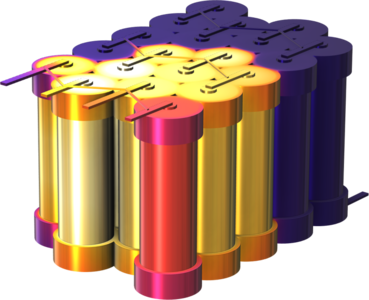
Due to abuse, such as internal or external short circuits or excessive heating, an individual battery cell may go into thermal runaway, during which the battery cell generates a significant amount of heat. If enough heat is transferred between adjacent cells during a thermal runaway ... En savoir plus
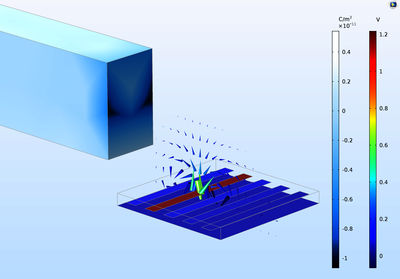
This tutorial model explains how to extract lumped matrices by means of the Stationary Source Sweep study. The capacitance matrix of a five-terminal system is used to infer the position of a metallic object rather like real-world capacitive position sensors. The example illustrates the ... En savoir plus
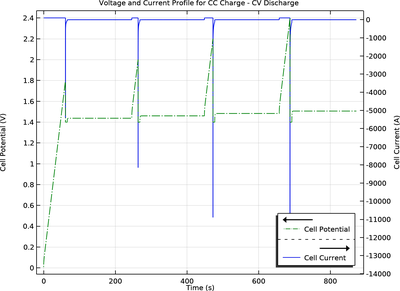
Electrochemical supercapacitors feature relatively higher energy densities than conventional capacitors. With several advantages, such as fast charging, long charge–discharge cycles, and broad operating temperature ranges, electrochemical supercapacitors have found wide applications in ... En savoir plus
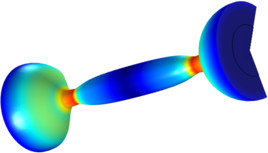
The Marangoni effect results in a slip velocity in the tangential direction on a fluid/fluid interface due to gradients in the surface tension coefficient. When the surface tension coefficient is constant, a two-fluid system may exist in static equilibrium. This is because the surface ... En savoir plus
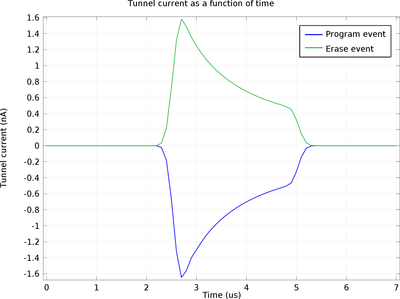
This model calculates the current and charge characteristics of a floating gate Electrically Erasable Programmable Read-Only Memory (EEPROM) device. A stationary study demonstrates the effects of varying the charge stored on the floating gate by computing Current-Voltage curves as a ... En savoir plus
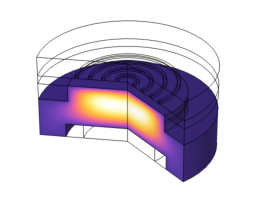
This tutorial model solves for an inductively coupled plasma reactor with RF bias (also known as ICP/CCP reactors) in a mixture of argon/chlorine. The model computes the fluid flow and gas heating. Important aspects and strategies for modeling electronegative discharges are discussed. En savoir plus


