
La Bibliothèque d'Applications présente des modèles construits avec COMSOL Multiphysics pour la simulation d'une grande variété d'applications, dans les domaines de l'électromagnétisme, de la mécanique des solides, de la mécanique des fluides et de la chimie. Vous pouvez télécharger ces modèles résolus avec leur documentation détaillée, comprenant les instructions de construction pas-à-pas, et vous en servir comme point de départ de votre travail de simulation. Utilisez l'outil de recherche rapide pour trouver les modèles et applications correspondant à votre domaine d'intérêt. Notez que de nombreux exemples présentés ici sont également accessibles via la Bibliothèques d'Applications intégrée au logiciel COMSOL Multiphysics® et disponible à partir du menu Fichier.
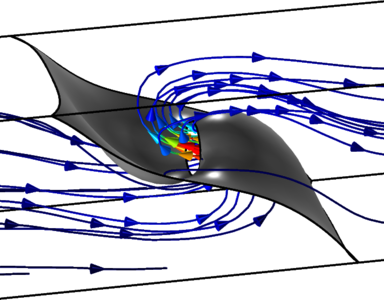
Inverted elements can prevent large deformations for shape optimization. This model demonstrates how this problem can be circumvented using export/import of the geometry and a model method. The technique is demonstrated on a benchmark problem from topology optimization, where the ... En savoir plus
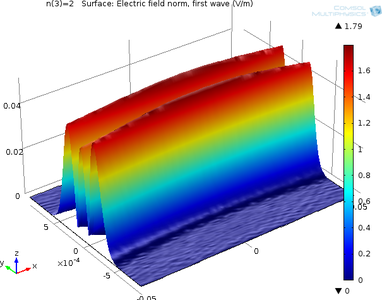
This model demonstrates how a nonlinear equation system can be setup to solve for the eigenfrequencies of a symmetric laser cavity. The model uses the bidirectional formulation of the Electromagnetic Waves, Beam Envelopes physics interface. The computed eigenfrequencies are verified with ... En savoir plus
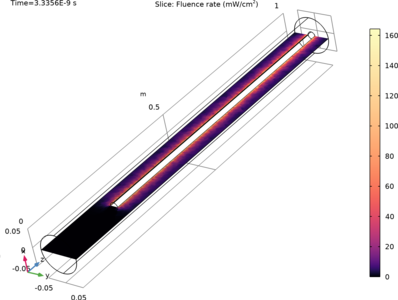
This model demonstrates how to compute the volumetric fluence rate in an ultraviolet (UV) reactor. The geometry is the annular fluid region surrounding a cylindrical lamp. The effect of reflection at the reactor walls on the radial fluence rate distribution is considered. En savoir plus
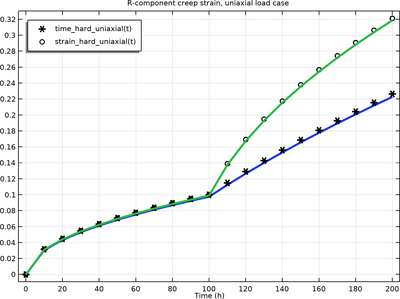
In this model example, you will study the creep behavior of material under non-constant loading. You will model the primary creep using a Norton–Bailey law and study the difference between the time hardening and the strain hardening methods available in COMSOL Multiphysics. The model is ... En savoir plus
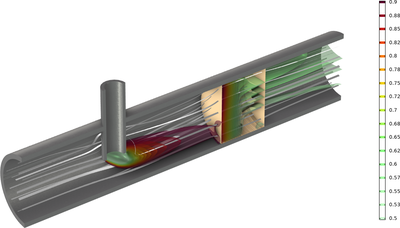
Modeling packed beds, monolithic reactors, and other catalytic heterogeneous reactors is substantially simplified with the Reacting Flow in Porous Media multiphysics interface. This defines the diffusion, convection, migration, and reaction of chemical species for porous media flow ... En savoir plus
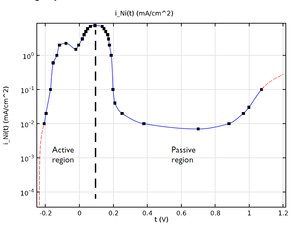
This model exemplifies the basic principles of crevice corrosion and how a time-dependent study can be used to simulate the electrode deformation. The model is in 2D and the polarization data for the corrosion reaction is taken from a paper by Absulsalam and others. The model and the ... En savoir plus
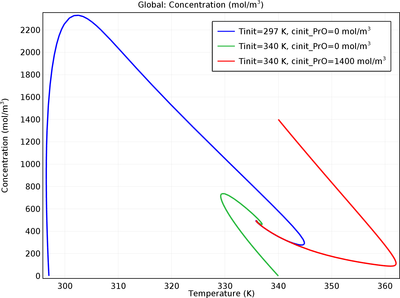
The hydrolysis of propylene oxide into propylene glycol is an important chemical process with 400,000 metric tons produced worldwide each year. Propylene glycol finds wide application as a moisturizer in foods, pharmaceuticals, and cosmetics. In this example, the startup phase of a ... En savoir plus
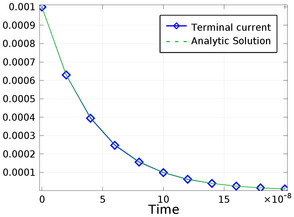
A transient model of a capacitor is solved in combination with an external electrical circuit. The finite element model of the capacitor is combined with a circuit model of a voltage source and a resistor. A step change in voltage is applied, and the transient current through the ... En savoir plus
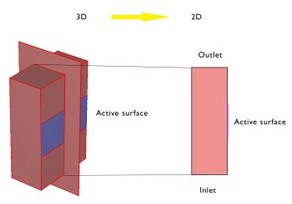
This model demonstrates how to model phenomena defined in different dimensions in a fully coupled manner using COMSOL Multiphysics. Whereas in most cases the reaction rate expression is defined as a function of the concentrations of the reactants and products, in adsorption reactions ... En savoir plus

This model example investigates the transport of reactants and water in a high temperature PEMFC. The model includes mass and momentum transport phenomena in the flow channels, gas diffusion layers (GDLs), and porous electrodes, as well as electrochemical currents in the GDLs, the porous ... En savoir plus