
La Bibliothèque d'Applications présente des modèles construits avec COMSOL Multiphysics pour la simulation d'une grande variété d'applications, dans les domaines de l'électromagnétisme, de la mécanique des solides, de la mécanique des fluides et de la chimie. Vous pouvez télécharger ces modèles résolus avec leur documentation détaillée, comprenant les instructions de construction pas-à-pas, et vous en servir comme point de départ de votre travail de simulation. Utilisez l'outil de recherche rapide pour trouver les modèles et applications correspondant à votre domaine d'intérêt. Notez que de nombreux exemples présentés ici sont également accessibles via la Bibliothèques d'Applications intégrée au logiciel COMSOL Multiphysics® et disponible à partir du menu Fichier.
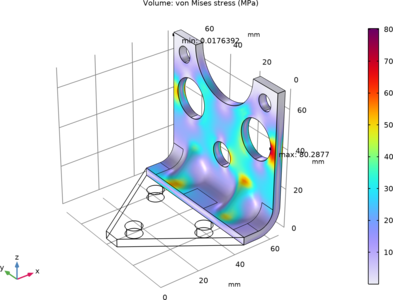
In these tutorial series, we demonstrate how to use the Offset Faces and Transform Faces operations as a way to reparameterize existing holes in a bracket geometry imported from a STEP file. The mass of the bracket is minimized with limits for both the lowest natural frequency, and for ... En savoir plus

This app demonstrates the following: Geometry parts and parameterized geometry A results table form object containing outputs Finned pipes are used for coolers, heaters, or heat exchangers to increase heat transfer. They come in different sizes and designs depending on the ... En savoir plus

The mutual inductance between a primary and secondary single turn coil in a concentric coplanar arrangement is computed using a DC, steady-state, model and compared against the analytic solution. The induced currents in the secondary coil are computed using an AC, frequency-domain, ... En savoir plus
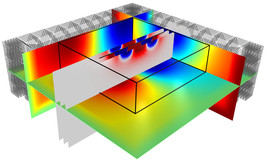
The classical forward problem of geoelectrics (includes electrical resistivity tomography, ERT and earlier techniques as vertical electric sounding, VES) is the calculation of potentials at a given set of electrodes (M,N) while current is injected at other electrodes (A,B) into the ... En savoir plus
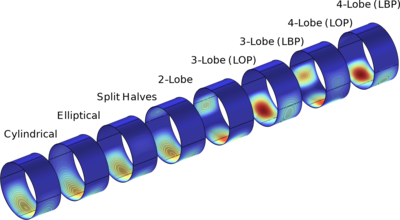
This example demonstrates how you can use modeling to investigate the performance of different hydrodynamic journal bearings. The model uses the Hydrodynamic Bearing interface, which solves the Reynolds equation to compute the pressure developed in a thin fluid film for four different ... En savoir plus
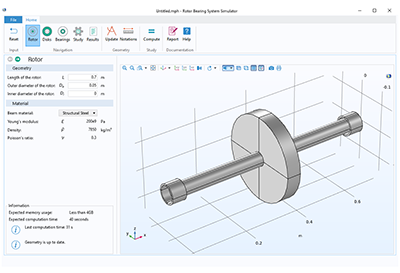
This app demonstrates the following: Navigation system using toggle buttons in the ribbon and Back/Forward buttons in the settings window Selecting predefined or user-defined materials Using a table for input of geometry objects The app simulates a rotor bearing system consisting of ... En savoir plus
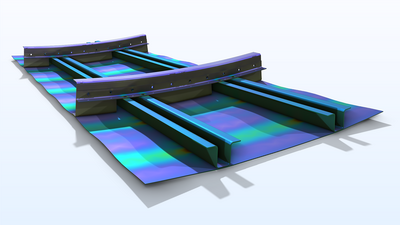
This model studies the structural deformation of an aircraft fuselage structure subjected to buckling loads. The structure is an assembly of panels and skin connected by rivets. The Fasteners feature sets up a large number of connections and computes the forces acting on each rivet. En savoir plus

This is a benchmark model for an axisymmetric transient thermal analysis. The temperature on the boundaries changes from 0 degrees C to 1000 degrees C at the start of the simulation. The temperature at 190 s from the anlysis is compared with a NAFEMS benchmark solution. En savoir plus
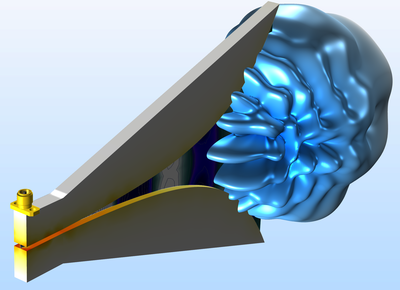
A double-ridged horn antenna is popularly used in anechoic chambers to characterize an antenna under test (AUT), from S-band to Ku-band, due to its reliable performance in a wideband frequency range. This tutorial models a double-ridged horn antenna and computes the voltage standing wave ... En savoir plus
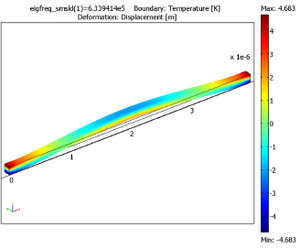
Thermoelastic damping, which arises when you subject a material to cyclic stress, is an important factor when designing MEMS resonators. The stress brings about deformation, where materials heat under compressive stress and cool under tensile stress. Thus, due to the resulting heat flux, ... En savoir plus


