
La Bibliothèque d'Applications présente des modèles construits avec COMSOL Multiphysics pour la simulation d'une grande variété d'applications, dans les domaines de l'électromagnétisme, de la mécanique des solides, de la mécanique des fluides et de la chimie. Vous pouvez télécharger ces modèles résolus avec leur documentation détaillée, comprenant les instructions de construction pas-à-pas, et vous en servir comme point de départ de votre travail de simulation. Utilisez l'outil de recherche rapide pour trouver les modèles et applications correspondant à votre domaine d'intérêt. Notez que de nombreux exemples présentés ici sont également accessibles via la Bibliothèques d'Applications intégrée au logiciel COMSOL Multiphysics® et disponible à partir du menu Fichier.
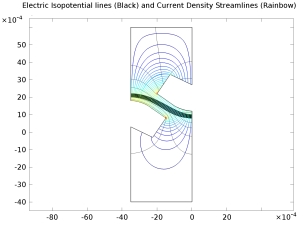
The chlor-alkali membrane process is one of the largest in industrial electrolysis with the production of roughly 40 million metric tons of both chlorine and caustic soda per year. Chlorine is used predominantly for the production of vinyl chloride monomer, which in turn is used for the ... En savoir plus
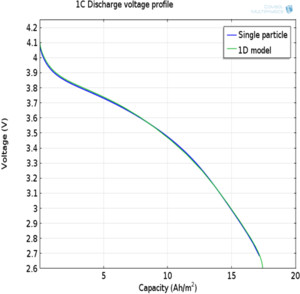
An isothermal single particle model formulation for a lithium-ion battery is presented in this work. The single particle model is a simplification of the 1D formulation for a lithium-ion battery along with a few assumptions. The model is typically valid for low-medium current scenarios. ... En savoir plus
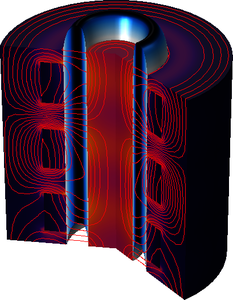
Induction pumps are used in high temperature cooling systems. The principle of operation is equivalent to a linear three phase induction motor. The lack of moving parts and the pumped liquid being kept in a hermetically closed system are clear advantages. This model shows how to simulate ... En savoir plus
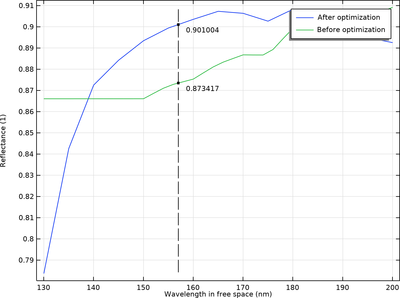
This example demonstrates how to optimize the thickness of a microelectromechanical systems (MEMS) mirror coating material for maximum reflectivity. To reduce the simulation time, a Layered Impedance Boundary Condition is used to model the thin coating material on top of the metallic ... En savoir plus
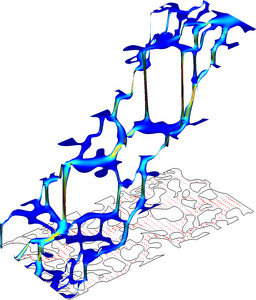
This non-conventional model of porous media flow utilizes creeping (Stokes) flow in the interstices of a porous media. The model comes from the pore-scale flow experiments conducted by Arturo Keller, Maria Auset, and Sanya Sirivithayapakorn of the University of California, Santa Barbara. ... En savoir plus
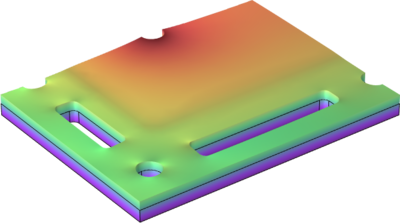
A fuel cell stack operates at temperatures just below 100 °C, which means that it has to be heated at start-up. The fuel cell stack consists of unit cell of anode, membrane, and cathode connected in series through bipolar plates. This study presents a model that couples the thermal and ... En savoir plus
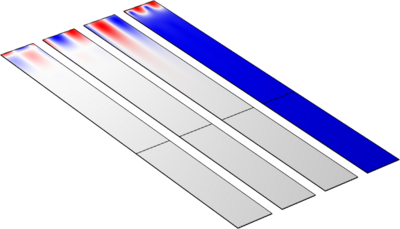
In the surface acoustic waves industry different crystal cuts of piezoelectric materials are used, e.g. 128ᵒ YX LiNbO3, AT&ST quartz, 42ᵒ YX LiTaO3, etc. Direct data isn’t available for all cuts. The standard approach is to use the so-called Euler angle rotation. COMSOL supports it ... En savoir plus
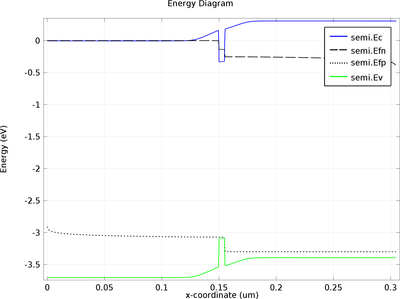
This model simulates a GaN based light emitting diode. The emission intensity, spectrum, and quantum efficiency are calculated as a function of the driving current. Direct radiative recombination across the band gap is modeled, as well as non-radiative Auger and trap-assisted ... En savoir plus
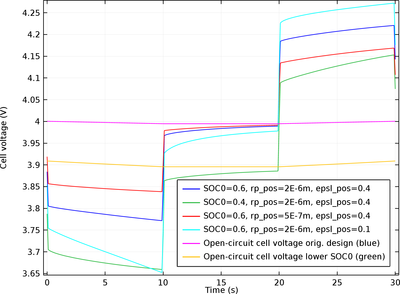
This tutorial digs deeper into the investigation of rate capability in a battery and shows how the Lithium-Ion Battery interface is an excellent modeling tool for doing this. The rate capability is studied in terms of polarization (voltage loss) or the internal resistance causing this ... En savoir plus
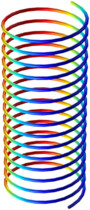
This model computes the trajectory of an ion in a uniform magnetic field using the Newtonian, Lagrangian and Hamiltonian formulations available in the Mathematical Particle Tracing interface. En savoir plus


