
La Bibliothèque d'Applications présente des modèles construits avec COMSOL Multiphysics pour la simulation d'une grande variété d'applications, dans les domaines de l'électromagnétisme, de la mécanique des solides, de la mécanique des fluides et de la chimie. Vous pouvez télécharger ces modèles résolus avec leur documentation détaillée, comprenant les instructions de construction pas-à-pas, et vous en servir comme point de départ de votre travail de simulation. Utilisez l'outil de recherche rapide pour trouver les modèles et applications correspondant à votre domaine d'intérêt. Notez que de nombreux exemples présentés ici sont également accessibles via la Bibliothèques d'Applications intégrée au logiciel COMSOL Multiphysics® et disponible à partir du menu Fichier.
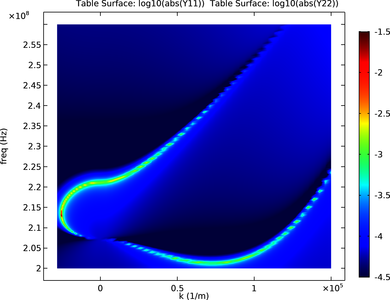
This model shows how to create dispersion diagrams from simulation results by extending the tutorial Thin-Film BAW Composite Resonator. The dispersion curve can be plotted against both real and imaginary values of the wave number, corresponding to the propagating modes and evanescent ... En savoir plus
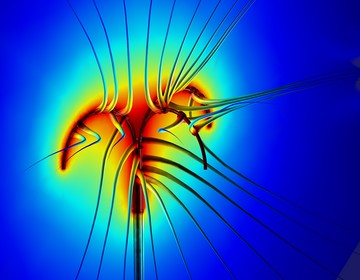
One method for removing cancerous tumors from healthy tissue is to heat the malignant tissue to a critical temperature that kills the cancer cells. This example accomplishes the localized heating by inserting a four-armed electric probe through which an electric current runs. Equations ... En savoir plus
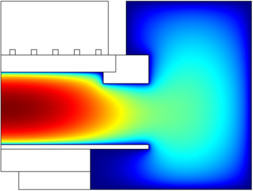
The GEC cell was introduced by NIST in order to provide a standardized platform for experimental and modeling studies of discharges in different laboratories. The plasma is sustained via inductive heating. The Reference Cell operates as an inductively-coupled plasma in this model. This ... En savoir plus
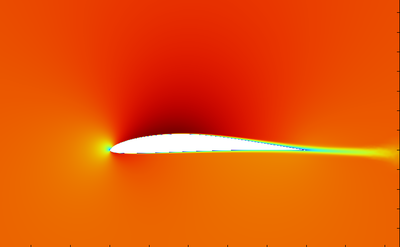
The flow around the Eppler 387 airfoil is computed with the SST turbulence model both with and without the transition model. The reuslts are compared with experimental values. En savoir plus
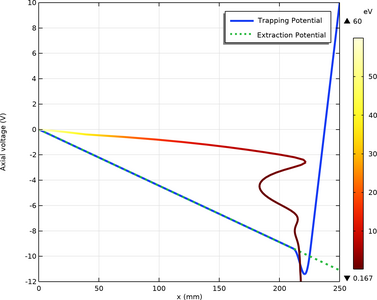
A radio frequency quadrupole ion trap utilizes a radio frequency quadrupole (RFQ) in order to trap an ion beam. A continuous high energy ion beam is first cooled and converted into a spatially confined bunch, which can then be released with minimal heating of the beam. The device is also ... En savoir plus
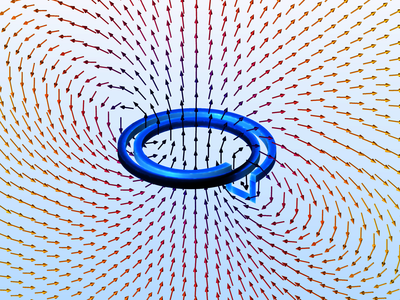
RF coils are important in numerous applications ranging from wireless technology to MRI scanning equipment. This introductory tutorial model demonstrates how to find the fundamental resonance frequency of an RF coil as well as how to perform a frequency sweep to extract the coil's Q ... En savoir plus
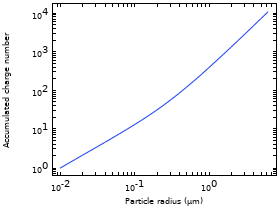
This model computes the fluid flow, charge transport and electric potential in an electrostatic precipitator. Based on the resulting fields, particles of different diameter are fed into the device and the transmission probability is computed. As expected, the separation efficiency shows ... En savoir plus

In this tutorial model, a step thrust bearing is topology optimized to maximize the bearing capacity. A step thrust bearing consists of a stepped bearing surface on which the end of the shaft rotates. The entire assembly is submerged in a lubricant. The shaft collar is assumed to be ... En savoir plus


