
La Bibliothèque d'Applications présente des modèles construits avec COMSOL Multiphysics pour la simulation d'une grande variété d'applications, dans les domaines de l'électromagnétisme, de la mécanique des solides, de la mécanique des fluides et de la chimie. Vous pouvez télécharger ces modèles résolus avec leur documentation détaillée, comprenant les instructions de construction pas-à-pas, et vous en servir comme point de départ de votre travail de simulation. Utilisez l'outil de recherche rapide pour trouver les modèles et applications correspondant à votre domaine d'intérêt. Notez que de nombreux exemples présentés ici sont également accessibles via la Bibliothèques d'Applications intégrée au logiciel COMSOL Multiphysics® et disponible à partir du menu Fichier.
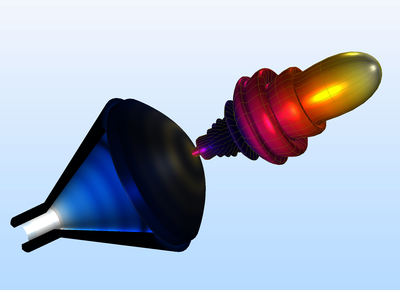
An axisymmetric 3D structure such as a conical horn antenna can be simulated in a fast and efficient way using only its 2D layout. In this model, the antenna radiation and matching characteristics are computed very quickly with respect to the dominant TE mode from the given circular ... En savoir plus
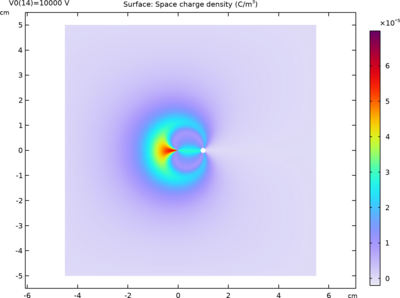
This model utilizes a continuation solver to efficiently compute the current–voltage characteristics of a corona discharge generated by a wire-to-wire configuration. It provides a flexible framework that can be easily adapted to study other discharge configurations and types. En savoir plus

The noise emitted from an electrical machine can have many sources. In this example, acoustic noise from vibrations created by magnetic force variation is studied. Such noise is often audible at twice the excitation frequency but can also occur at higher frequencies or harmonics of the ... En savoir plus
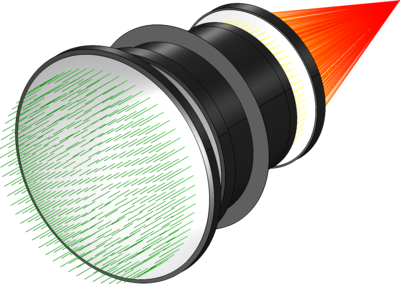
This tutorial shows how to set up a multi-element objective lens. The chosen lens is the Double Gauss described in 'Modern Lens Design (2nd edition)', by W. Smith, 2005, pg 323. The tutorial demonstrates how to create a geometry sequence using the 'Spherical Lens 3D' part found in the ... En savoir plus
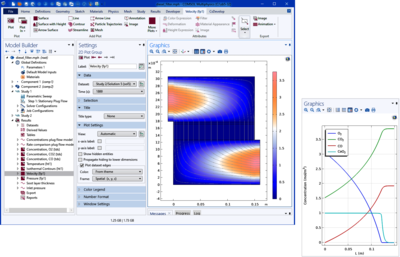
In this tutorial, a filter system for a diesel engine is modeled, including a soot layer development and oxidization. The build-up of the layer is held in check by both catalytic and non-catalytic reactions, where carbon is oxidized to carbon monoxide and carbon dioxide, which in turn ... En savoir plus
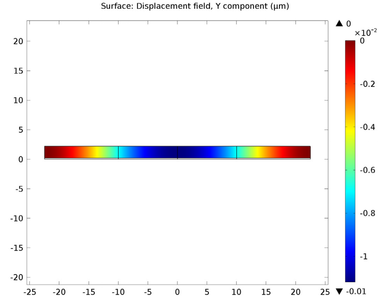
Silicon micromechanical resonators have long been used for designing sensors and are now becoming increasingly important as oscillators in the consumer electronics market. In this series of models, a surface micromachined MEMS resonator, designed as part of a micromechanical filter, is ... En savoir plus
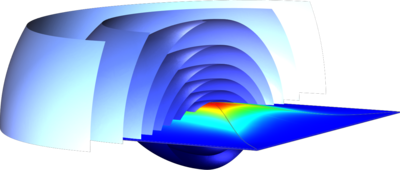
This model analyzes a piezoelectric microelectromechanical system (MEMS) speaker. The speaker, composed of four triangular membranes, uses a layer of lead zirconate titanate (PZT) material with two electrodes on top of a silicon layer as actuators. The triangular membranes are separated ... En savoir plus
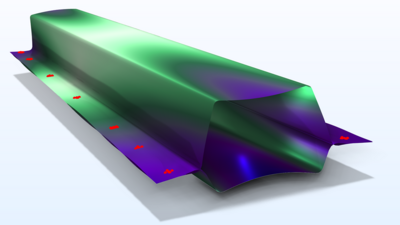
In this example, the natural frequencies of a double hat beam are studied. The beam is made of two thin steel plates, joined together by spot welds along the flanges. The Spot Welds feature sets up multiple mesh-independent connections between the shells. En savoir plus
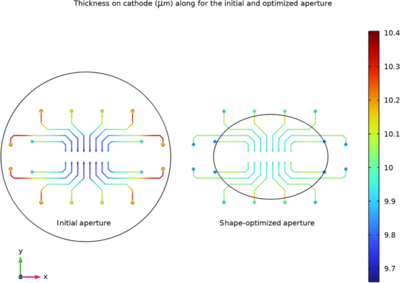
An aperture is often used in electroplating baths in order to improve the uniformity of the deposited metal layer. This example simulates electroplating of a printed circuit board (PCB) in 3D using a secondary current distribution. The size and aspect ratio of the aperture is optimized ... En savoir plus
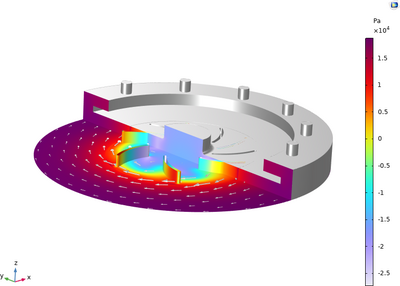
The present example simulates the steady-state flow in a radial pump using the mixing plane methodology. It solves for the averaged flow resulting from different blade positions of the rotor, thus circumventing the need to perform costly time-dependent simulations. En savoir plus


