
La Bibliothèque d'Applications présente des modèles construits avec COMSOL Multiphysics pour la simulation d'une grande variété d'applications, dans les domaines de l'électromagnétisme, de la mécanique des solides, de la mécanique des fluides et de la chimie. Vous pouvez télécharger ces modèles résolus avec leur documentation détaillée, comprenant les instructions de construction pas-à-pas, et vous en servir comme point de départ de votre travail de simulation. Utilisez l'outil de recherche rapide pour trouver les modèles et applications correspondant à votre domaine d'intérêt. Notez que de nombreux exemples présentés ici sont également accessibles via la Bibliothèques d'Applications intégrée au logiciel COMSOL Multiphysics® et disponible à partir du menu Fichier.
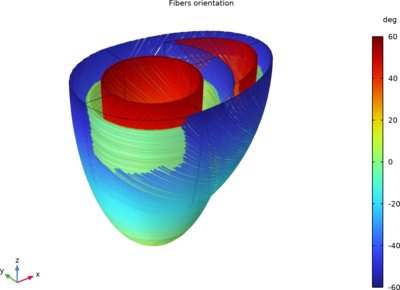
The standard biventricular cardiac model is used to show how to set up fiber directions in a complex geometry. The fibers are then used to model the large deformation of the myocardium with the Holzapfel-Gasser-Ogden anisotropic material model. The Aliev-Panfilov equations are included ... En savoir plus
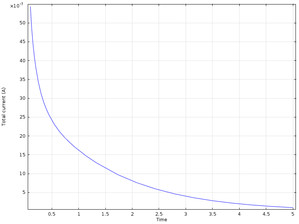
The common electroanalytical method of exhaustive amperometric detection in a microscopic thin layer is modelled as a 1D-symmetric diffusion problem. The simulated result agrees with the analytical Cottrell equation at short times, and deviates as expected at long times when the ... En savoir plus
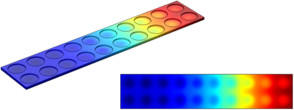
In small PEM fuel cell systems (in the sub-100 W range) no active devices for cooling or air transport are normally used. This is due to the desire to minimize parasitic power losses from pumps and fans, and to reduce the system complexity, size, and cost. The reactants at the cathode ... En savoir plus
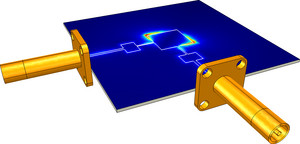
Patch antennas are becoming more common in wireless equipment, like wireless LAN access points, cellular phones, and GPS handheld devices. The antennas are small in size and can be manufactured with simple and cost-effective techniques. Due to the complicated relationship between the ... En savoir plus
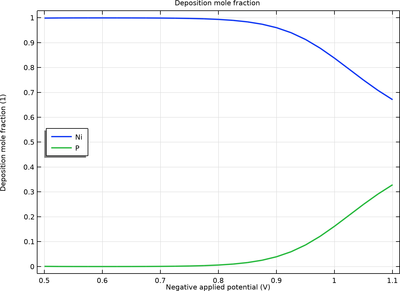
Electrochemical codeposition is a common low-cost method for producing metal alloys. This tutorial model demonstrates electrodeposition of a nickel (Ni)–phosphorous (P) alloy. The model accounts for charge and mass transport of a multitude of species along with multiple electrode ... En savoir plus
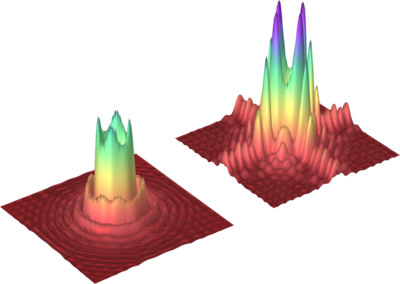
This example presents transient analysis of the wave propagation in rock mass caused by a short duration load on the surface. Such loads are typical during tunnel constructions and other excavations using blasting. The example shows the use of the Low-reflecting boundary conditions to ... En savoir plus
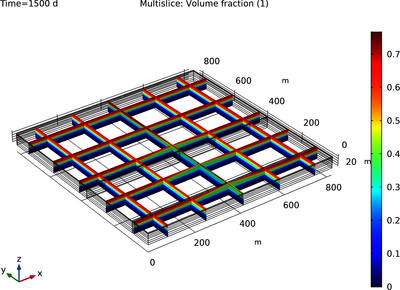
This example models an oil reservoir with two horizontal wells. The reservoir contains two phases, water and oil. Oil is recovered by injecting water through the bottom well, so the oil production rate and the water-oil production ratio over time are computed. En savoir plus
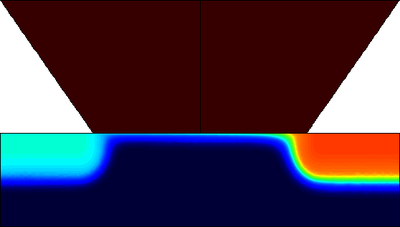
An ion-sensitive field-effect transistor (ISFET) is constructed by replacing the gate contact of a MOSFET with an electrolyte of interest. The concentration of a specific ionic species in the electrolyte can be determined by measuring the change in the gate voltage due to the interaction ... En savoir plus
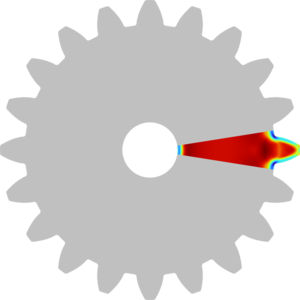
This model shows how to simulate carburization and quenching of a steel gear. Diffusion of carbon into the surface of the gear affects the onset of martensitic transformation. Residual stresses are computed, and it is shown that high residual compressive stresses appear at the root of ... En savoir plus
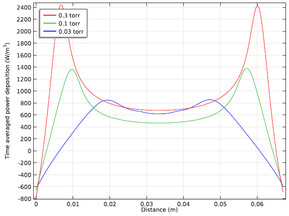
The underlying physics of a capacitively coupled plasma is rather complicated, even for rather simple geometric configurations and plasma chemistries. This model benchmarks the Capacitively Coupled Plasma physics interface against many different codes. En savoir plus


