
La Bibliothèque d'Applications présente des modèles construits avec COMSOL Multiphysics pour la simulation d'une grande variété d'applications, dans les domaines de l'électromagnétisme, de la mécanique des solides, de la mécanique des fluides et de la chimie. Vous pouvez télécharger ces modèles résolus avec leur documentation détaillée, comprenant les instructions de construction pas-à-pas, et vous en servir comme point de départ de votre travail de simulation. Utilisez l'outil de recherche rapide pour trouver les modèles et applications correspondant à votre domaine d'intérêt. Notez que de nombreux exemples présentés ici sont également accessibles via la Bibliothèques d'Applications intégrée au logiciel COMSOL Multiphysics® et disponible à partir du menu Fichier.
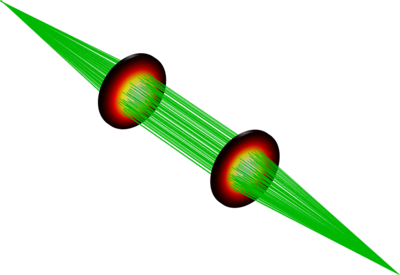
A modern high-power industrial fiber laser system can deliver up to 3kW of single-mode laser radiation on to surfaces to be cut, drilled, welded or marked. Even using highly transmissive materials, the optical component used to focus the laser beam onto target surfaces can be affected ... En savoir plus
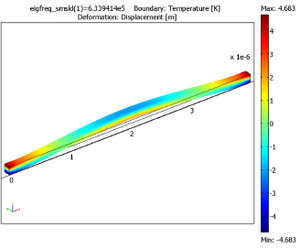
Thermoelastic damping, which arises when you subject a material to cyclic stress, is an important factor when designing MEMS resonators. The stress brings about deformation, where materials heat under compressive stress and cool under tensile stress. Thus, due to the resulting heat flux, ... En savoir plus

This tutorial demonstrates how to compute the response of an ultrasonic car parking sensor transducer coupling Pressure Acoustics, Frequency Domain, Solid Mechanics, and Piezoelectric Materials. The far-field radiation pattern of the transducer is then used as a source for a Ray ... En savoir plus
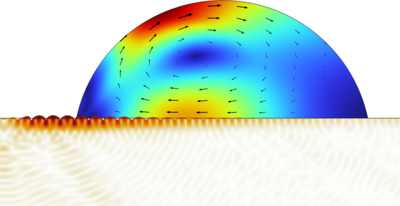
When a droplet is placed on a substrate on which surface acoustic waves (SAWs) are traveling, the energy of the SAWs is transferred into the droplet to form an acoustic field. The transferred energy is attenuated and generates a streaming flow. This type of streaming enables contactless ... En savoir plus
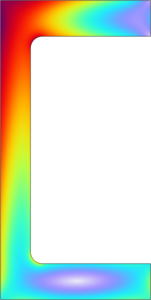
This benchmark demonstrates how to use the Beam interface in the Structural Mechanics Module. It calculates the deformation, section forces, and stresses in a cantilever beam as well as a number of eigenfrequencies. It also illustrates how to use the Beam Cross Section interface to ... En savoir plus
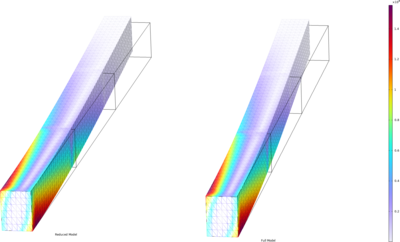
In this tutorial example, the concepts of Component Mode Synthesis (CMS) are introduced through a simple solid model of a cantilever beam. Parts of the beam are reduced by the CMS technique. It is, furthermore, shown how CMS can be used to represent both the static and dynamic behavior ... En savoir plus
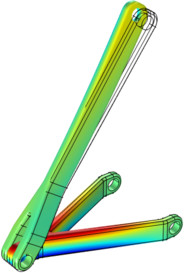
A hinge between two mechanical components is modeled by coupling two rigid connectors. This method can be used for simulating many types of mechanisms. In mechanical assemblies, parts are sometimes connected so that they are free to move relative to each other in one or more degrees of ... En savoir plus

This model showcases how to use fibers in thin layers to model thin anisotropic composites embedded in a solid without explicitly drawing either the layer of material or the reinforcing fibers. Here, it is used to model steel cords in tire belts that are used to provide structural ... En savoir plus
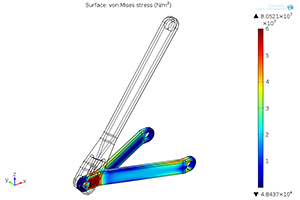
This example illustrates how to model a barrel hinge connecting two solid objects in an assembly. In this model, the details of the connection are not the focus of the analysis, therefore, the hinge joint is modeled using a Joint feature in the Multibody Dynamics Module. The connected ... En savoir plus
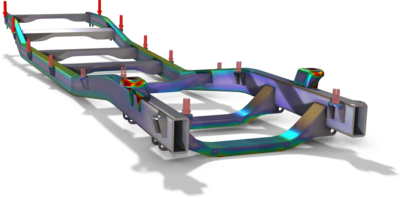
This example illustrates how to perform eigenfrequency and static analyses of a ladder frame structure for a light truck. Important modeling strategies are described. For example, how to convert a solid geometry to a shell model, how to make different types of connections, and how to ... En savoir plus


