
La Bibliothèque d'Applications présente des modèles construits avec COMSOL Multiphysics pour la simulation d'une grande variété d'applications, dans les domaines de l'électromagnétisme, de la mécanique des solides, de la mécanique des fluides et de la chimie. Vous pouvez télécharger ces modèles résolus avec leur documentation détaillée, comprenant les instructions de construction pas-à-pas, et vous en servir comme point de départ de votre travail de simulation. Utilisez l'outil de recherche rapide pour trouver les modèles et applications correspondant à votre domaine d'intérêt. Notez que de nombreux exemples présentés ici sont également accessibles via la Bibliothèques d'Applications intégrée au logiciel COMSOL Multiphysics® et disponible à partir du menu Fichier.
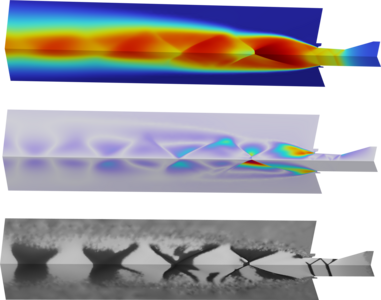
In this example, the High Mach Number Flow, Low Reynolds Number k-e interface is used to compute the compressible turbulent flow from a rectangular nozzle. Mesh refinement based on the estimation of the shock strength and the shear-layer strength is employed to achieve appropriate ... En savoir plus
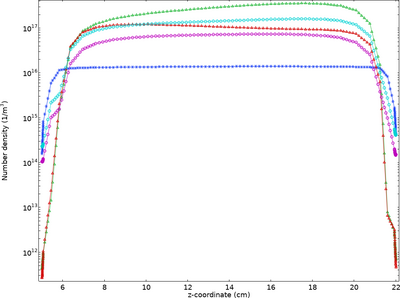
This tutorial model solves for an inductively coupled plasma reactor in a mixture of SF6/argon. The model computes the fluid flow and gas heating. Important aspects and strategies for modeling electronegative discharges are discussed. En savoir plus
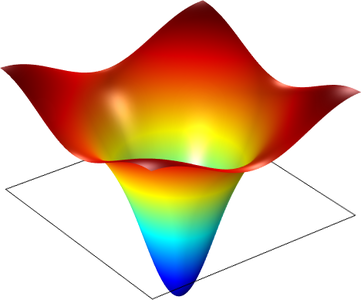
This model investigates the wave propagation in a photonic crystal that consists of GaAs pillars placed equidistant from each other. The distance between the pillars determines a relationship between the wave number and the frequency of the light, which prevents light of certain ... En savoir plus
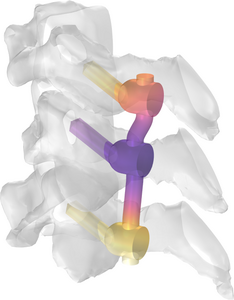
Tutorial example of the RF heating of passive conductive implants (rod and screws) inserted in three vertebrae during MRI. The RF fields are locally enhanced in the proximity of a passive conductive implant resulting in the heating of the portion of tissue facing the implant's surface. En savoir plus
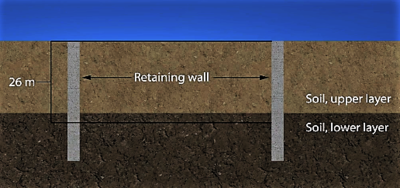
This example shows how to model a deep excavation. The main application area of this type of modeling is in civil engineering. In this case, the in situ lateral pressure acting on the retaining wall during the soil excavation is modeled with boundary loads. The soil assumes Drucker ... En savoir plus
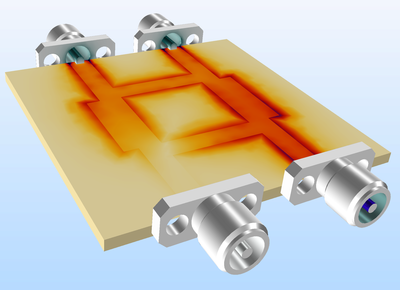
A Branch Line Coupler (Quadrature 90° Hybrid) is a four-port network device with a 90° phase difference between two coupled ports. The device can be used for a single antenna Transmitter/Receiver system or an I/Q signal splitter/combiner. The objective of this model is to compute the S ... En savoir plus
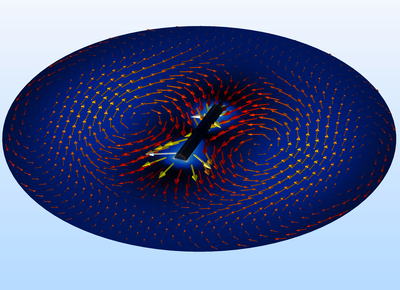
A metallic cylindrical rod is hidden inside a spherical dielectric shell and its orientation is unknown. By studying the polarization-dependent scattered field of a cylindrical object and performing a parametric sweep as a function of polarization angle, the rod is detected for the ... En savoir plus
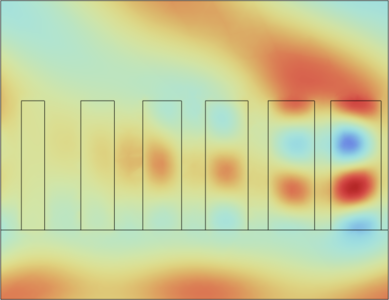
This model demonstrates how to simulate a metasurface beam deflector that uses anomalous refraction. The structure itself is a repeated array of six posts (so-called meta elements). The periodicity of the individual posts is 500 nm, so the full structure of six posts is 3 um wide. The ... En savoir plus


