
La Bibliothèque d'Applications présente des modèles construits avec COMSOL Multiphysics pour la simulation d'une grande variété d'applications, dans les domaines de l'électromagnétisme, de la mécanique des solides, de la mécanique des fluides et de la chimie. Vous pouvez télécharger ces modèles résolus avec leur documentation détaillée, comprenant les instructions de construction pas-à-pas, et vous en servir comme point de départ de votre travail de simulation. Utilisez l'outil de recherche rapide pour trouver les modèles et applications correspondant à votre domaine d'intérêt. Notez que de nombreux exemples présentés ici sont également accessibles via la Bibliothèques d'Applications intégrée au logiciel COMSOL Multiphysics® et disponible à partir du menu Fichier.
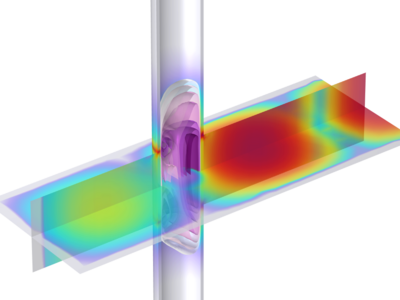
This tutorial model explores the behavior of a microwave plasma torch. The plasma is generated within a dielectric tube inserted in a rectangular waveguide. The simulation solves the coupled equations for plasma transport and heating, microwave electromagnetic fields, fluid flow, and ... En savoir plus
The following example solves a pure conduction and a free-convection problem in which a vacuum flask holding hot coffee dissipates thermal energy. The main interest is to calculate the flask's cooling power; that is, how much heat it loses per unit time. This tutorial model treats the ... En savoir plus

When producing glass, the glass melt is cooled down through radiation to form the final shape, subjecting it to stresses. Numerical treatment of radiative heat transfer, using the Radiative Transfer Equation (RTE), helps to optimize this process. COMSOL Multiphysics provides three ... En savoir plus
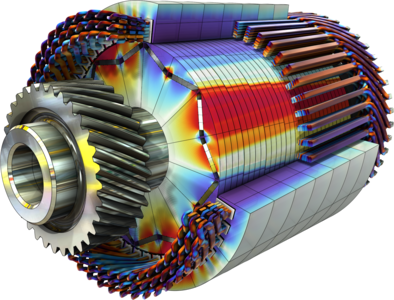
This series of models demonstrates how to do advanced electric machine modeling with COMSOL Multiphysics® — in 2D, 2.5D, and full 3D with end effects included. It investigates the performance of a Permanent Magnet Synchronous Motor, as is often used in modern electric vehicles. ... En savoir plus
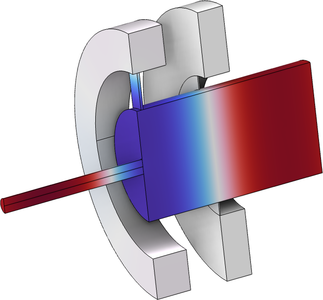
This tutorial computes the transfer matrix of a tube and coupler measurement test setup. This type of setup is used for standardized testing, for example, for miniature loudspeakers or hearing aids. The Port boundary condition in Pressure Acoustics, Frequency Domain is used together ... En savoir plus
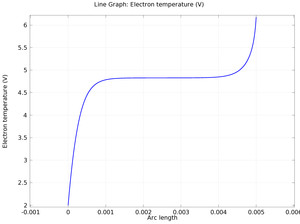
The Drift Diffusion interface solves a pair of reaction/advection/diffusion equations, one for the electron density and the other for the mean electron energy. This tutorial example computes the electron number density and mean electron energy in a drift tube. Electrons are released due ... En savoir plus
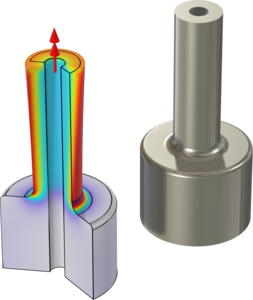
Including circumferential displacements in a 2D axisymmetric Solid Mechanics interface allows to compute twist and bending deformations. This model determines stress concentration factors for a hollow shaft for load cases of axial extension, torsion, as well as bending, using a ... En savoir plus
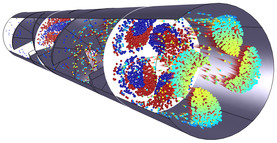
In static mixers, also called motionless or in-line mixers, a fluid is pumped through a pipe containing stationary blades. This mixing technique is particularly well suited for laminar flow mixing because it generates only small pressure losses in this flow regime. This example studies ... En savoir plus

Silicon carbide (SiC) epitaxial furnaces are a specialized equipment for the production and preparation of SiC epitaxial wafers. This example model demonstrates the process of preparing an SiC epitaxial wafer based on the physical vapor transport (PVT) method in a furnace. This involves ... En savoir plus
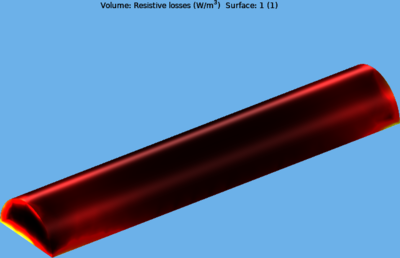
This example demonstrates the usage of the Scattered Field formulation to compute the scattering of light off of a single scatterer on top of a dielectric half-space. It uses the analytic Fresnel equations to design the background field. For a detailed introduction to this model, see ... En savoir plus


