
La Bibliothèque d'Applications présente des modèles construits avec COMSOL Multiphysics pour la simulation d'une grande variété d'applications, dans les domaines de l'électromagnétisme, de la mécanique des solides, de la mécanique des fluides et de la chimie. Vous pouvez télécharger ces modèles résolus avec leur documentation détaillée, comprenant les instructions de construction pas-à-pas, et vous en servir comme point de départ de votre travail de simulation. Utilisez l'outil de recherche rapide pour trouver les modèles et applications correspondant à votre domaine d'intérêt. Notez que de nombreux exemples présentés ici sont également accessibles via la Bibliothèques d'Applications intégrée au logiciel COMSOL Multiphysics® et disponible à partir du menu Fichier.
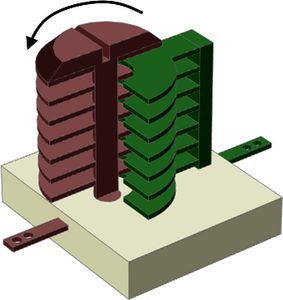
A trimmer capacitor has a variable capacitance. One way of obtaining this is to use parallel facing electrodes with a variable overlap area. In this example, the capacitance can be changed by turning one electrode using a screwdriver. Typically a linear angular response is desired. ... En savoir plus
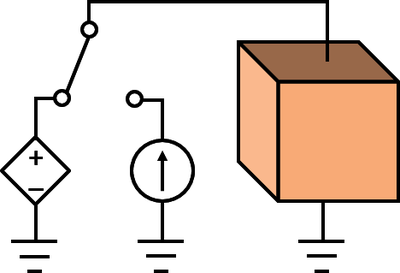
This example exemplifies how to model the switching between current and voltage excitations in Terminal boundary conditions. A more detailed description of the phenomenon and the modeling process can be seen in the blog post "Control Current and Voltage Sources with the AC/DC Module". En savoir plus
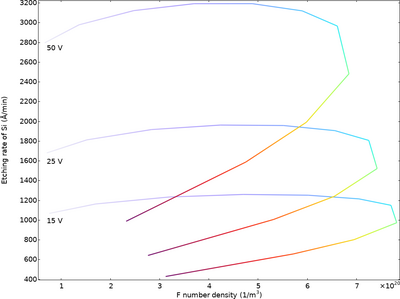
In this example, the etching of silicon in a CF4/O2 plasma reactor is studied using a global model. Parametric sweeps for ion energy and oxygen mole fraction are computed. En savoir plus
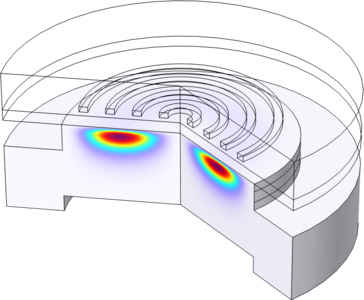
This tutorial model solves for an inductively coupled plasma reactor in a mixture of CF4/O2. The plasma transport, magnetic fields, fluid flow, and heat transfer are solved for fully self-consistently. The oxygen mole fraction of the reactor feed is parameterized. En savoir plus
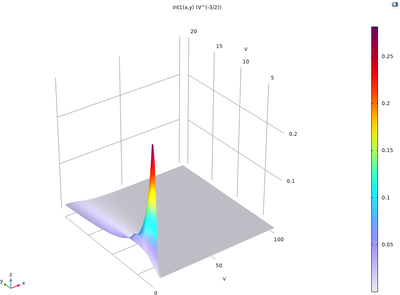
The model of 1D Dielectric Barrier Discharge (DBD) has been recomputed with the three different kinds of electron energy distribution functions (EEDFs): The Maxwellian function The Druyvesteyn function The computed EEDF based on the Boltzmann Equation, Two-Term Approximation ... En savoir plus
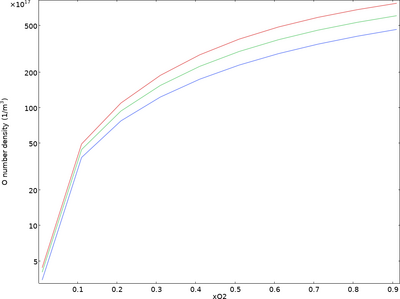
In this example, an CF4/O2 plasma reactor at low pressure is studied using a global model. Parametric sweeps for pressure and oxygen mole fraction are computed. En savoir plus


