
La Bibliothèque d'Applications présente des modèles construits avec COMSOL Multiphysics pour la simulation d'une grande variété d'applications, dans les domaines de l'électromagnétisme, de la mécanique des solides, de la mécanique des fluides et de la chimie. Vous pouvez télécharger ces modèles résolus avec leur documentation détaillée, comprenant les instructions de construction pas-à-pas, et vous en servir comme point de départ de votre travail de simulation. Utilisez l'outil de recherche rapide pour trouver les modèles et applications correspondant à votre domaine d'intérêt. Notez que de nombreux exemples présentés ici sont également accessibles via la Bibliothèques d'Applications intégrée au logiciel COMSOL Multiphysics® et disponible à partir du menu Fichier.

Optical computing has been a promising paradigm alternative to the current electronic computers. This model simulates an optical 4-by-4 unitary matrix multiplication device based on a network of six Mach–Zehnder interferometers (MZIs). A more detailed description of this model can be ... En savoir plus

An acousto-optic modulator (AOM) is a device which can be used for controlling the power, frequency or spatial direction of a laser beam with an electrical drive signal. It is based on the acousto-optic effect, that is, the modification of the refractive index by the oscillating ... En savoir plus
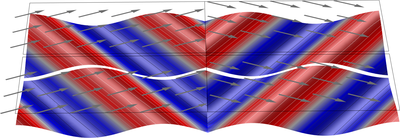
It is possible to engineer the structure of materials such that both the permittivity and permeability are negative. Such materials are realized by engineering a periodic structure with features comparable in scale to the wavelength. It is possible to model both the individual unit cells ... En savoir plus
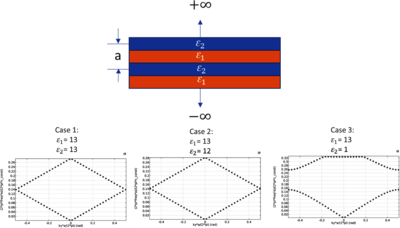
In this model, an eigenfrequency analysis is performed to give a bandgap analysis of a 1D multilayer photonic crystal extending to infinity in +/- y direction. We perform the bandgap analysis for three different cases of material properties, as discussed in Chapter 4 of Ref. 1. Case ... En savoir plus
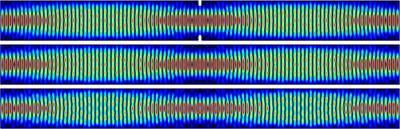
This model demonstrates three different ways to find the eigenfrequencies of a rectangular metallic cavity. The first method uses an eigenfrequency study step together with the Electromagnetic Waves, Beam Envelopes interface. Here, it is important to define a wave vector for the physics ... En savoir plus
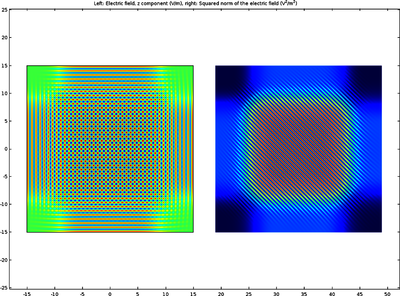
When two coherent light beams intersect, an interference pattern appears. If this occurs in a material that is sensitive to light, with intensities greater than a certain exposure threshold, the interference pattern is recorded in the material as a modulation of the refractive index and ... En savoir plus
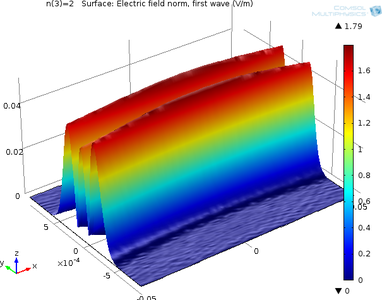
This model demonstrates how a nonlinear equation system can be setup to solve for the eigenfrequencies of a symmetric laser cavity. The model uses the bidirectional formulation of the Electromagnetic Waves, Beam Envelopes physics interface. The computed eigenfrequencies are verified with ... En savoir plus
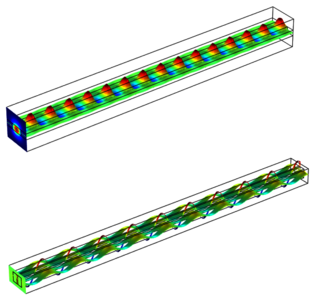
A 3D silicon waveguide is set up with rib and slot configurations. The meshing includes physics-controlled mesh, with the number of longitudinal mesh elements set to 50 to visualize the wave oscillation. The detailed discussion of the model setup is discussed in the blog post: "Silicon ... En savoir plus


