
- Bridging the Terahertz Gap
- Modeling the Lithium-Ion Battery
- Protection contre la Corrosion
- Modélisation des batteries
- Modélisation et Simulation dans le développement des piles à combustible
- Modélisation thermique des petits satellites
- Analyse électro-vibroacoustique d'un transducteur à armature équilibrée
Acoustic Levitation of Magmatic Samples for (Exo)planetary Research
The so-called "LEViathan" is an experimental device for planetary science research. It acoustically levitates a tiny mineral sample with a diameter of ~2 mm and subsequently heats it with a laser to temperatures of up to 3000 K. The mineral therefore melts, forming a levitating magmatic droplet. This enables spectroscopy of the molten sample and allows its interactions with the surrounding atmosphere to be studied closely. The experimental results are used to constrain models of planetary and atmospheric formation. Similar research using aerodynamic levitation of samples has been worked on for years by the Experimental Planetology group at ETHZ, led by Prof. Dr. Paolo Sossi [1].
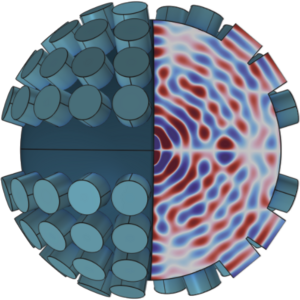
The inside of LEViathan is depicted in Figure 1 while levitating a red Styrofoam sphere. A COMSOL simulation was created to support its design and characterization of. The presented model performs acoustic wave simulations using the (acpr) interface in the frequency domain and describes the interference patterns generated by 120 piezoelectric transducers at 40 kHz. Using the Gor'kov equation, the acoustic force field is calculated in order to quantify the forces experienced by the suspended sample (see Figure 2).
The model also includes the heating of the sample. This is simulated by prescribing a constant sample temperature and calculating heat dissipation through conduction, convection, and blackbody radiation within a time dependent study. The utilized interfaces include (spf) to model the fluid flow of hot air, as well as (ht) and (rad) for thermal modelling. These are coupled via the multiphysics interfaces (nitf) and (htrad). An example is shown in Figure 3.
The simulations provide insight into the effects of heating on the acoustic field. Sound travels faster through hot air, leading to an acoustic lensing effect. Figure 4 (left) shows a temperature field and (right) shows the resulting lensing distortions of propagating acoustic waves. The simulations contributed to the understanding of the severity of thermal distortions and informed several design decisions for the LEViathan prototype. It answered questions regarding optimal device size, design of the chimney for thermal energy removal, and estimated the amount of time the device's electronics could withstand different sample temperatures.
The acoustic amplitudes in the COMSOL model were calibrated to match the measured performance of the LEViathan prototype. Lastly, the simulation performed a series of predictive studies to assess the device's capabilities under pressurized atmospheric conditions of up to 10 bar, using atmospheres of air, pure nitrogen, and argon.
Téléchargement
- 9 - Alex Korocencev.pdf - 2.74MB
- 17931_final_poster.pdf - 1.49MB


