
- Bridging the Terahertz Gap
- Modeling the Lithium-Ion Battery
- Protection contre la Corrosion
- Modélisation des batteries
- Modélisation et Simulation dans le développement des piles à combustible
- Modélisation thermique des petits satellites
- Analyse électro-vibroacoustique d'un transducteur à armature équilibrée
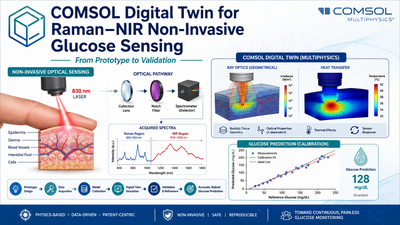
COMSOL Digital Twin for Raman–NIR Non-Invasive Glucose Sensing: From Prototype to Validation
The importance of blood glucose monitoring for diabetics cannot be overemphasized. However, all current CGM methods utilize the use of needles for inserting sensors. The use of optical sensors looks promising since it promises to become both non-invasive and reliable. However, there are some difficulties that emerge when developing the device. The reason for this is the fact that the blood glucose indicator is quite weak; the light can diffuse in tissue layers, some external influences can interfere with the readings, and an improper orientation may result in different outcomes. In this work, we introduce a digital twin workflow built with COMSOL Multiphysics for a Raman–NIR optical sensing platform intended for non-invasive glucose monitoring. The overall project is organized in two phases. Phase 1 creates a digital-twin-guided Raman–NIR setup for bench studies and tissue-mimicking phantom tests. Phase 2 builds on those results with future directions, including NV-diamond quantum sensing, mid-infrared confirmation, NIR photoplethysmography, and multimodal glucose estimation. The present work focuses on the Phase 1 digital twin, which forms the modeling backbone of the broader project, and this system uses an 830 nm light source and includes Rayleigh rejection, collection optics, band-pass detection around the glucose-sensitive Raman window, reference channels, a Raman detector, and data-acquisition hardware. We evaluate the system using glucose solutions at different concentrations and tissue phantoms under controlled conditions. Rather than relying only on trial-and-error rebuilding of the optical setup, we first model the full measurement pathway virtually in COMSOL Multiphysics. Inside the COMSOL model, Ray Optics is used to study how light propagates through the system, where lenses should be placed, how much signal can be collected, and how alignment affects performance. Wave Optics is used to examine spectral behavior, filter response, detector-plane field patterns, Rayleigh rejection, and possible interference effects. Heat Transfer modeling is used to estimate how much the sample may warm under continuous optical exposure and to help define safe operating conditions. Parameter sweeps and sensitivity studies are then used to compare different setups and identify operating regions that balance signal collection, spectral quality, Rayleigh blocking, and thermal safety. The digital twin provides practical design choices for the laboratory, including optical arrangement, filter-detector alignment, collection efficiency, Rayleigh leakage estimates, thermal safety limits, and operating conditions. These outputs help focus experiments with glucose solutions and phantoms. Simulated and measured spectra will be compared to improve the model, refine calibration, and build well-documented datasets for future AI-powered glucose estimation. An important advantage of this work is that it connects physics modeling, optical prototyping, experimental validation, and biomedical data analysis. COMSOL does not replace experiments; it makes each stage more focused, repeatable, and easier to interpret. Figure 1 shows the overall two-phase project vision, while Figure 2 provides a detailed view of the Phase 1 COMSOL digital twin workflow. Thus, this work demonstrates how COMSOL Multiphysics can bridge biomedical need, optical sensing design, and experimental validation for future smart-health technologies.
Téléchargement
- Poster_COMSOL_Digital_Twin.pptx - 6.25MB
- Paper_COMSOL_Digital_Twin.pdf - 4.67MB


