
- Bridging the Terahertz Gap
- Modeling the Lithium-Ion Battery
- Protection contre la Corrosion
- Modélisation des batteries
- Modélisation et Simulation dans le développement des piles à combustible
- Modélisation thermique des petits satellites
- Analyse électro-vibroacoustique d'un transducteur à armature équilibrée
DEM-Based Analysis of Particles Mixing Using the Granular Flow Module
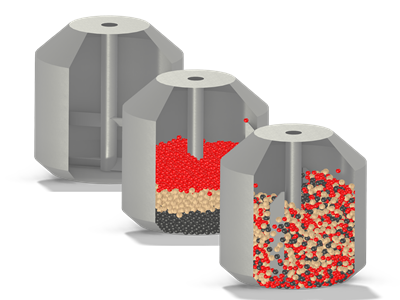
The Granular Flow Module was introduced in late 2025 with COMSOL Multiphysics® version 6.4, extending the software platform with a dedicated environment for the simulation of powders and bulk granular materials. Based on the discrete element method (DEM), the module resolves the translational and rotational motion of individual grains and their interactions with other particles and surrounding equipment. This makes it possible to investigate phenomena such as flow, packing, segregation, and mixing while retaining access to particle-scale quantities and macroscopic process indicators within the same modeling environment. At BE CAE & Test, the capabilities of the new module are being investigated through the numerical analysis of a granular-material mixer. A three-dimensional model of the mixing vessel and rotating mixing element is developed in the COMSOL Model Builder. The Granular Flow interface is used to define multiple grain species, including their size, density, and contact properties. Grain–grain and grain–wall interactions are represented through the available collision, friction, restitution, and rotational-resistance formulations. The granular components are introduced using controlled release features, while the mixer motion is imposed through moving-wall conditions with a prescribed angular velocity. A time-dependent study is then used to follow the evolution of the particle distribution during the loading and mixing stages. Mixing performance is evaluated by tracking the spatial distribution of the different grain species and by defining a mixing index based on their concentration within selected sampling regions. The model is used to compare different operating conditions through parametric studies. Investigated parameters include the mixer rotational speed, the order and timing of grain addition, the initial arrangement of the components, and other process variables that may influence mixing time, homogeneity, or segregation. The developed workflow demonstrates how the Granular Flow Module provides a direct and accessible approach to the numerical investigation of granular mixing equipment, without requiring the implementation of a custom DEM solver. By resolving the trajectories and interactions of the individual grains, the model makes it possible to relate particle-scale mechanisms to the overall evolution of mixture homogeneity. The numerical analysis also provides information that is difficult to obtain experimentally, such as the internal distribution of the different grain species, the formation of poorly mixed regions, and the occurrence of local segregation phenomena. The model therefore represents a useful basis for identifying conditions that improve mixture homogeneity, reduce mixing time, and limit segregation, as well as for supporting the future optimization and scale-up of industrial powder-mixing processes.
Téléchargement
- 18681_final_poster.pdf - 1.08MB


