
- Bridging the Terahertz Gap
- Modeling the Lithium-Ion Battery
- Protection contre la Corrosion
- Modélisation des batteries
- Modélisation et Simulation dans le développement des piles à combustible
- Modélisation thermique des petits satellites
- Analyse électro-vibroacoustique d'un transducteur à armature équilibrée
Design-Driven Seasonal BTES Configurations Using COMSOL Multiphysics
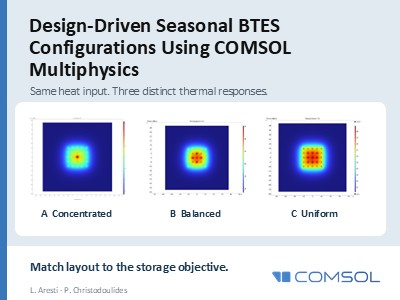
Borehole Thermal Energy Storage (BTES) can play an important role in the decarbonization of heating by storing surplus renewable or waste heat over seasonal timescales. However, the performance of a BTES system depends strongly on the borefield configuration, including borehole spacing, field shape, heat injection distribution, and thermal interaction between neighbouring boreholes. In practical applications, the available land area and the amount of thermal energy to be stored are often known at an early design stage, while the most suitable borefield layout remains uncertain. This work presents a COMSOL-based numerical framework for screening BTES configurations based on a target amount of stored thermal energy and simple site constraints. A transient heat transfer model is developed in COMSOL Multiphysics v6.3 to simulate the charging behaviour of borehole fields embedded in the ground. The model uses a simplified 1D borehole representation coupled with the surrounding three-dimensional ground domain, allowing the thermal response of different configurations to be evaluated with reduced computational cost. The baseline model considers at first a 5 × 5 borefield with 100 m borehole depth and 5 m spacing. A one-year charging period is simulated using a total heat injection rate of 65 kW. The model is used to compare alternative borefield arrangements under the same total heat input, including compact, distributed, and edge-weighted configurations. The aim of the proposed framework is not to perform detailed final-stage system design, but to provide an early-stage screening tool that links available heat input to a suitable borefield arrangement. Candidate configurations are assessed using practical performance indicators, including maximum ground temperature, average storage temperature, spatial temperature uniformity, and thermal interference. Preliminary results show that compact layouts can produce higher local temperatures but stronger thermal gradients, while more distributed layouts provide smoother temperature fields and improved use of the available storage volume. These findings indicate that the preferred borefield shape depends on whether the design priority is high peak temperature, reduced heat losses, or more uniform seasonal storage. The numerical results demonstrate that COMSOL Multiphysics can support practical BTES configuration screening by evaluating how borefield geometry influences heat accumulation and storage efficiency.
Téléchargement
- 17891_final_poster.pdf - 0.79MB


