
- Bridging the Terahertz Gap
- Modeling the Lithium-Ion Battery
- Protection contre la Corrosion
- Modélisation des batteries
- Modélisation et Simulation dans le développement des piles à combustible
- Modélisation thermique des petits satellites
- Analyse électro-vibroacoustique d'un transducteur à armature équilibrée
How to Enter Partial Differential Equations in Natural Form into COMSOL Multiphysics
COMSOL Multiphysics provides powerful tools for solving partial differential equations (PDEs), including the Coefficient Form, the General Form and Weak Form PDE interfaces. However, both require users to reformulate their equations into specific mathematical representations before entering them into the software. The Coefficient and the General Form PDE expect a predefined (matrix) structure with coefficients (ea, da, c, α, β, γ, a, f), while the Weak Form PDE requires manual integration by parts and knowledge of test function notation. For researchers and engineers whose work starts from a PDE in standard textbook notation — such as ρ·cp·∂u/∂t = k·∇²u + Q for heat conduction — this reformulation step represents a significant barrier.
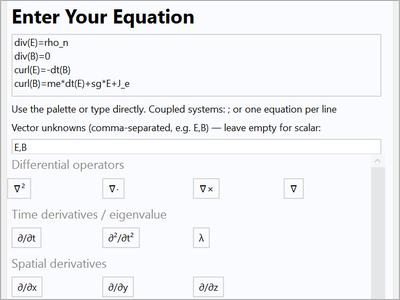
This work presents an application built entirely within the COMSOL Application Builder that allows users to enter PDEs directly in natural mathematical notation. The application automatically parses the input, identifies differential operators (∂/∂t, ∇², ∇·, ∇×, and others), extracts physical parameters, performs integration by parts where required, and generates the corresponding weak form expressions. These are then passed to COMSOL's Weak Form PDE interface for solving.
The application supports both a Natural Notation input mode, where equations are typed as written in textbooks (e.g., "rhocpdt(u) = k*laplacian(u) + Q"), and a Coefficient Form input mode, where users enter individual PDE coefficients directly. This dual-mode design accommodates both intuitive equation entry and structured coefficient specification, including nonlinear expressions that COMSOL's built-in Coefficient Form PDE interface cannot handle yet.
The core of the application is a Java-based equation parser (v3.7) embedded in the Application Builder, consisting of four classes: EquationParser, WeakFormGenerator, Term, and ParseResult. The parser handles operator detection, scientific notation, sign management across the equals sign, and automatic parameter extraction. An interactive symbol palette provides clickable buttons for operators and mathematical functions, eliminating syntax errors.
The application manages the complete simulation workflow: geometry creation for nine predefined 2D and 3D shapes (rectangle, circle, ellipse, triangle, L-shape, ring, box, sphere, cylinder), interactive boundary selection by mouse click using COMSOL's Selection Input mechanism, meshing, solving (stationary, transient, and eigenfrequency studies), and result visualization including time-dependent plots at user-defined probe points.
The application has been validated against analytical solutions through a comprehensive test suite: 18 test cases in natural notation (Poisson, Laplace, Helmholtz, heat equation, wave equation, diffusion, Bratu, reaction-diffusion, and others) and 7 coefficient form test cases, all passing in both 2D and 3D. Cross-validation confirms consistent results across all nine geometry types.
This application demonstrates that the Application Builder can extend COMSOL's capabilities in ways that genuinely lower the barrier to PDE-based simulation. By accepting equations in the notation that scientists and engineers already use, it eliminates the reformulation step and makes COMSOL accessible to users who may not be familiar with weak form theory or coefficient form conventions. Future development targets vector field equations including the curl-curl operator for electromagnetic applications. However, it can and shall not replace specialized modules that offer specialized methods for setting boundary conditions and special elements for FEA.
Téléchargement
- 17431_final.pdf - 0.72MB
- 17341_final.pdf - 0.58MB


