- Bridging the Terahertz Gap
- Modeling the Lithium-Ion Battery
- Protection contre la Corrosion
- Modélisation des batteries
- Modélisation et Simulation dans le développement des piles à combustible
- Modélisation thermique des petits satellites
- Analyse électro-vibroacoustique d'un transducteur à armature équilibrée
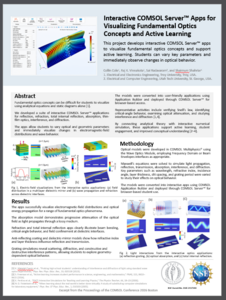
Interactive COMSOL Server Apps for Engaged Learning in Undergraduate Optics and Photonics
Undergraduate students often find optics and photonics concepts challenging because many phenomena involve wave behavior that is difficult to visualize using equations and static diagrams alone. Topics such as reflection, refraction, Snell's law, total internal reflection, optical absorption, thin-film interference, anti-reflecting coatings, dielectric mirrors, diffraction gratings, and double-slit interference require students to connect mathematical relationships with field distributions, phase changes, boundary conditions, and energy flow. To address this need, we developed a set of browser-accessible COMSOL Server™ simulation apps that support active learning in undergraduate physics, optics and photonics courses. The app library is organized around core wave-optics and electromagnetic concepts. Each app allows students to explore how refractive-index contrast, wavelength, angle of incidence, layer thickness, slit spacing, grating period, and material absorption affect light propagation and optical response. The simulations visualize electric-field distributions, reflected and transmitted waves, interference patterns, diffraction behavior, absorption regions, and total-internal-reflection conditions. Through simplified app interfaces, students can manipulate key parameters and immediately observe changes in the optical field behavior without modifying the full model setup. To date, fifteen interactive apps have been developed across optics, photonics, and semiconductor-device topics. This poster focuses on the optics and photonics subset, including reflection, refraction, Snell's law, total internal reflection, absorption, anti-reflecting coatings, dielectric mirrors, reflection and transmission gratings, Young's double-slit interference, and multi-slit diffraction. The apps are being integrated into guided classroom and laboratory activities where students make predictions, run simulations, compare results with analytical models, and interpret physical trends. Representative activities include verifying Snell's law, identifying critical-angle behavior, examining attenuation in absorbing media, optimizing thin-film coating response, and studying how aperture or grating geometry controls interference and diffraction patterns. This poster presents the design approach, app-based simulation framework, representative app interfaces, optical-field visualizations, and examples of classroom activities. The work demonstrates how COMSOL Server™ apps can bridge theory and practice by transforming abstract optical phenomena into interactive, visual, and parameter-driven learning experiences. These app-based modules provide a flexible platform for improving student engagement and conceptual understanding in optics, photonics, and related electrical engineering courses.