- Bridging the Terahertz Gap
- Modeling the Lithium-Ion Battery
- Protection contre la Corrosion
- Modélisation des batteries
- Modélisation et Simulation dans le développement des piles à combustible
- Modélisation thermique des petits satellites
- Analyse électro-vibroacoustique d'un transducteur à armature équilibrée
Modeling Pulsed CO2 Reduction Elucidates Mass Transport Enhancements for Dilute CO2 Conversion
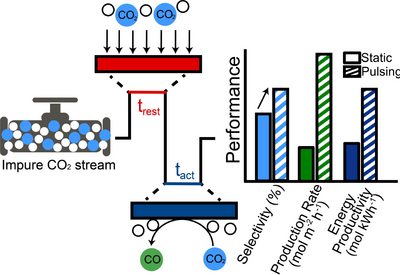
Industrial CO2 waste streams exhibit significant compositional variability, ranging from pure CO2 to as low as 3%, posing challenges for purification or direct conversion. Electrochemical reduction is a sustainable approach to convert CO2 to valuable products, but faces severe mass transport limitations when operating with dilute feeds, even when leveraging gas-diffusion electrodes that are capable of achieving high-rates with pure CO2 feeds. Experimental work has demonstrated that pulsed current electrolysis enhances electroreduction across variable feed CO2 compositions and current densities, suggesting that short pulsing periods can effectively overcome mass transport limitations at low CO2 concentrations and high current densities. To confirm the effect of pulsing on the mass transport of dilute CO2 and help to elucidate the origin of its enhancement, a dynamic, multiphysics continuum model was developed using COMSOL Multiphysics® software. The model coupled Tertiary Current Distribution, Transport of Concentrated Species, and Darcy’s Law physics modules to resolve 1D domains of the catalyst layer (CL) and gas diffusion layer (GDL) of a porous CO2 reduction cathode. The model results resolve the transient chemical microenvironment in the CL during pulsed operation at time and length-scales inaccessible by experiment alone, and revealed up to a 60% increase in CO2 concentration in the catalyst layer and a local pH shift from 14 to 9 in pulsed conditions compared to static current baselines. Multiphysics model results of the average CO2, HCO3–, CO32–, and pH in the CL were used to develop Gaussian Process Regression (GPR) models that map the electrocatalyst microenvironment over a broad parameter space of potential pulsing sequences. The greatest enhancements in available CO2 in the CL occur at the most dilute feed compositions and the highest current densities—where CO2 mass transport is most limited—indicating that pulsing can provide dilute CO2 the necessary residence time to accumulate in the CL during the rest period and react at greater rates during the active period. These findings rationalize and guide the design of experimental pulse sequences for dilute CO2 electroreduction and establish pulsed electrolysis as a viable strategy for directly converting dilute CO2 industrial streams into valuable feedstocks, bypassing costly pre-separation.