
- Bridging the Terahertz Gap
- Modeling the Lithium-Ion Battery
- Protection contre la Corrosion
- Modélisation des batteries
- Modélisation et Simulation dans le développement des piles à combustible
- Modélisation thermique des petits satellites
- Analyse électro-vibroacoustique d'un transducteur à armature équilibrée
Simulation Framework for Brownian Thermal Noise In Dielectric Metasurfaces
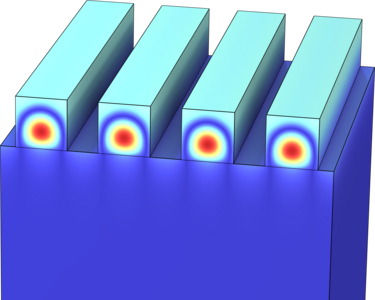
Brownian thermal noise in high-reflectivity dielectric mirror coatings is a fundamental limitation for ultra-stable optical resonators, precision interferometry, and gravitational-wave detectors. Dielectric metasurfaces offer a promising alternative to conventional multilayer Bragg coatings because they can provide high reflectivity with significantly reduced coating volume and lower thermal displacement noise. However, the behavior of Brownian thermal noise of resonant nanostructured optical surfaces is not straightforward to predict, since it depends on the interplay between optical field localization, geometry-dependent resonances, and elastic dissipation. In this work, we present a COMSOL Multiphysics-based simulation framework for calculating Brownian thermal displacement noise in arbitrarily shaped dielectric metasurfaces. The method is based on the fluctuation-dissipation theorem using the direct approach introduced by Yuri Levin. A single periodic unit cell of the metasurface is modeled in COMSOL using Floquet periodic boundary conditions. First, the electromagnetic response is calculated with the Electromagnetic Waves, Frequency Domain interface to obtain the electric and magnetic field distributions inside and around the nanostructure. From these fields, Maxwell stresses are evaluated at all relevant material interfaces using the Maxwell stress tensor. These optically induced surface stresses define the virtual pressure distribution required by Levins approach. The calculated Maxwell stresses are then transferred to the Solid Mechanics interface, where a stationary mechanical study is used to determine the elastic energy density stored in the metasurface and substrate. Together with the material loss factors, this elastic energy is used to calculate the dissipated power and, subsequently, the power spectral density of Brownian thermal displacement noise. By implementing the workflow through the COMSOL Java API, the complete calculation chain—from geometry generation and optical simulation to stress application, mechanical analysis, and noise extraction—can be automated for wavelength sweeps and large geometric parameter studies. We apply the framework to several silicon-on-silica metasurface geometries, including cylindrical, cube, ridge, and embedded-ridge structures. The simulations reveal that Brownian noise does not simply correlate with reflectance or metasurface volume. Instead, strong noise peaks occur near resonant features, especially where small wavelength or geometry changes produce rapid variations in the complex scattering response and enhanced surface fields. This COMSOL-based multiphysics approach therefore provides a flexible tool for understanding the origin of thermal noise in resonant metasurfaces and for guiding the future optimization of low-noise, high-reflectivity optical coatings.
Téléchargement
- 17731_final_poster.pdf - 1.27MB


