- Bridging the Terahertz Gap
- Modeling the Lithium-Ion Battery
- Protection contre la Corrosion
- Modélisation des batteries
- Modélisation et Simulation dans le développement des piles à combustible
- Modélisation thermique des petits satellites
- Analyse électro-vibroacoustique d'un transducteur à armature équilibrée
Simulation of Capillary Filling in a Microfluidic Channel
Capillary filling—the autonomous wicking of liquids through hydrophilic microchannels driven by surface tension and wettability—enables pump-free fluid handling in microfluidic devices for point-of-care diagnostics, lab-on-a-chip systems, and biomedical applications. A critical design challenge is ensuring robust and repeatable capillary filling performance, as the dynamics are highly sensitive to channel geometry, surface wettability, and fluid properties. Insufficient wettability or geometric complexity can cause filling failure, air trapping, or unacceptable variability across devices. In this study, we use high-fidelity multiphase CFD simulations to predict the dynamic capillary filling of an L-shaped microchannel and quantify the sensitivity of filling time and interfacial dynamics to surface wettability.
We developed multiphase flow simulations in COMSOL Multiphysics® to model capillary filling of water through an L-shaped microchannel. The model couples the two-phase Laminar Flow interface with dynamic wetting boundary conditions to capture the motion of the air–water interface along the hydrophilic channel walls. The phase-field method tracks the evolving interface between the two immiscible fluids. Inputs to the model include channel geometry, fluid properties, and the equilibrium contact angle θ, which characterizes surface wettability and is varied parametrically from ultra-hydrophilic (θ = 15°) to moderately hydrophilic (θ = 45°) conditions.
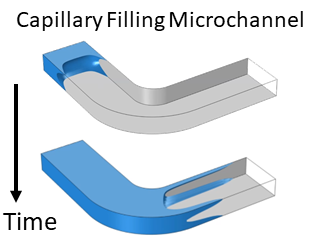
Figure 1 shows the time evolution of capillary filling for contact angles of 15° and 45°. For the ultra-hydrophilic case (θ = 15°), water rapidly advances along the walls, forming a concave meniscus, and the front traverses the L-shaped bend smoothly; the inner corner fills first due to the shorter path length. For θ = 45°, filling is noticeably slower with a less pronounced meniscus curvature and greater asymmetry between inner and outer contact line speeds at the bend. Figure 2 shows inner and outer contact line positions as a function of time for both cases. For θ = 15°, both contact lines advance at nearly equal velocities until the inner line reaches the bend corner, after which the outer catches up; the inner-outer asymmetry is more pronounced at θ = 45°.
Figure 3 quantifies filling time as a function of contact angle across a parametric range. Filling time increases exponentially with contact angle and diverges as θ approaches 90°, where the capillary driving force vanishes and filling ceases entirely. This strong nonlinear sensitivity underscores the critical importance of wettability control in microfluidic device design and manufacturing. Even modest increases in contact angle—due to surface contamination, aging, or manufacturing variability—can substantially degrade filling performance and device reliability.
High-fidelity multiphase CFD simulations in COMSOL Multiphysics® successfully capture the complex interfacial dynamics of capillary filling in L-shaped microchannels, including contact line motion, meniscus evolution, and the transition through channel bends. The simulations reveal a strong exponential sensitivity of filling time to surface contact angle, providing critical design guidance for microfluidic devices. These results demonstrate how simulation can accelerate system design and optimization by rapidly evaluating the effects of channel geometry, surface wettability, and fluid properties, reducing the need for costly and time-consuming fabrication iterations.