- Bridging the Terahertz Gap
- Modeling the Lithium-Ion Battery
- Protection contre la Corrosion
- Modélisation des batteries
- Modélisation et Simulation dans le développement des piles à combustible
- Modélisation thermique des petits satellites
- Analyse électro-vibroacoustique d'un transducteur à armature équilibrée
Structural Optimization of a CFRP-Nomex Pressure Vessel for the EPIC dRICH Detector
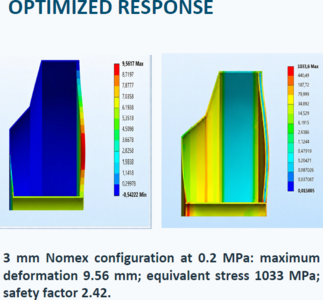
The dual-radiator Ring Imaging Cherenkov (dRICH) detector of the EPIC experiment requires a pressurized gas vessel that combines low mass, dimensional stability, and structural reliability. This work investigates a 1:10 scale vessel prototype manufactured from carbon-fiber-reinforced polymer (CFRP) and a Nomex honeycomb core. A numerical-experimental workflow was used to assess the baseline design and compare alternative sandwich-panel layups under uniform internal pressures from 0.2 to 0.5 MPa. Static structural finite-element analyses were performed on a quarter-symmetry model with anisotropic material properties, bonded contacts, and representative boundary conditions. The prototype was subsequently subjected to 24 h and 48 h pressurization cycles; pressure and local displacements were monitored using a transducer, data logger, and dial indicators. The experimental deformation trend was consistent with the numerical prediction and confirmed that interfaces between monolithic and sandwich regions govern the local response. Three configurations were compared: a 4 mm Nomex baseline, a 5 mm core with 0.30 mm CFRP skins, and a 3 mm core with 1.30 mm CFRP skins. The 3 mm configuration produced the lowest deformation at every investigated pressure and achieved, at 0.3 MPa, a maximum directional deformation of 14.34 mm, an equivalent stress of 1550 MPa, and a safety factor of 1.61. At 0.4 MPa its safety factor decreased to 1.20; therefore, none of the investigated configurations satisfied the stated design target of 1.5 at this pressure. The results identify the 3 mm core configuration as the most promising option while showing that local reinforcement or interface-geometry optimization is required for higher-pressure operation. The study provides a validated basis for transferring the model to COMSOL Multiphysics and conducting laminate-level sensitivity and optimization analyses.