
- Bridging the Terahertz Gap
- Modeling the Lithium-Ion Battery
- Protection contre la Corrosion
- Modélisation des batteries
- Modélisation et Simulation dans le développement des piles à combustible
- Modélisation thermique des petits satellites
- Analyse électro-vibroacoustique d'un transducteur à armature équilibrée
Surrogate Model for Porous Dams
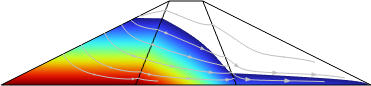
The earth dam problem, in its simplest form, is a classic example as is has been studied for over a century using various modelling approaches: experimental, analytical, numerical and statistical. One reason for this surely is its importance for real embankments, which play a crucial role in flood protection around the world. Another reason surely is that despite its simplicity at first sight, difficulties must be overcome to set up a model for a real site. Hydraulic parameters of the unsaturated soil are usually unknown, or if they are known, models are highly sensitive to their values. Neglect of the unsaturated zone leads to a free surface problem, demanding more sophisticated numerics. A model was set up that includes an inner part of the dam, which usually has a lower permeability than the outer parts, and drainage on the outflow side. It is assumed that under unsaturated conditions the permeability decreases exponentially with the suction head. For a normalized standard geometry, I present the derivation of a surrogate model using deep neural networks. The surrogate model delivers the maximum outflow across the downstream surface of the dam in dependence on two dam design parameters: the permeability contrast between the inner and outer parts of construction and the extension of the drainage. The model can deliver information concerning the design of an earth dam that can be important already in the design phase of a construction project. I examined the influence of various statistical parameters concerning the neural network design and solution strategies: number of hidden layers and neurons, scaling, learning rate, and choice of activation function. The following conclusions could be drawn from the experiments: (1) the ‘tanh’ activation function should be used as the default for all nodes; (2) all parameters at all nodes should be scaled to the interval [0,1], except the output parameter, which should not be scaled; (3) 2e-3 is the best starting value for the learning rate; (4) ’Adam’ should be used as the method. For good results, i.e. low validation loss, the DNN network should not be too simple, but it should also not be too complex in order to keep the number of parameters limited, and depending on this the computation time. Our best results were obtained with a network of 4 hidden layers, with 4, 8, 32, and 16 nodes, which leads to 885 network parameters.
Téléchargement
- 19741_final_paper.pdf - 1.26MB


