- Bridging the Terahertz Gap
- Modeling the Lithium-Ion Battery
- Protection contre la Corrosion
- Modélisation des batteries
- Modélisation et Simulation dans le développement des piles à combustible
- Modélisation thermique des petits satellites
- Analyse électro-vibroacoustique d'un transducteur à armature équilibrée
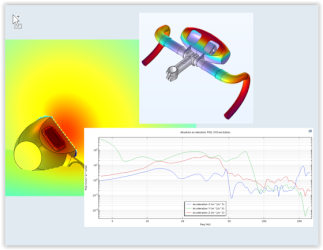
Vibro-Acoustic Modelling, Structural Optimization, and Experimental Validation of a Bicycle Speaker
While personal audio devices are popular among cyclists, conventional earbuds attenuate ambient traffic sounds and compromise situational awareness. Handlebar-mounted speakers provide an open-ear alternative, but designing such devices requires resolving severe vibro-acoustic trade-offs: mitigating broadband road vibration that threatens internal electronics and batteries while maximizing acoustic directivity towards the rider in an open-air environment.
This ongoing study presents a coupled structural-acoustic modelling and optimization framework implemented in COMSOL Multiphysics®. Real-world vibration data is collected using a tri-axial accelerometer mounted on a road bicycle stem over paved cycling tracks containing discrete speed bumps under controlled tire pressures. The processed Power Spectral Density (PSD) serves as base excitation in the Structural Mechanics Module. To ensure computational efficiency and accurate structural fidelity, a mixed solid–shell formulation is employed, utilizing shell elements for the thin-walled enclosure and solid elements for structural brackets, internal mounts, and battery assemblies.
Preliminary eigenfrequency analyses identified low-excitation mounting zones on the handlebar near the stem. Leveraging the Optimization Module, structural shape and topology optimization are applied to design a lightweight, high-stiffness mounting bracket, alongside parametric tuning of the internal elastomeric vibration isolation mounts for PCB and batteries.
Acoustic performance is modelled in the Acoustics Module using a coupled Finite Element Method (FEM) and Boundary Element Method (BEM) approach. The FEM domain resolves the internal back-volume acoustic compliance and cavity resonances, while the BEM domain computes open-field acoustic radiation patterns and directivity toward the rider’s ear level.
To validate the numerical models, a 3D-printed prototype is subjected to multi-point vibration testing on an electrodynamic shaker driven by the measured road profiles, correlating mechanical transfer functions at the bracket, PCB, and battery locations. In parallel, acoustic measurements correlate simulated sound pressure level (SPL) distributions and directivity with the coupled FEM–BEM results. The final presentation will detail the end-to-end simulation methodology, solid–shell coupling strategies, and numerical-experimental correlation.