
Boston Scientific Simulates Release Mechanisms in Drug-Eluting Stents
T. Schauer, I. Guler
Boston Scientific Corporation, MN, USA
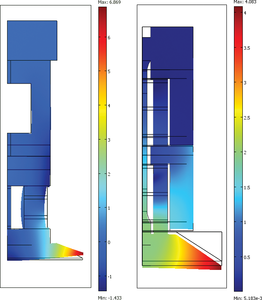
Stent insertion through the coronary artery is a common procedure used to treat restricted blood flow to the heart caused by stenosis. Following the procedure, restenosis may occur due to excessive tissue growth around the stent. Researchers at Boston Scientific are using multiphysics simulation to better understand how drug-eluting stents prevent tissue regrowth and further improve their design.
In COMSOL Multiphysics, the researchers developed a pore-shell model of a stent coating designed for controlled release of medication into surrounding tissues. In their model, the stiff-spring method was implemented to ensure a continuous diffusive flux of medicine at the pore-shell interface. The Optimization Module was used to refine model parameters that could not be determined experimentally, such as the polymer shell thickness and the retardation coefficient of the pores in the stent coating. Both simulation and experimental data confirm a fast release mechanism from pores and slow diffusion through the polymer encapsulant in the shell.
Suggested Stories
Making Smart Materials Smarter with Multiphysics Simulation
Smart materials with magnetostrictive behavior are engineered and incorporated in high-precision devices by the ...
A 100-Fold Improvement in Lithography Resolution Realized with a 150-Year-Old “Perfect Imaging” System
The idea of "perfect imaging", that is a resolution less than the wavelength of light producing the image, was first ...
Application Builder and COMSOL Server: A Review
William Vetterling, research fellow and manager of the Image Science Laboratory at Zink Imaging, created an intuitive ...
Un modèle d'oeil humain, paramétrique et en 3D, offre 20 ans supplémentaires de confort de vision
Pour corriger la presbytie, les chercheurs de Kejako, une société suisse de technologie médicale, développent un ...


