
Conformément à notre Politique de qualité, COMSOL maintient une bibliothèque de centaines d'exemples de modèles documentés qui sont régulièrement testés avec la dernière version du logiciel COMSOL Multiphysics®, notamment des benchmarks de référence en provenance de l'ASME et de NAFEMS, ainsi que des problèmes TEAM.
Notre suite de tests de vérification et de validation (V&V) fournit des solutions précises qui sont comparées aux résultats analytiques et aux données de référence établies. Les modèles documentés ci-dessous font partie des bibliothèques d'applications intégrées du logiciel COMSOL Multiphysics®. Ils comprennent des valeurs de référence et des sources documentaires pour un large éventail de benchmarks, ainsi que des instructions étape par étape pour reproduire les résultats attendus dans votre propre environnement de travail. Vous pouvez utiliser ces modèles non seulement pour documenter vos efforts en matière d'assurance qualité logicielle (SQA) et de vérification de code numérique (NVC), mais aussi dans le cadre d'un programme de formation interne.
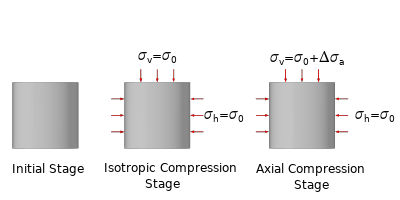
In this example, triaxial and oedometer tests are simulated using the Hardening Soil material model. Both tests exhibit a hyperbolic stress–strain relationship. For the triaxial test, it is confirmed that the axial stress approaches the analytical failure stress asymptotically. In the ... En savoir plus
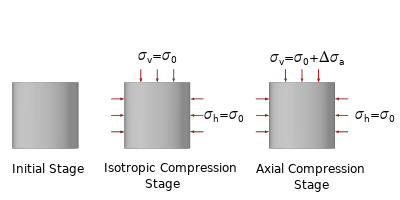
In this example, monotonic and cyclic triaxial tests are simulated using the Hardening Soil Small Strain material model. The model captures the effects of small strain stiffness and hysteresis under cyclic loading. The stress-strain relationship matches the hyperbolic curve reported in ... En savoir plus
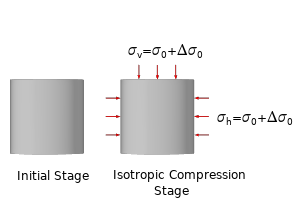
Isotropic compression is a common material test in soil mechanics. The modified Cam-Clay (MCC) model describes the relation between the void ratio and the logarithm of the pressure. In this example, a cylindrical soil sample under isotropic compression is simulated. It is verified that, ... En savoir plus
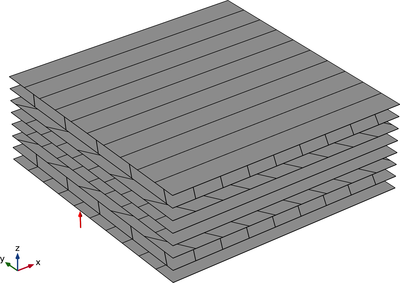
This model serves the purpose of validation and verification of the Linear Elastic Material, Layered model in the Shell interface. In COMSOL Multiphysics, composites are analyzed either based on Layerwise 3D elasticity theory through the Layered Shell interface or based on FSDT-ESL ... En savoir plus
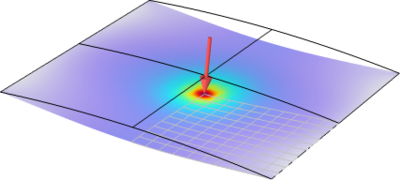
For slender structures, buckling can be a catastrophic instability if the service load exceeds the critical buckling load. For such structures, it can be important to study the structural behavior beyond the critical buckling load. Such a study is known as a postbuckling analysis. ... En savoir plus

In this example, learn how to model two rotors connected by a spline coupling. The first rotor is a fixed cantilevered rotor and the second rotor is supported. The model assumes that only translational motion is coupled between the rotors through the coupling, while the rotations of both ... En savoir plus

This example models the radiation of fan noise from the annular duct of a turbofan aeroengine. When the jet stream exits the duct, a vortex sheet appears along the extension of the duct wall due to the surrounding air moving at a lower speed. The near field on both sides of the vortex ... En savoir plus
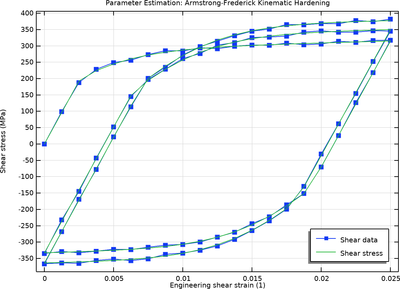
This tutorial model demonstrates how to estimate the material parameters of a combined hardening elastoplastic material model given cyclic shear data. En savoir plus
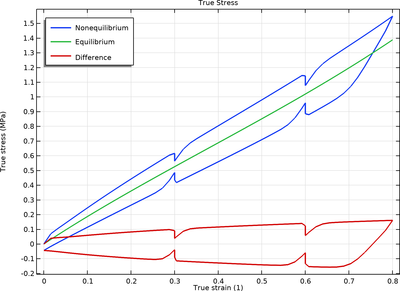
In this example, the Bergstrom–Boyce material model is used to capture the nonequilibrium behavior of carbon-black-filled chloroprene rubber under a strain history that alternates compression with relaxation. Results are verified against experimental and numerical results taken from the ... En savoir plus
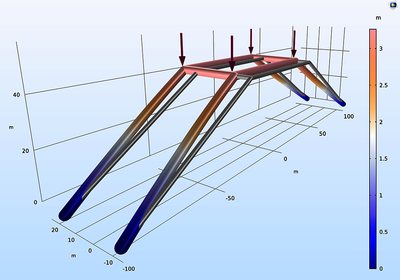
This model illustrates the instability of a space arc frame under concentrated vertical loading. The Beam interface is utilized. Two different approaches are used: A full incremental nonlinear analysis, where a small lateral load is applied to break the symmetry of the structure A ... En savoir plus


