
Conformément à notre Politique de qualité, COMSOL maintient une bibliothèque de centaines d'exemples de modèles documentés qui sont régulièrement testés avec la dernière version du logiciel COMSOL Multiphysics®, notamment des benchmarks de référence en provenance de l'ASME et de NAFEMS, ainsi que des problèmes TEAM.
Notre suite de tests de vérification et de validation (V&V) fournit des solutions précises qui sont comparées aux résultats analytiques et aux données de référence établies. Les modèles documentés ci-dessous font partie des bibliothèques d'applications intégrées du logiciel COMSOL Multiphysics®. Ils comprennent des valeurs de référence et des sources documentaires pour un large éventail de benchmarks, ainsi que des instructions étape par étape pour reproduire les résultats attendus dans votre propre environnement de travail. Vous pouvez utiliser ces modèles non seulement pour documenter vos efforts en matière d'assurance qualité logicielle (SQA) et de vérification de code numérique (NVC), mais aussi dans le cadre d'un programme de formation interne.
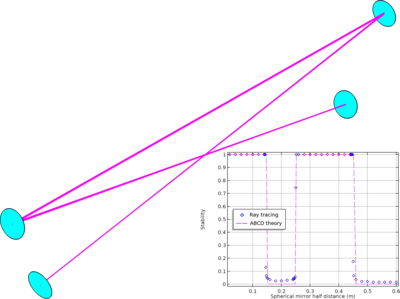
This type is one of the most popular laser cavities. In particular, it is often used for the Ti-doped sapphire femto-second laser. The stability of the laser cavity is analyzed by releasing a ray inside the cavity and is traced for a predefined time period that is sufficiently long. ... En savoir plus
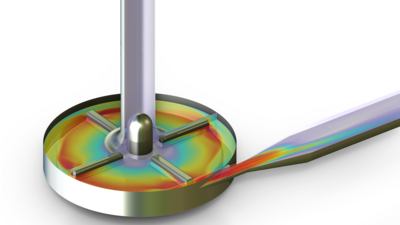
In this benchmark model for blood flow in a centrifugal pump, simulations are performed for several flow rates and pump speeds. The modeled geometry is taken from the FDA’s Computational Round Robin and the results are in good agreement with the experimental data. The computed shear ... En savoir plus
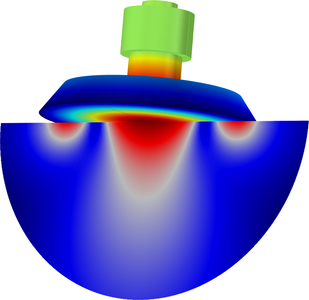
A tonpilz transducer is used for relatively low frequency, high power sound emission. It is one of the popular transducer configurations for SONAR applications. The transducer consists of piezoceramic rings stacked between a head mass and a tail mass which are connected by a central ... En savoir plus
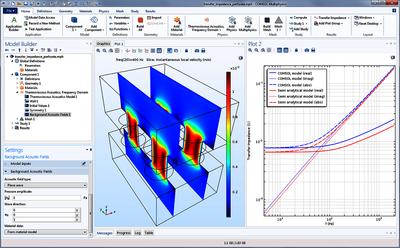
Perforates are plates with a distribution of small perforations or holes. They are used in muffler systems, sound absorbing panels, and in many other places as liners, where it is important to control attenuation precisely. As the perforations become smaller and smaller, viscous and ... En savoir plus
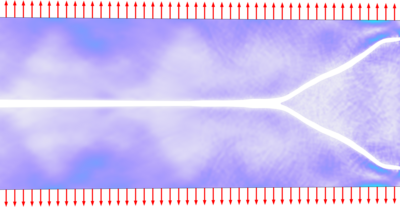
In this example, a benchmark problem in dynamic fracture of brittle materials is analyzed using the AT1 phase-field damage model. An instantaneous tensile load is applied to a planar tension specimen with a pre-existing crack. Initially, the crack propagates perpendicular to the loading ... En savoir plus
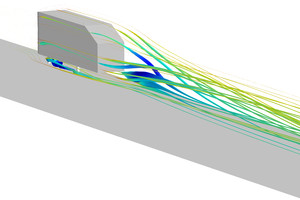
The Ahmed body represents a simplified, ground vehicle geometry of a bluff body type. Its shape is simple enough to allow for accurate flow simulation but retains some important practical features relevant to automobile bodies. This model describes how to calculate the turbulent flow ... En savoir plus
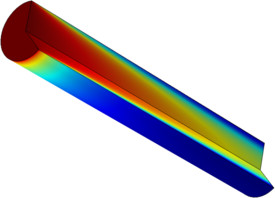
Chemical engineering students can model a nonideal tubular reactor, including radial and axial variations in temperature and composition, and investigate the impact of different operating conditions with this easy-to-use app. The process described by the Tubular Reactor with ... En savoir plus
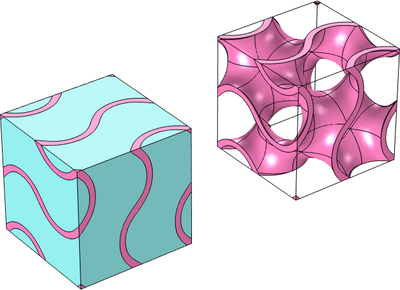
In this example, the homogenized elastic and thermal properties of a composite material based on a triply periodic minimal surface (TPMS) are computed. A gyroid TPMS-based unit cell is subjected to periodic boundary conditions to get the homogenized material properties. The effects of ... En savoir plus
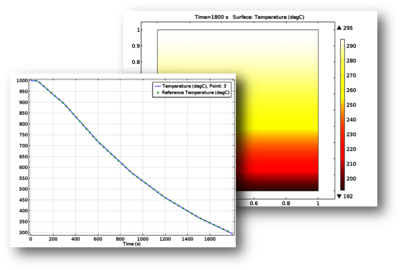
This entry is a compilation of some examples from DIN EN 1991-1-2 (Actions on structures exposed to fire). Models that are included: 1. Cooling (HT) 2. Heating (HT) 3. Heat transfer through multiple layers (HT) 4. Thermal elongation (SME, thermal stress) 5. Thermal expansion (SME, HT, ... En savoir plus
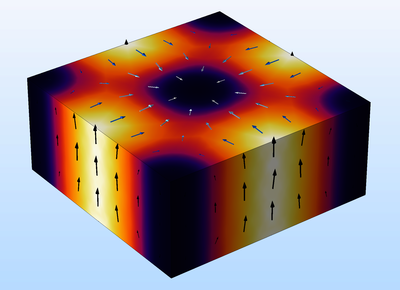
A classic benchmark example in computational electromagnetics is to find the resonant frequency and Q-factor of a cavity with lossy walls. Here, models of rectangular, cylindrical, and spherical cavities are shown to be in agreement with analytic solutions. En savoir plus


