
Conformément à notre Politique de qualité, COMSOL maintient une bibliothèque de centaines d'exemples de modèles documentés qui sont régulièrement testés avec la dernière version du logiciel COMSOL Multiphysics®, notamment des benchmarks de référence en provenance de l'ASME et de NAFEMS, ainsi que des problèmes TEAM.
Notre suite de tests de vérification et de validation (V&V) fournit des solutions précises qui sont comparées aux résultats analytiques et aux données de référence établies. Les modèles documentés ci-dessous font partie des bibliothèques d'applications intégrées du logiciel COMSOL Multiphysics®. Ils comprennent des valeurs de référence et des sources documentaires pour un large éventail de benchmarks, ainsi que des instructions étape par étape pour reproduire les résultats attendus dans votre propre environnement de travail. Vous pouvez utiliser ces modèles non seulement pour documenter vos efforts en matière d'assurance qualité logicielle (SQA) et de vérification de code numérique (NVC), mais aussi dans le cadre d'un programme de formation interne.
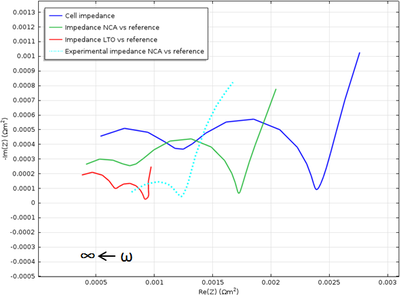
The goal with this app is to explain experimental electrochemical impedance spectroscopy (EIS) measurements and to show how you can use a simulation app, along with measurements, to estimate the properties of lithium-ion batteries. The app takes measurements from an EIS experiment and ... En savoir plus
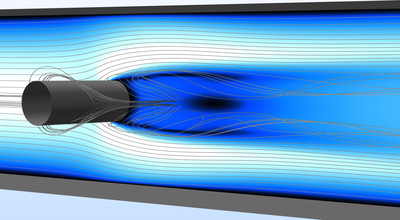
This example simulates 3D unsteady laminar flow past a cylinder in a channel. The inflow velocity profile is time-varying. The lift and drag coefficients are computed, and results show good agreement with those published in the literature. En savoir plus

Many piezoelectric materials are ferroelectric. Ferroelectric materials exhibit nonlinear polarization behavior, such as hysteresis and saturation at large applied electric fields. In addition, the polarization and mechanical deformations in such materials can be strongly coupled due to ... En savoir plus
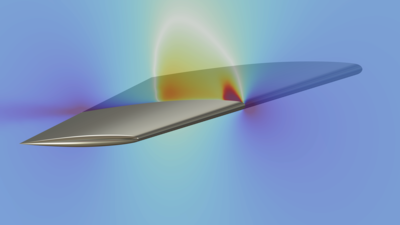
This example demonstrates how to set up the classical external-flow problem of solving for the high-speed, compressible, turbulent flow over the ONERA-M6 wing. The problem involves finding a steady-state solution of the flow field around the 3D, swept wing geometry, immersed in a ... En savoir plus
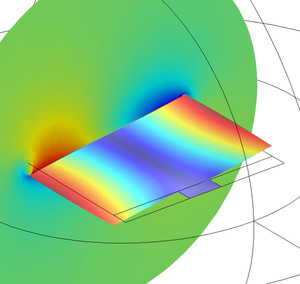
Micromirrors are used in certain MEMS devices to control optical elements. This example of a vibrating micromirror surrounded by air uses the Thermoacoustic-Shell Interaction user interface to model the fluid-solid interaction, and it thus includes the correct viscous and thermal damping ... En savoir plus
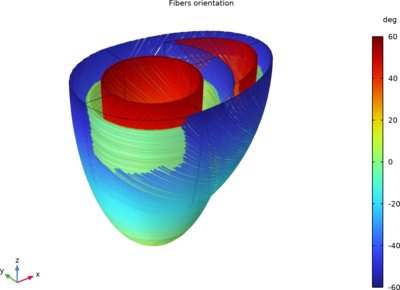
The standard biventricular cardiac model is used to show how to set up fiber directions in a complex geometry. The fibers are then used to model the large deformation of the myocardium with the Holzapfel-Gasser-Ogden anisotropic material model. The Aliev-Panfilov equations are included ... En savoir plus
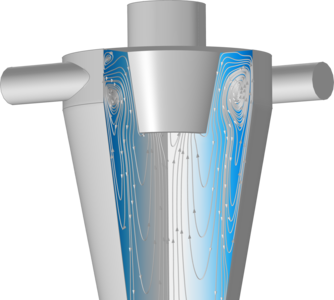
Cyclones are used in a variety of applications ranging from the mining industry to vacuum cleaners. The flow in a cyclone is characterized by a very strong swirl, which makes it difficult to simulate. In this tutorial example, the v2-f turbulence model is used to simulate the flow in a ... En savoir plus
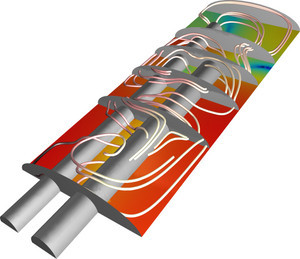
Reflective mufflers are best suited for the low-frequency range where only plane waves can propagate in the system, while dissipative mufflers with fibers are efficient in the mid- to high-frequency range. Dissipative mufflers based on flow losses, on the other hand, also work at low ... En savoir plus
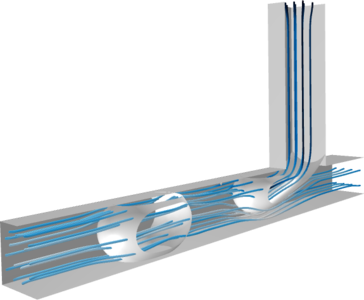
Emulsions consist of small liquid droplets immersed in an immiscible liquid and widely occur in the production of food, cosmetics, fine chemicals, and pharmaceutical products. The quality of the product is typically dependent on the size of the droplets. Simulating these processes can ... En savoir plus
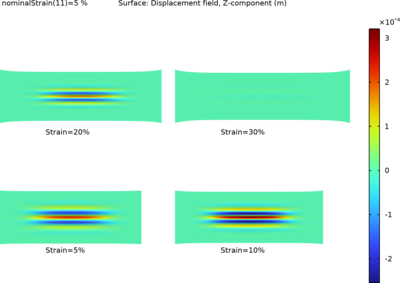
This example demonstrates the wrinkling of a thin rectangular sheet stretched uniaxially. First, a static analysis is performed to determine the region of negative principal stresses without wrinkling. Next, a prestressed buckling analysis is carried out to find out the linearized ... En savoir plus


