
Conformément à notre Politique de qualité, COMSOL maintient une bibliothèque de centaines d'exemples de modèles documentés qui sont régulièrement testés avec la dernière version du logiciel COMSOL Multiphysics®, notamment des benchmarks de référence en provenance de l'ASME et de NAFEMS, ainsi que des problèmes TEAM.
Notre suite de tests de vérification et de validation (V&V) fournit des solutions précises qui sont comparées aux résultats analytiques et aux données de référence établies. Les modèles documentés ci-dessous font partie des bibliothèques d'applications intégrées du logiciel COMSOL Multiphysics®. Ils comprennent des valeurs de référence et des sources documentaires pour un large éventail de benchmarks, ainsi que des instructions étape par étape pour reproduire les résultats attendus dans votre propre environnement de travail. Vous pouvez utiliser ces modèles non seulement pour documenter vos efforts en matière d'assurance qualité logicielle (SQA) et de vérification de code numérique (NVC), mais aussi dans le cadre d'un programme de formation interne.
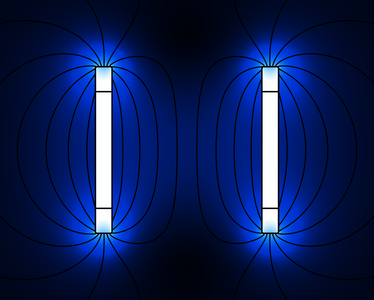
In this set of verification models and associated documentation, the accuracy of electromagnetic force calculations is investigated. Using various techniques, the total force and torque on a rigid body is determined and compared to analytical models. Using fillets, advanced meshing and ... En savoir plus
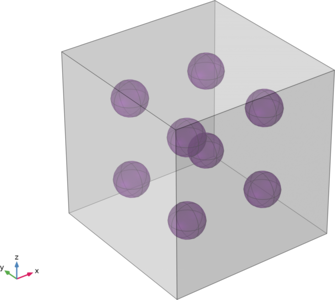
In this example, the homogenized elastic and viscoelastic properties of a particulate composite are computed based on the individual properties of elastic particles embedded in a viscoelastic matrix. Periodic boundary conditions are applied to a unit cell of the particulate composite ... En savoir plus
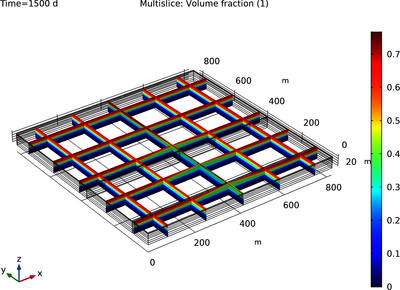
This example models an oil reservoir with two horizontal wells. The reservoir contains two phases, water and oil. Oil is recovered by injecting water through the bottom well, so the oil production rate and the water-oil production ratio over time are computed. En savoir plus
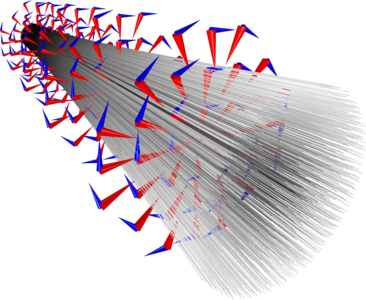
When modeling the propagation of charged particle beams at high currents and relativistic speeds, the space charge and beam current create significant electric and magnetic forces that tend to expand and focus the beam, respectively. The Charged Particle Tracing interface uses an ... En savoir plus
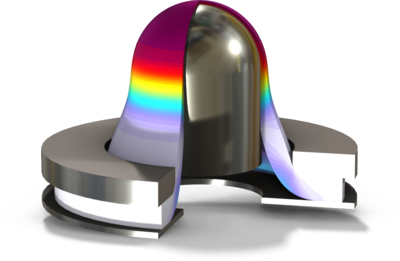
Ultrahigh Molecular Weight (UHMW) Polyethylene is a material commonly employed in knee and hip joint replacements. The “small punch test” is designed to assess mechanical properties using very small samples, which because of their reduced size can be directly explanted. This example ... En savoir plus
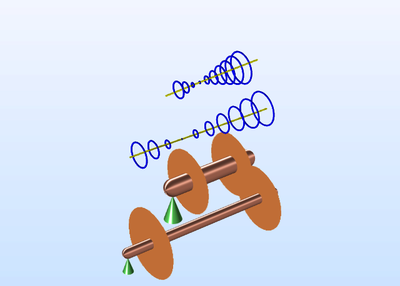
Due to the demand for larger power with a smaller size, dual-shaft systems with intershaft bearings are becoming a standard configuration for gas turbine engines. Such systems consist of two coaxial rotors running at different speeds, interlinked through a multi-spool bearing. In this ... En savoir plus
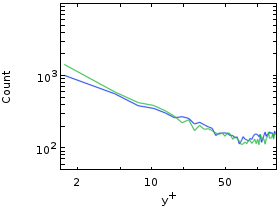
In this benchmark model, solid particles are released in a fully developed turbulent channel flow. The particles are subjected to a drag force that includes contributions from the fluid turbulence, implemented using a Continuous Random Walk (CRW) model. Because the turbulence in the ... En savoir plus
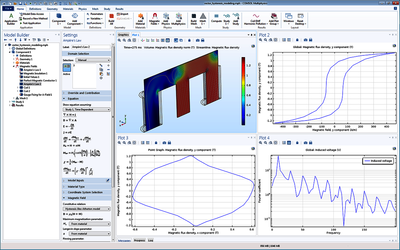
This tutorial is a benchmark model that reproduces the Testing Electromagnetic Analysis Method (TEAM) Problem 32, which evaluates numerical methods for the simulation of anisotropic magnetic hysteresis. A hysteretic three-limbed laminated iron core is subject to a time-varying magnetic ... En savoir plus

A square airbag made of a hyperelastic, compressible neo-Hookean material is inflated using pressurized air. Compressive stresses trigger wrinkling in some regions of the thin airbag. In this example, the wrinkling behavior is modeled using tension field theory, which gives a correct ... En savoir plus
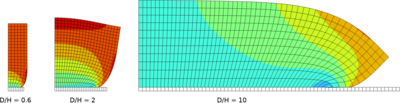
Polymer hydrogels consist of a crosslinked network of long-chained polymers that has imbibed a large number of solvent molecules. Such materials are used in many biomedical applications, such as targeted drug delivery, tissue engineering, and stimuli-sensitive actuators. This benchmark ... En savoir plus


