
Buckling of a Composite Cylinder
Application ID: 67261
Buckling is a structural instability that can cause a component to fail even when the material remains within the elastic regime. Therefore, determining the critical buckling loads and corresponding mode shapes can be important from a design perspective, even when the applied loads produce only elastic deformations. For components made from laminated composite materials, the elastic properties, ply thicknesses, and stacking sequence can significantly affect the buckling loads and mode shapes.
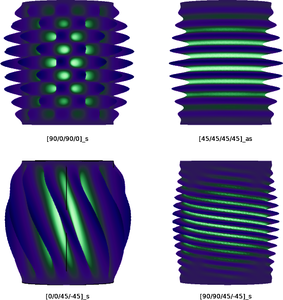
This example presents a linear buckling analysis of a composite cylinder subjected to compressive loading with fixed-end conditions. The cylinder consists of eight layers (plies) of carbon-fiber-reinforced polymer (CFRP), with different fiber orientations. The analysis uses an Equivalent Single Layer (ESL) theory-based approach. It also investigates the effect of the stacking sequence on the critical load factor for different balanced laminates, including symmetric and antisymmetric angle-ply laminates.
This model example illustrates applications of this type that would nominally be built using the following products:
however, additional products may be required to completely define and model it. Furthermore, this example may also be defined and modeled using components from the following product combinations:
The combination of COMSOL® products required to model your application depends on several factors and may include boundary conditions, material properties, physics interfaces, and part libraries. Particular functionality may be common to several products. To determine the right combination of products for your modeling needs, review the Grille des spécifications and make use of a free evaluation license. The COMSOL Sales and Support teams are available for answering any questions you may have regarding this.


