
La Bibliothèque d'Applications présente des modèles construits avec COMSOL Multiphysics pour la simulation d'une grande variété d'applications, dans les domaines de l'électromagnétisme, de la mécanique des solides, de la mécanique des fluides et de la chimie. Vous pouvez télécharger ces modèles résolus avec leur documentation détaillée, comprenant les instructions de construction pas-à-pas, et vous en servir comme point de départ de votre travail de simulation. Utilisez l'outil de recherche rapide pour trouver les modèles et applications correspondant à votre domaine d'intérêt. Notez que de nombreux exemples présentés ici sont également accessibles via la Bibliothèques d'Applications intégrée au logiciel COMSOL Multiphysics® et disponible à partir du menu Fichier.
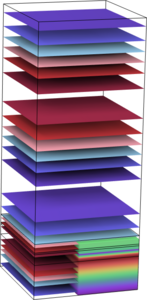
In applications where pressure waves and elastic waves propagate in porous materials filled with air both thermal and viscous losses are important. This is typically the case in insulation materials for room acoustics or lining materials in car cabins. Another example is porous materials ... En savoir plus
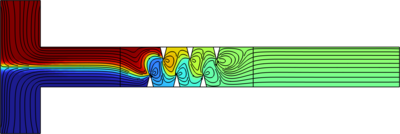
In microfluidic devices, it is a challenge to mix different fluids. One method is to use acoustic streaming to create a flow which enhances the mixing of two fluids. In this model, the vibrations of PDMS structures in a channel induces fast acoustic streaming used for mixing a diluted ... En savoir plus
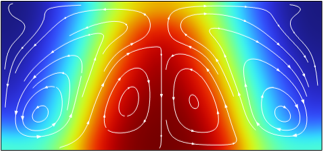
In acoustofluidics, acoustics is used to manipulate particles and fluids in microfluidic devices. This model demonstrates the phenomena of the inhomogeneous acoustic body force and how it can move a fluid with an inhomogeneous density due to a solute. The model is of a 2D cross section ... En savoir plus

These models are featured in the blog post Analyze Violin Tone and Volume with Multiphysics Modeling. One applies acoustic-structure interaction to study how the air mode resonance is affected by the coupled vibrations in the violin body. The other uses a potential flow approximation to ... En savoir plus
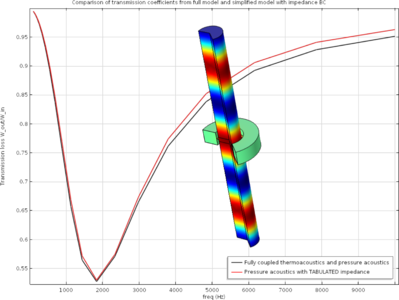
This application illustrates a modeling approach for deriving physically consistent simplified models in the Acoustics Module. The approach consists of converting complex sub-components to an impedance boundary condition and otherwise using simple acoustics throughout the COMSOL model. ... En savoir plus
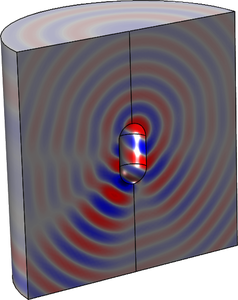
The problem of a plane wave scattering off a cylinder-shaped object suggests the use of the 2D axisymmetric formulation. This can save computation time and reduce the memory usage compared to the model in 3D space. This example demonstrates the use of the built-in plane wave expansion ... En savoir plus
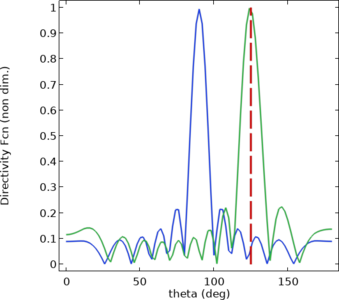
A line array of eleven spherical hydrophones embedded in a neoprene coating is modeled in 3D. The sensitivity of the array is analyzed with regard to varying angles of incidence of the background pressure field. The array directivity function is computed and compared to the analytical ... En savoir plus

Opto-acoustophoresis is a term used to describe the interplay between acoustics and optical fields. In most cases (including this) the optical field is heating up the material and therefore affecting the acoustic field. In this example of an acoustic trap a set of particle are trapped ... En savoir plus
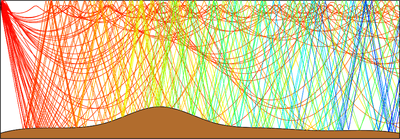
When computing ray intensity in 2D axisymmetric models, the wavefront associated with the propagating ray is treated as a spherical or ellipsoidal wave, instead of a cylindrical wave. This tutorial example illustrates how to set up several important features using the Ray Acoustics ... En savoir plus
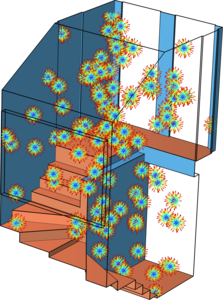
This model uses the Ray Acoustics interface to extract statistical information about a room. Two examples of rooms are analyzed: The staircase from the One-Family House Acoustics tutorial model A long corridor The models compute the mean free path as well as the reflection frequency ... En savoir plus


