
La Bibliothèque d'Applications présente des modèles construits avec COMSOL Multiphysics pour la simulation d'une grande variété d'applications, dans les domaines de l'électromagnétisme, de la mécanique des solides, de la mécanique des fluides et de la chimie. Vous pouvez télécharger ces modèles résolus avec leur documentation détaillée, comprenant les instructions de construction pas-à-pas, et vous en servir comme point de départ de votre travail de simulation. Utilisez l'outil de recherche rapide pour trouver les modèles et applications correspondant à votre domaine d'intérêt. Notez que de nombreux exemples présentés ici sont également accessibles via la Bibliothèques d'Applications intégrée au logiciel COMSOL Multiphysics® et disponible à partir du menu Fichier.
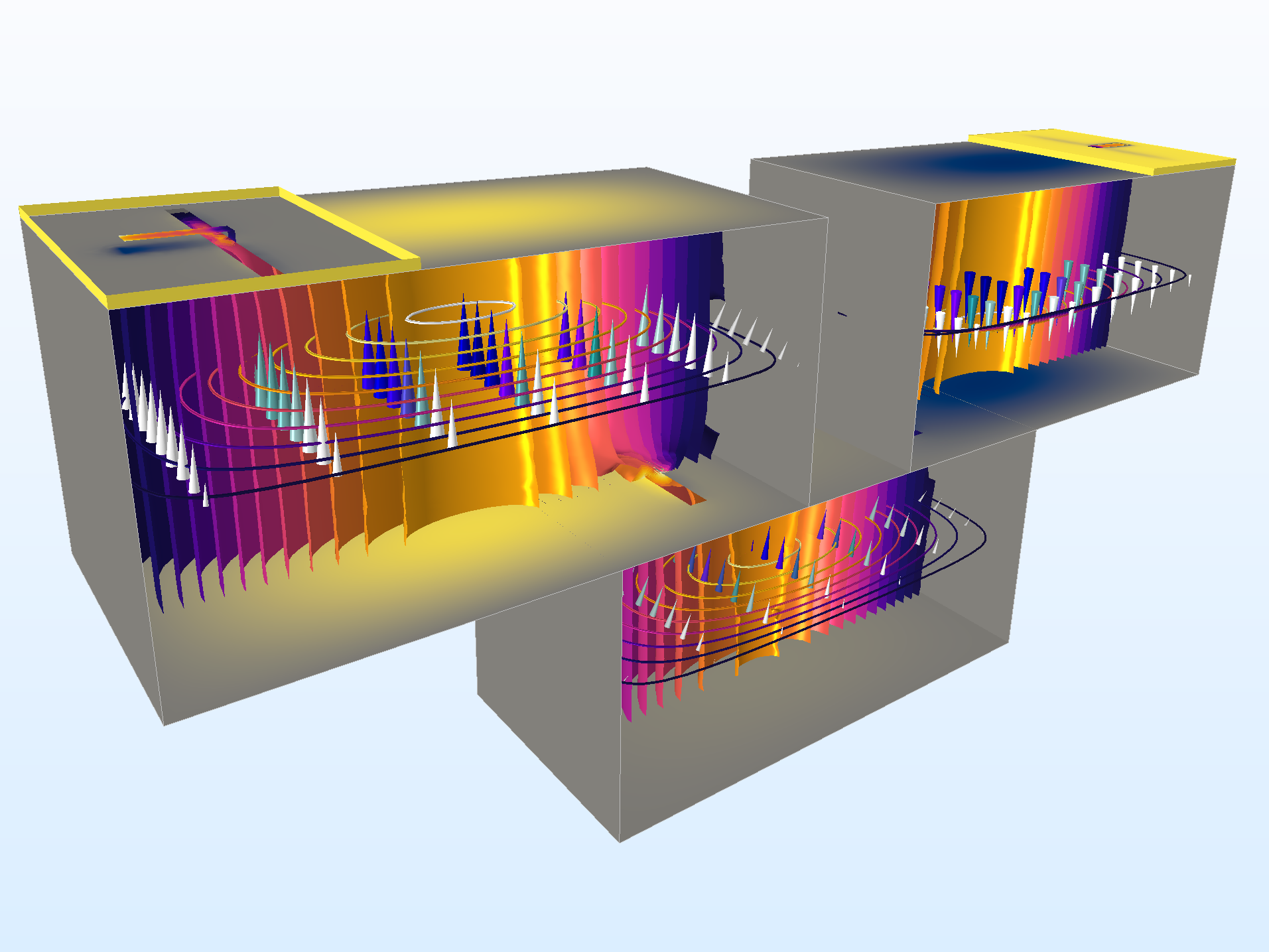
A cascaded cavity filter provides much better bandpass filter performance compared to a single cavity. Out-of-band rejection improves dramatically using a cascaded design. This model uses three rectangular cavity filters coupled via slots. The calculated S-parameters show excellent out ... En savoir plus
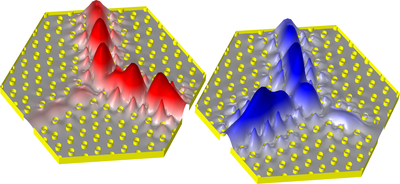
This model simulates the propagation of two frequency bands in a photonic crystal with three ports. The crystal is initially symmetric, so that the two frequency bands are directly equally to either output port. The model optimizes the position of the pillars in order to make the two ... En savoir plus
Developments in the last decade have made circuit quantum electrodynamics (cQED) the leading architecture for quantum computation. cQED is the solid-state version of cavity QED, which studies the basic light-matter interactions at the quantum level. This model examines one of the main ... En savoir plus
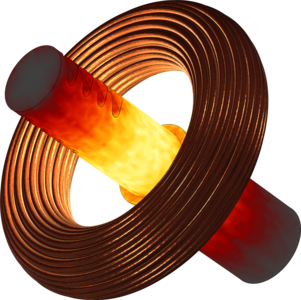
Induction heating is used for various metallurgical processes such as hardening. Here the 3D induction heating of a mechanical joint passing through an induction heating coil is simulated. Curie point effects and temperature dependent resistivity in the iron are taken into account. To ... En savoir plus
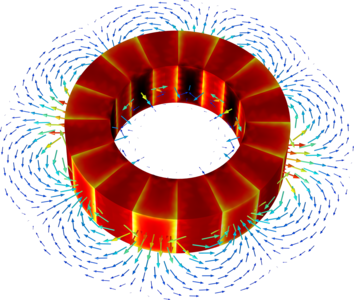
This model presents the static field modeling of an outward flux focusing magnetic rotor using permanent magnets. This magnetic rotor is also often called a Halbach rotor. The use of permanent magnets in rotatory devices such as motors, generators and magnetic gears is increasing. The ... En savoir plus
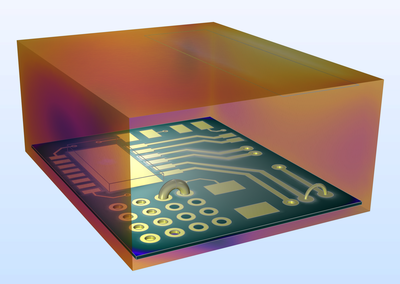
This model example shows how to simulate basic electromagnetic interference (EMI) and electromagnetic compatibility (EMC) behavior in a printed circuit board (PCB). The model contains two analyses to evaluate radiated emissions from PCB traces, crosstalk between adjacent microstrip ... En savoir plus
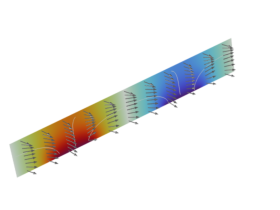
This model demonstrates the switching capability of a liquid crystal (LC) display cell in In-Plane Switching (IPS) configuration. The Oseen-Frank model is used to solve for the LC director (optical axis) distribution when a static electric field is applied. A Weak Form PDE interface is ... En savoir plus

Scientists use the SAR (specific absorption rate) to determine the amount of radiation that human tissue absorbs. This measurement is especially important for mobile telephones, which radiate close to the brain. The model studies how a human head absorbs a radiated wave from an antenna ... En savoir plus


