
La Bibliothèque d'Applications présente des modèles construits avec COMSOL Multiphysics pour la simulation d'une grande variété d'applications, dans les domaines de l'électromagnétisme, de la mécanique des solides, de la mécanique des fluides et de la chimie. Vous pouvez télécharger ces modèles résolus avec leur documentation détaillée, comprenant les instructions de construction pas-à-pas, et vous en servir comme point de départ de votre travail de simulation. Utilisez l'outil de recherche rapide pour trouver les modèles et applications correspondant à votre domaine d'intérêt. Notez que de nombreux exemples présentés ici sont également accessibles via la Bibliothèques d'Applications intégrée au logiciel COMSOL Multiphysics® et disponible à partir du menu Fichier.
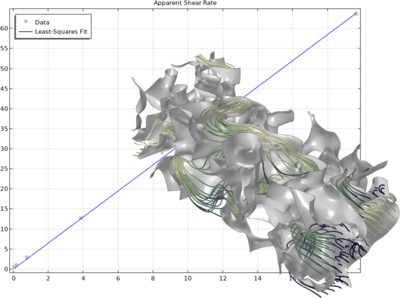
Non-Newtonian fluids have complex flow characteristics that vary with shear rate, making their behavior in porous materials difficult to predict. Pore scale modeling captures these flow patterns at a microscopic level, helping derive properties for macroscale use. This model ... En savoir plus
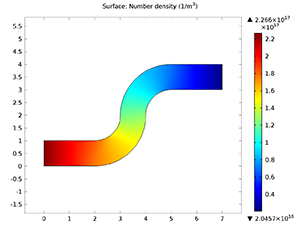
This model computes the transmission probability through an s-bend geometry using both the angular coefficient method available in the Free Molecular Flow interface and a Monte Carlo method using the Mathematical Particle Tracing interface. The computed transmission probability by the ... En savoir plus
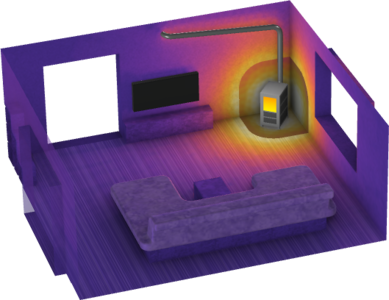
This model represents a stove in a living room. A radiation study is performed with the Surface-to-Surface Radiation physics interface. It shows the intensity of the stove radiation received on different surfaces of the room. En savoir plus
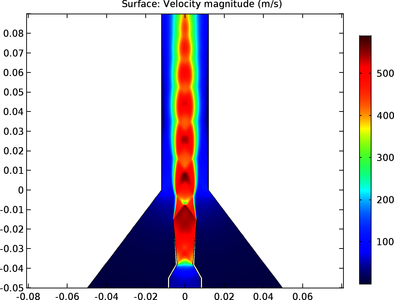
In this study, the compressible turbulent flow through a supersonic ejector is modeled using the High Mach Number Flow interface in the CFD Module. Ejectors are simple mechanical components used for a wide range of applications, including industrial refrigeration, vacuum generation, gas ... En savoir plus

This example describes the cooling and solidification, from melt to solid metal, in a continuous casting process. The model includes nonisothermal properties, temperature distribution, flow field, and phase change. This example uses the arbritrary Lagrangian-Eulerian method for modeling ... En savoir plus
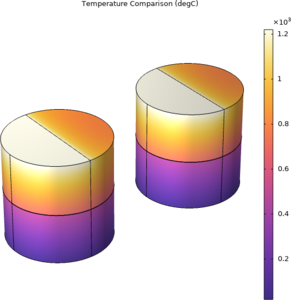
This example is a variant of the Composite Thermal Barrier tutorial and shows how to set up multiple sandwiched thin layers with different thermal conductivities in two different ways. First, the composite is modeled as a 3D object. In the second approach the Lumped Thermal System ... En savoir plus
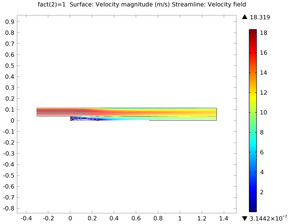
The backward facing step is an interesting case for studying the performance and solution strategy of a turbulence model. In this case, the flow is subjected to a sudden increase of cross-sectional area, resulting in a separation of flow starting at the point of expansion. Spatial ... En savoir plus
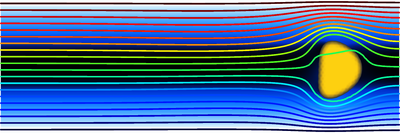
Applying an electric field across a suspension of immiscible liquids may stimulate droplets of the same phase to coalesce. The method known as electrocoalescence has important applications, for instance, in the separation of oil from water. To model electrocoalescence, you need to solve ... En savoir plus
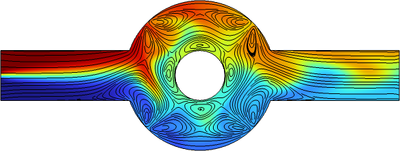
Microlaboratories for biochemical applications often require rapid mixing of different fluid streams. At the microscale, flow is usually highly ordered laminar flow, and the lack of turbulence makes diffusion the primary mechanism for mixing. While diffusional mixing of small ... En savoir plus
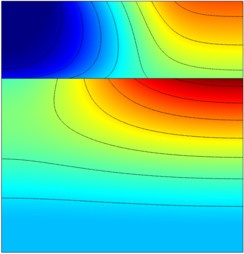
In this example water ponded in a ring on the ground moves into a relatively dry soil column and carries a chemical with it. As it moves through the variably saturated soil column, the chemical attaches to solid particles, slowing the solute transport relative to the water. Additionally ... En savoir plus


