
La Bibliothèque d'Applications présente des modèles construits avec COMSOL Multiphysics pour la simulation d'une grande variété d'applications, dans les domaines de l'électromagnétisme, de la mécanique des solides, de la mécanique des fluides et de la chimie. Vous pouvez télécharger ces modèles résolus avec leur documentation détaillée, comprenant les instructions de construction pas-à-pas, et vous en servir comme point de départ de votre travail de simulation. Utilisez l'outil de recherche rapide pour trouver les modèles et applications correspondant à votre domaine d'intérêt. Notez que de nombreux exemples présentés ici sont également accessibles via la Bibliothèques d'Applications intégrée au logiciel COMSOL Multiphysics® et disponible à partir du menu Fichier.
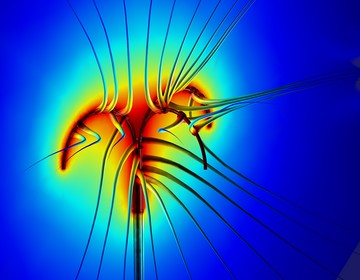
One method for removing cancerous tumors from healthy tissue is to heat the malignant tissue to a critical temperature that kills the cancer cells. This example accomplishes the localized heating by inserting a four-armed electric probe through which an electric current runs. Equations ... En savoir plus
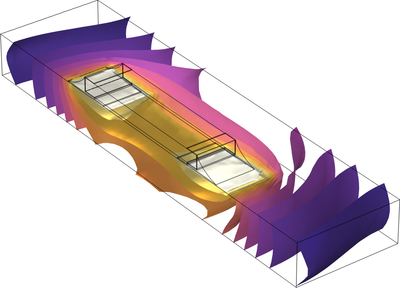
The drive for miniaturizing electronic devices has resulted in today’s extensive use of surface-mount electronic components. An important aspect in electronics design and the choice of materials is a product’s durability and lifetime. For surface-mount resistors and other components ... En savoir plus
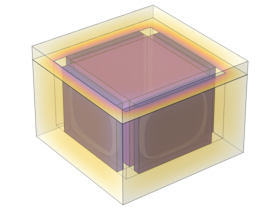
This example solves the heat transfer in an isothermal box aimed at transporting refrigerated articles such as medical materials for 24 hours. In this case, the box has to keep the contents cold for a long period of time while respecting storage temperature restrictions between 2°C and 8 ... En savoir plus
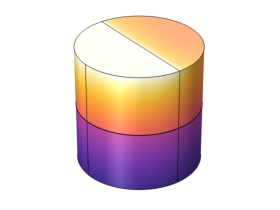
This example shows how to set up multiple sandwiched thin layers with different thermal conductivities in two different ways. First, the composite is modeled as a 3D object. In the second approach the Thin Layer boundary condition with the thermally thick option is used to avoid ... En savoir plus
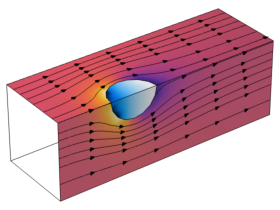
This model demonstrates the use of the Heat and Moisture Flow features for the simulation of superheated steam drying of a wood particle. A nonequilibrium formulation is used to compute the transport of the liquid water and vapor phases in the wood particle. Reference: Le, K. H., ... En savoir plus
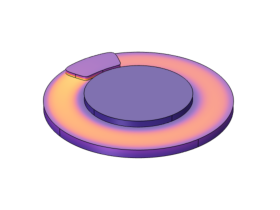
This example models the transient heating, and final temperature, of a disc brake of a car in brake-and-release sequence. It is important to model the transient heating and the following convective cooling to determine the minimum interval between a series of similar brake engagements. ... En savoir plus

This example is a model of a continuous casting process. Liquid metal is poured into a mold of uniform cross section. The outside of the mold is cooled and the metal solidifies as it flows through. When the metal leaves the mold, it is completely solidified on the outside, but still ... En savoir plus
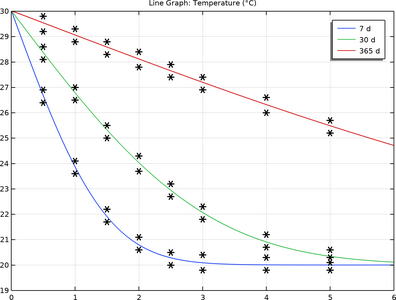
The model is defined as a benchmark case in norm 15026:2007 annex A. The purpose of the model is to calculate the temperature and moisture profiles at different times after a change in the external conditions (temperature and relative humidity) inside a wall material (kind of concrete). ... En savoir plus
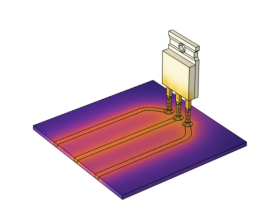
In every system where there is conduction of electric current, and where the conductivity of the material is finite, there will be electric heating. Electric heating, also referred to as Joule heating, is in many cases an undesired by-product of current conduction. This model simulates a ... En savoir plus
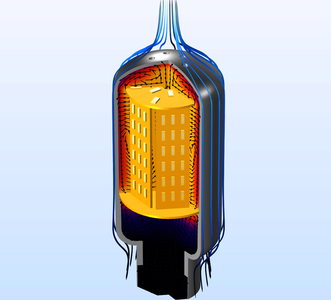
This model describes the three heat transfer modes: conduction, convection, and radiation, combined with nonisothermal flow in a realistic geometry representing a light bulb and the surrounding air. The LED chips dissipate heat. The model computes the equilibrium temperature induced by ... En savoir plus


