
La Bibliothèque d'Applications présente des modèles construits avec COMSOL Multiphysics pour la simulation d'une grande variété d'applications, dans les domaines de l'électromagnétisme, de la mécanique des solides, de la mécanique des fluides et de la chimie. Vous pouvez télécharger ces modèles résolus avec leur documentation détaillée, comprenant les instructions de construction pas-à-pas, et vous en servir comme point de départ de votre travail de simulation. Utilisez l'outil de recherche rapide pour trouver les modèles et applications correspondant à votre domaine d'intérêt. Notez que de nombreux exemples présentés ici sont également accessibles via la Bibliothèques d'Applications intégrée au logiciel COMSOL Multiphysics® et disponible à partir du menu Fichier.
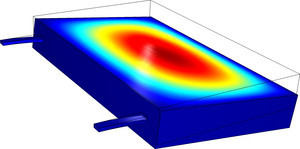
Squeezed-film gas damping is a critical aspect of many MEMS transducers and actuators. In accelerometers, for example, inertia produces a motion that the device detects. A typical structure connects a large proof mass to surrounding structures with elastic beams, which forms a mechanical ... En savoir plus
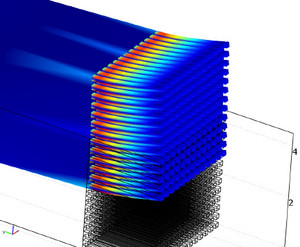
In nature, geckos use dry adhesion forces to climb walls. They have inspired researchers to develop synthetic gecko foot hairs to be used in, for example, robot applications. This model contains the nano/micro hierarchy of a synthetic gecko foot hair, where cantilever beams both in nano ... En savoir plus
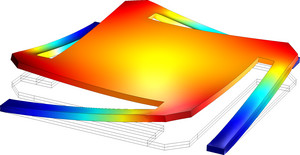
One method of creating spring-like structures or inducing curvature in thin structures is to plate them to substrates that are under the influence of residual stresses. The plating process can control this stress even for similar materials. One such device is the electrostatically ... En savoir plus
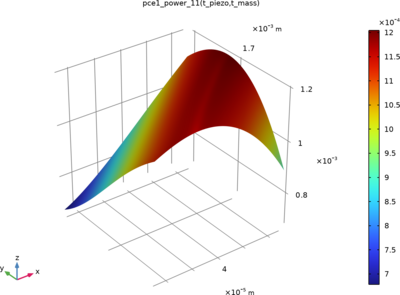
Uncertainty Quantification (UQ) is used to study the effect of manufacturing variation on the performance of Piezoelectric Energy Harvester. This tutorial shows how UQ studies are specified for a frequency domain study that calculates the energy harvester's power output. En savoir plus
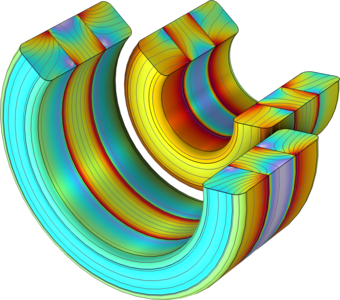
The model compare the electromagnetic force calculated by virtual work and maxwell stress tensor methods on the axial magnetic bearing. The forces is evaluated by studying the effect of a small displacement on the electromagnetic energy of the system. This is done by using the Magnetic ... En savoir plus
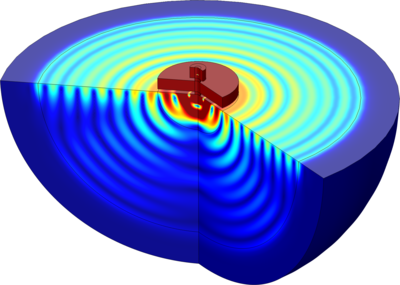
This model shows how to compute the anchor loss limited quality factor of a diamond disc resonator. The resonator is anchored to the substrate by a polysilicon post and power is transmitted to the substrate through the post. A perfectly matched layer is used to represent the essentially ... En savoir plus
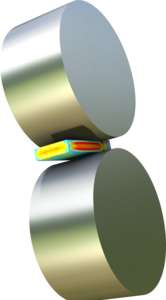
Roll forming processes are widely used in metal processing, battery electrode production and manufacturing processes. The model demonstrates the process of roll forming, where a workpiece is pressed after passing through a pair of rollers. The workpiece is carried between rollers by ... En savoir plus
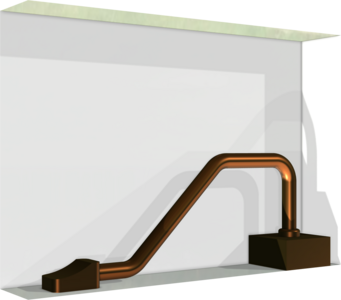
This model analyzes Joule heating and thermal expansion in a bond wire in an LED. Its purpose is to estimate the temperature increase and the resulting mechanical stresses in the bond wire due to thermal expansion. The magnitude of these stresses can be used to assess the risk of fatigue ... En savoir plus
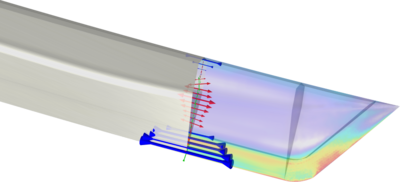
The katana is a legendary Japanese sword used by the samurai in olden days. Here, we present a simple model where we simulate a differential hardening process to explore some of the features of the katana. Learn more in this related blog post: Modeling the Differential Quenching of a ... En savoir plus
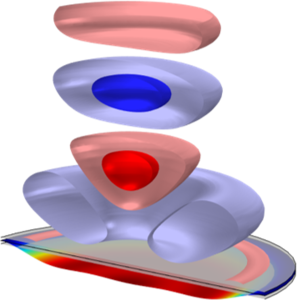
This tutorial demonstrates a full electro-vibroacoustic analysis of a conceptual electrostatic speaker driver, composed of thin conducting plastic diaphragm residing between two perforated metal sheets called grids or stators. When an audio signal is applied to the grids (out of phase), ... En savoir plus


