
La Bibliothèque d'Applications présente des modèles construits avec COMSOL Multiphysics pour la simulation d'une grande variété d'applications, dans les domaines de l'électromagnétisme, de la mécanique des solides, de la mécanique des fluides et de la chimie. Vous pouvez télécharger ces modèles résolus avec leur documentation détaillée, comprenant les instructions de construction pas-à-pas, et vous en servir comme point de départ de votre travail de simulation. Utilisez l'outil de recherche rapide pour trouver les modèles et applications correspondant à votre domaine d'intérêt. Notez que de nombreux exemples présentés ici sont également accessibles via la Bibliothèques d'Applications intégrée au logiciel COMSOL Multiphysics® et disponible à partir du menu Fichier.
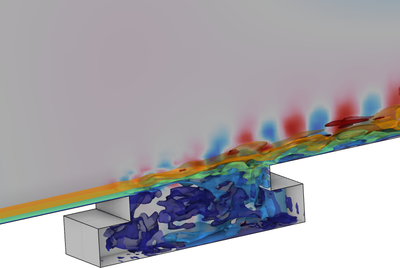
Flow over a cavity and the tonal noise generated is a typical flow noise source in piping systems that have valves and other cavities. This tutorial model represents a simple case of cavity flow noise in a ducted system. The model is set up based on an example from Lafon et al. The ... En savoir plus
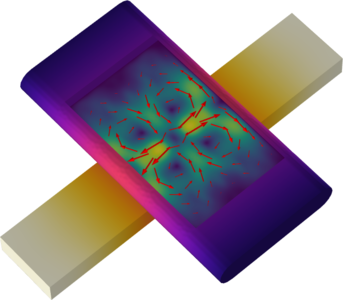
A 3D model of an acoustic trap in a glass capillary actuated by a piezoelectric transducer. The system is actuated by an oscillating electric potential across the piezoelectric transducer inducing mechanical vibrations in the solid and an acoustic pressure field in the fluid. The heat ... En savoir plus
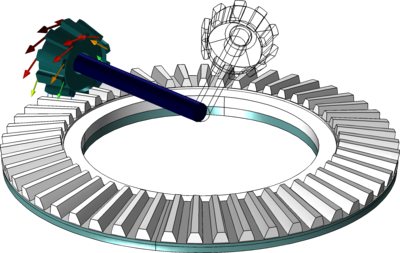
This tutorial model simulates a pair of straight conical bevel gears. The gears are modeled as rigid, but one of the gears is fixed while the other is hinged on a rigid bar. The rigid bar is also hinged at a point lying on the axis of the fixed gear. A transient analysis is performed to ... En savoir plus
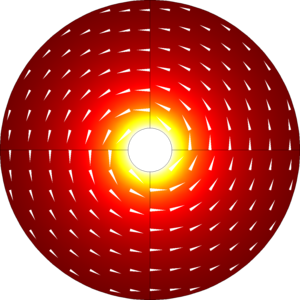
The coaxial cable (coax) is one of the most ubiquitous transmission line structures. It is composed of a central circular conductor, surrounded by an annular dielectric, and shielded by an outer conductor. This model computes the electric and magnetic field distribution inside of the ... En savoir plus
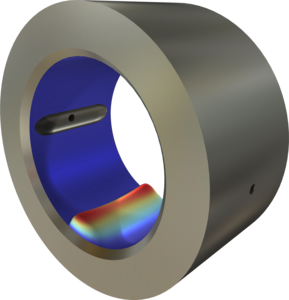
In this example, the importance of including elastic deformations when analyzing heavily loaded fluid-film bearings is investigated. The structural parts are modeled using the Solid Mechanics interface, while the pressure in the lubricant is determined by the means of the Hydrodynamic ... En savoir plus
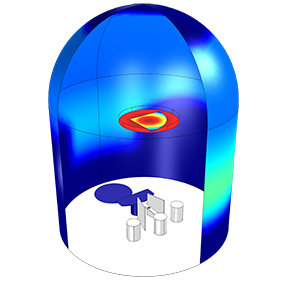
This model shows how to compute the thickness of a thermally evaporated gold film. The thickness of the deposited film is computed both on the walls of the chamber and on the sample. En savoir plus
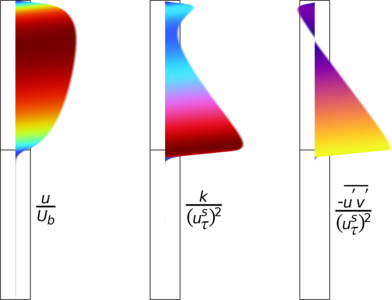
This setup demonstrates how the characteristics of turbulent flow in a channel are modified by the presence of an adjacent porous region. Asymmetric velocity profiles, higher turbulence levels, and higher friction coefficients both at the solid wall and the fluid-porous interface are ... En savoir plus
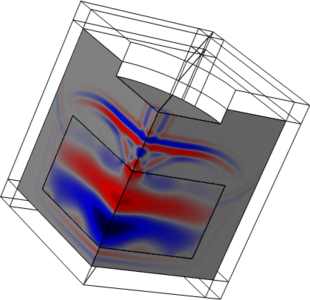
This tutorial showcases the principles of the immersion ultrasonic testing technique. A search unit placed in a water tank sends an ultrasonic pulse signal that scatters off a solid object. Part of the signal is reflected back to the search unit by the object and possible flaws in it. By ... En savoir plus


