
La Bibliothèque d'Applications présente des modèles construits avec COMSOL Multiphysics pour la simulation d'une grande variété d'applications, dans les domaines de l'électromagnétisme, de la mécanique des solides, de la mécanique des fluides et de la chimie. Vous pouvez télécharger ces modèles résolus avec leur documentation détaillée, comprenant les instructions de construction pas-à-pas, et vous en servir comme point de départ de votre travail de simulation. Utilisez l'outil de recherche rapide pour trouver les modèles et applications correspondant à votre domaine d'intérêt. Notez que de nombreux exemples présentés ici sont également accessibles via la Bibliothèques d'Applications intégrée au logiciel COMSOL Multiphysics® et disponible à partir du menu Fichier.
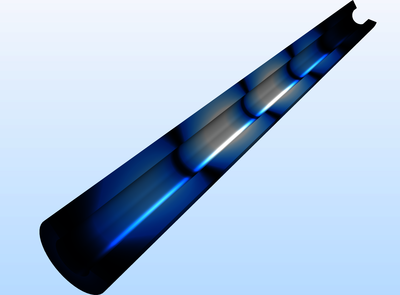
Simulation of Maxwell’s equations in the time domain is useful if the objective of the analysis is to observe a transient phenomenon, to find the time it takes a signal to propagate, or if the materials being modeled are non-linear with respect to the electric or magnetic field strength. ... En savoir plus
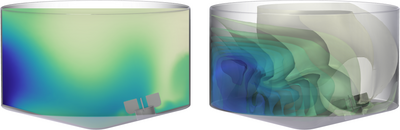
This space-dependent model describes a stirred semibatch reactor used for producing antibody–drug conjugates. The reactor is set up in 3D and the conjugation reactions, turbulent flow, and concentration fields are simulated as functions of time. The resulting yield and drug-to-antibody ... En savoir plus
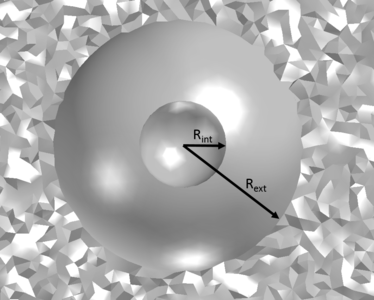
When simulating surface-to-surface radiation, we rely on the view factors between elements of diffuse surfaces that emit and receive radiation. To compute surface-to-surface radiation in a given geometry, operators are created by the heat interface and can be used to evaluate view ... En savoir plus
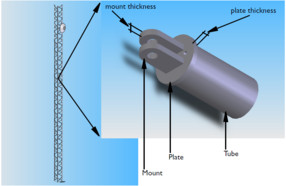
The example Stiffness Analysis of a Communication Mast’s Diagonal Mounting in the COMSOL Multiphysics Model Library shows how you can modify a 3D CAD model to improve its performance. In that case, the applied changes were based solely on the analyst’s experience with similar structures. ... En savoir plus
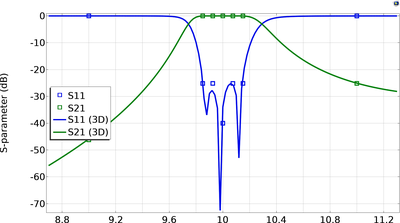
A waveguide filter is designed using shape optimization. The irises of the initial geometry are optimized to ensure good bandpass response and out-of-band rejection, while maintaining the double mirror symmetry. En savoir plus
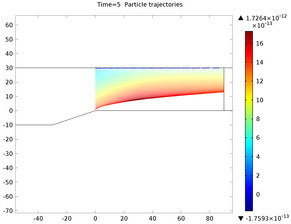
When a temperature gradient in a gas exists, suspended particles will tend to move from regions of high temperature to low. The force which produces this effect is called the thermophoretic force. Gas molecules colliding with a particle from the hot side have a higher velocity than the ... En savoir plus
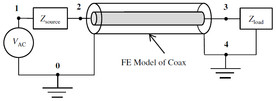
A model built with the RF Module can be connected to an electrical circuit equivalent, if there is some structure outside of the model space that you wish to approximate as a circuit equivalent. In this model, the 3D model of a coaxial cable is connected to a voltage source, in series ... En savoir plus

This tutorial simulates a standard test and benchmark model for perfectly matched layers (PMLs) as absorbing boundary conditions in the time domain. It involves the propagation of a transient Gaussian pulse with no flow. The Pressure Acoustics, Transient interface is used together with ... En savoir plus


