
La Bibliothèque d'Applications présente des modèles construits avec COMSOL Multiphysics pour la simulation d'une grande variété d'applications, dans les domaines de l'électromagnétisme, de la mécanique des solides, de la mécanique des fluides et de la chimie. Vous pouvez télécharger ces modèles résolus avec leur documentation détaillée, comprenant les instructions de construction pas-à-pas, et vous en servir comme point de départ de votre travail de simulation. Utilisez l'outil de recherche rapide pour trouver les modèles et applications correspondant à votre domaine d'intérêt. Notez que de nombreux exemples présentés ici sont également accessibles via la Bibliothèques d'Applications intégrée au logiciel COMSOL Multiphysics® et disponible à partir du menu Fichier.
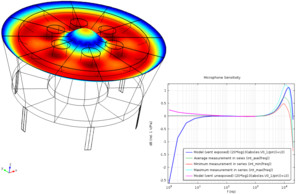
This is a model of the Brüel and Kjær 4134 (BK 4134) condenser microphone. The geometry and material parameters are those of the actual microphone. The modeled sensitivity level is compared to measurements performed on an actual microphone and shows good agreement. The membrane ... En savoir plus
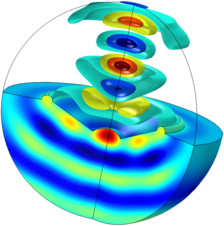
Example of a moving-coil loudspeaker where lumped parameters represent the behavior of the electrical and mechanical components. The Thiele-Small parameters (small-signal parameters) serve as input to the lumped model, which is represented using the Electric Circuit interface. The ... En savoir plus
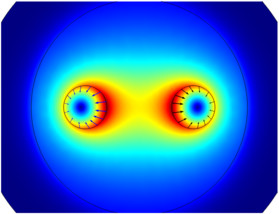
This model shows a setup of two parallel wires with a constant current running through both. Their cross-sections are successively reduced until a set force per unit length is reached. En savoir plus
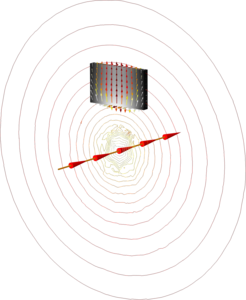
Induced eddy currents and associated thermal loads is of interest in many high power AC applications. This example is of general nature and illustrates some of the involved physics as well as suitable modeling techniques in the AC/DC Module. In this model a metallic plate is placed ... En savoir plus
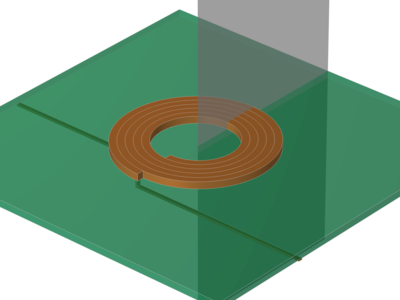
At the resonance frequency, the capacitive coupling between the turns causes the impedance of a coil to transition from inductive to capacitive. This application analyzes the resonance of a 5 turn spiral coil of copper equipped with a thin epoxy varnish insulation layer. The capacitive ... En savoir plus
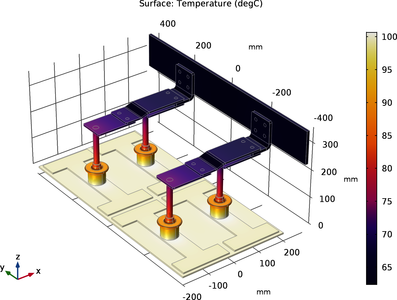
This tutorial analyzes the resistive heating (Joule heating) of a busbar assembly designed to conduct a direct current from a current source to the anode in an electrolysis process. En savoir plus

An AC contactor is a particular type of magnetic switch device, which is activated by a primary coil fed by an alternating current. Unlike DC switches, such devices can suffer from a tendency to reopen when the AC current crosses zero. The addition of a shading coil that supports ... En savoir plus
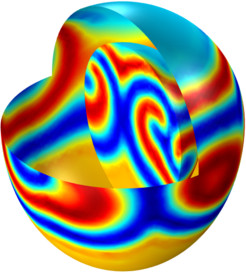
Modeling the electrical activity in cardiac tissue is an important step in understanding the patterns of contractions and dilations in the heart. The heart produces rhythmic electrical pulses, which trigger the mechanical contractions of the muscle. A number of heart conditions involve ... En savoir plus
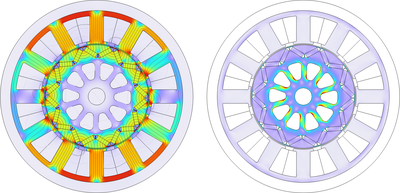
The magnets in an Interior Permanent Magnet (IPM) motor are embedded in the rotor core, where they form narrow regions known as bridges. The thickness of the magnetic bridge is an important parameter to consider in design, both from the electromagnetic and the mechanical perspectives. As ... En savoir plus
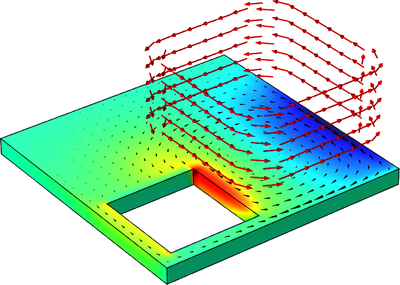
This model solves the Testing Electromagnetic Analysis Methods (TEAM) problem 7, “Asymmetrical Conductor with a Hole”—a benchmark problem concerning the calculation of eddy currents and magnetic fields produced when an aluminum conductor is placed asymmetrically above a multi-turn coil ... En savoir plus


